Is Marksy Safe? Addressing Academic Dishonesty and AI Data Privacy Concerns
If you're an IB student considering using Marksy to grade your Internal Assessments, Extended Essays, or TOK work, you might have legitimate concerns about data privacy and academic integrity. This practical guide addresses the most common questions and misconceptions about using AI grading tools like Marksy, explaining exactly how the technology works and why your academic work remains completely safe. For a detector-specific deep dive, read Why MLA Citations Are Flagged by AI Detectors.
Understanding the Concerns: What Students Are Worried About
We've heard the concerns from IB students across various platforms, and they generally fall into three main categories:
- "Will my work be flagged as AI-generated if I use Marksy?"
- "Does the AI train on my work and store my data?"
- "Am I committing academic dishonesty by using an AI grading tool?"
Let's address each of these concerns with clear, evidence-based explanations. If you want to apply this safely in practice, use Draft Grading on your own drafts and keep your revision trail.
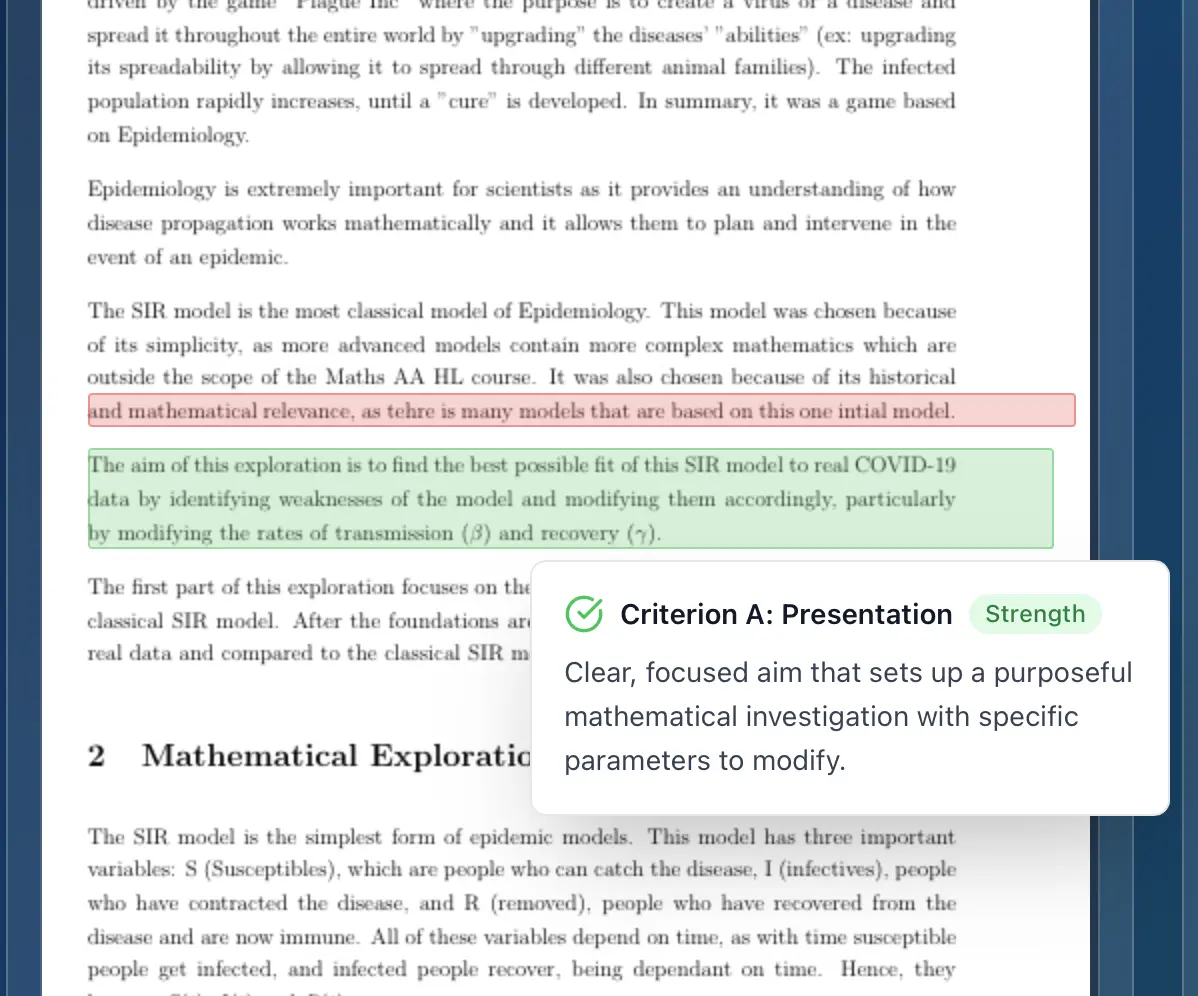
Stuck on your IB draft?
Get instant, detailed feedback on structure, evidence, and reasoning, then compare it with your current school materials.
How AI Detection Actually Works (And Why Marksy Won't Flag Your Work)
One of the most common misconceptions is that if you upload your work to any AI tool, it will somehow be "stored" and later detected as AI-generated. This fundamentally misunderstands how AI detection technology works.
The Reality of AI Detection
AI detection tools (like TurnItIn's AI detector, GPTZero, or Copyleaks) work by analyzing the statistical patterns in your writing, not by cross-referencing your work against a database of submissions. Specifically, they use a technique called perplexity analysis.
Here's what that means:
- Perplexity is a measure from information theory that determines how "predictable" text is
- AI-generated text tends to be more predictable (lower perplexity) because language models generate text by predicting the most likely next word
- Human writing is typically more varied and less predictable (higher perplexity)
- AI detectors are themselves smaller AI models trained to calculate this perplexity score
Important: AI detectors do NOT work by:
- Comparing your text to a database of AI-generated content
- Checking if your work has been "seen" by an AI system before
- Accessing the training data or logs of AI companies like OpenAI
Why Marksy Doesn't Impact Detection
When you submit your work to Marksy:
- Marksy reads your work to provide feedback based on IB criteria
- Your original work remains unchanged - you wrote it, not the AI
- The perplexity of your writing doesn't change just because an AI read it
- No "signature" or "fingerprint" is added to your document
Think of it this way: If you email your essay to a friend for feedback, does that make your essay look like your friend wrote it? Of course not. The same principle applies when an AI tool reads your work to provide feedback.
Data Privacy: Does OpenAI Train on Your Work?
This is perhaps the most technical concern, but it's also the one where we can provide the clearest answer: No, OpenAI does not train on data submitted through the API.
Understanding the Difference: ChatGPT vs. API Usage
Many students confuse ChatGPT (the consumer product) with the OpenAI API (what developers use). Here's the critical distinction:
ChatGPT (Consumer Product):
- Free and Plus users' data MAY be used for training (unless opted out)
- Designed for general public use
- Data retention policies favor model improvement
OpenAI API (What Marksy Uses):
- Explicitly does NOT train on submitted data by default
- Designed for business and developer use
- Strict data privacy guarantees
Official Documentation from OpenAI
According to OpenAI's official API data usage policy (available at https://openai.com/enterprise-privacy):
"By default, we do not train on any inputs or outputs from our products for business users, including ChatGPT Business, ChatGPT Enterprise, and the API. We offer API customers a way to opt-in to share data with us, such as by providing feedback in the Playground, which we then use to improve our models. Unless they explicitly opt-in, organizations are opted out of data-sharing by default."
Marksy uses the OpenAI API and has NOT opted in to any data sharing. Your work is:
- Not used for training
- Not stored permanently (only temporarily for processing)
- Not accessible to other users or systems
Additional Privacy Layer: OpenRouter
Marksy routes requests through OpenRouter, which provides an additional layer of privacy protection. According to OpenRouter's privacy documentation (https://openrouter.ai/docs/guides/privacy/logging):
- Requests can be configured to avoid logging
- When training opt-out is enabled on your OpenRouter account, they do NOT route to providers that train on data
- Data retention is strictly controlled
Academic Integrity: Is Using Marksy Cheating?
Let's be absolutely clear: Using Marksy is NOT academic dishonesty. Here's why:
What Marksy Actually Does
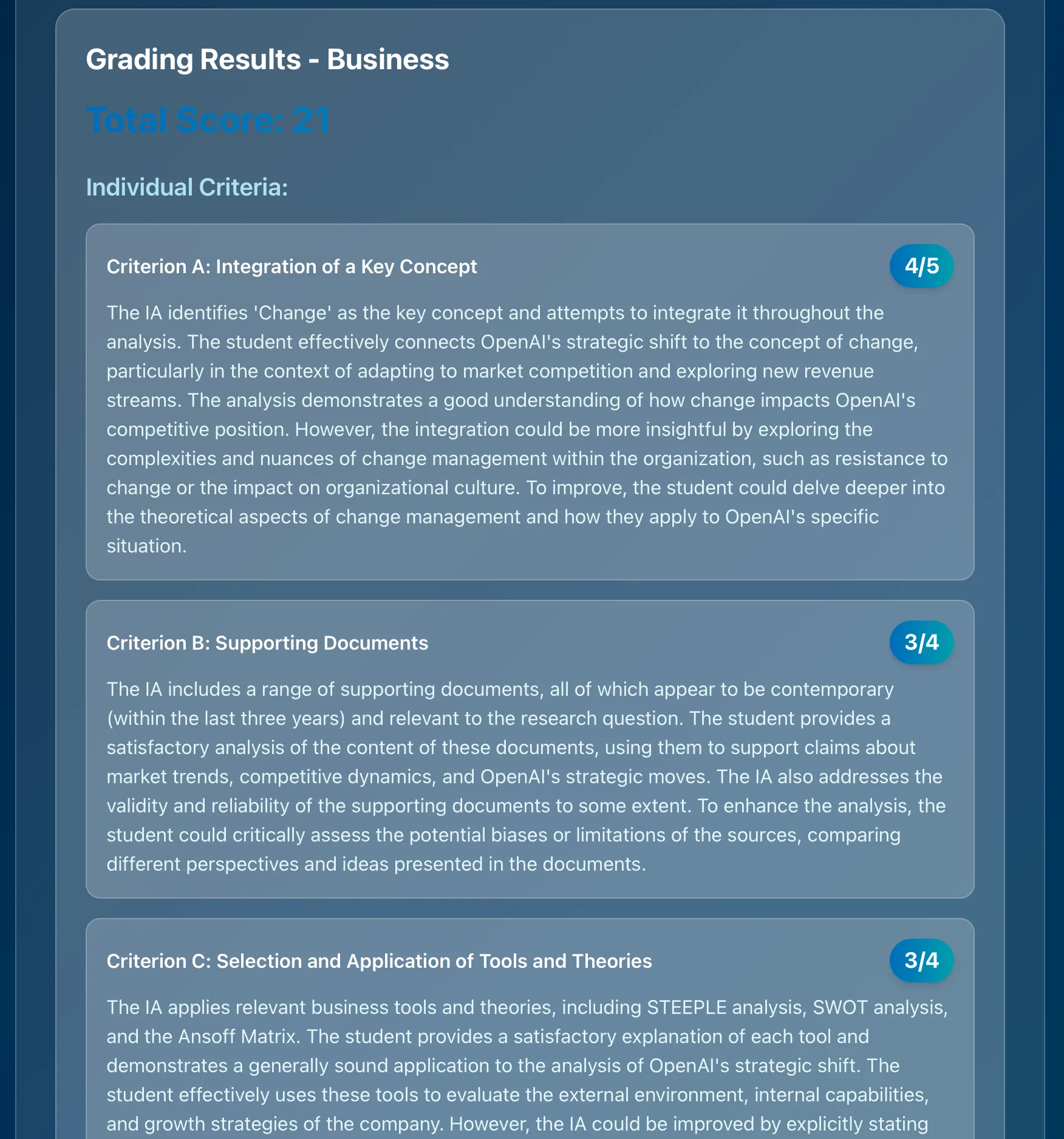
Marksy is a feedback tool, not a writing tool. It:
- Reads your work that you already wrote
- Analyzes it against official IB criteria
- Provides feedback on strengths and areas for improvement
- Suggests how you might improve based on rubric requirements
Marksy does NOT:
- Write your work for you
- Generate content that you can copy-paste
- Make changes to your document
- Complete assignments on your behalf
How This Compares to Traditional Resources
Consider these perfectly acceptable IB study practices:
| Traditional Resource | What It Does | How Marksy Is Similar |
|---|---|---|
| Teacher feedback | Reviews your work against criteria | Marksy reviews against official IB criteria |
| Peer review | Another student reads and comments | Marksy reads and provides structured comments |
| IB Study guides | Explain what examiners look for | Marksy explains what each criterion requires |
| Revision services (paid) | Human tutors grade your practice work | Marksy grades your practice work |
If getting feedback from a teacher, tutor, or peer is acceptable (and encouraged!), then getting feedback from an AI tool that does the same thing is equally acceptable.
What the IB Says About Using Resources
The IB's Academic Integrity policy states that students must:
- Produce authentic work (work that is your own)
- Acknowledge when they receive help or use resources
- Not engage in malpractice (cheating, plagiarism, collusion)
Using Marksy for feedback on your own authentic work does not violate any of these principles. However, as with any resource:
- The work you submit must still be your own writing
- You should acknowledge that you used resources (including AI tools) if your teacher or school requires it
- You must not submit AI-generated content as your own work (which Marksy doesn't provide anyway)
Debunking Common Myths
Let's address some specific myths we've seen circulating:
Myth #1: "AI companies own anything you input"
Reality: This is false for API usage. While some consumer AI tools have broad terms of service, OpenAI's API explicitly states that users retain ownership of their data. Your IA, EE, or TOK essay remains YOUR intellectual property.
Myth #2: "If you use AI tools, everything will be flagged later"
Reality: AI detectors cannot tell that an AI has "seen" your work. They can only detect if the writing style matches AI-generated patterns. Since you wrote your work, it will have your human writing patterns.
Myth #3: "Using any AI tool is academic dishonesty"
Reality: Using AI for feedback is like using a spell-checker, grammar tool, or getting feedback from a tutor. What matters is that the work itself is your own original creation.
Myth #4: "Your essay will end up in AI training data"
Reality: With proper API usage and privacy settings (which Marksy implements), your work is not included in any training datasets. This is a contractual guarantee from OpenAI for API users.
Myth #5: "Schools and IB can detect if you've used Marksy"
Reality: There is no technological way for schools or IB to detect that you received feedback from Marksy, just as they cannot detect if you received feedback from a private tutor, parent, or friend. What they can detect is if work is not your own or is AI-generated (which is different from AI-reviewed).
Real-World Comparison: How IB Teachers Use Similar Tools
It's worth noting that many IB teachers and schools are already using AI tools to help with their workload:
- Grading assistants to provide faster feedback
- Plagiarism detectors (which also use AI) to check work
- Automated rubric generators for assessment
- Data analysis tools to track student progress
If teachers can ethically use AI to help them grade more efficiently, students can ethically use AI to understand how their work would be graded.
Best Practices for Using Marksy Responsibly
While Marksy is safe and ethical to use, here are some best practices to ensure you're using it responsibly:
1. Use It for Feedback, Not Replacement
- Do: Use Marksy to understand where your work stands against IB criteria
- Don't: Rely solely on AI feedback without also seeking human input from teachers
2. Be Transparent (If Required)
- Do: If your school has policies about using AI tools, follow them
- Don't: Hide your use of resources if your school asks about them
3. Maintain Authenticity
- Do: Ensure all work you submit is your own original writing and research
- Don't: Use any AI tool (including ChatGPT, not Marksy) to generate content you claim as your own
4. Use Multiple Resources
- Do: Combine Marksy feedback with teacher feedback, peer review, and official IB resources
- Don't: Depend on any single resource exclusively
5. Understand the Feedback
- Do: Read and understand why Marksy gave certain feedback
- Don't: Blindly follow suggestions without understanding the underlying IB criteria
Check your own draft
Get estimated marks by criterion, comments on your writing, and a clear list of what to fix first.
Technical Safeguards in Marksy
For those interested in the technical details, here are the specific safeguards Marksy implements:
Data Handling
- Encryption: All data is encrypted using industry-standard TLS/SSL
- Private to You: Only you can access your files and grading history
- Delete Anytime: Remove any grading run from your history whenever you want
- Optional Sharing: Share specific results via private link if you choose
API Configuration
- Training Opt-Out: Marksy's OpenAI API usage is configured to opt-out of all training
- Zero Data Retention (OpenAI side): OpenAI retains API data for only 30 days for abuse monitoring, then permanently deletes it
- No Model Fine-Tuning: Marksy does not use any custom fine-tuned models that would require training on user data
Access Controls
- User Authentication: Only you can access your submissions through your account
- No Data Sharing: Marksy never shares your work with third parties
- Privacy by Design: The entire system is designed to minimize data exposure
Frequently Asked Questions
Can IB examiners tell if I used Marksy?
No. IB examiners evaluate your final submitted work based on its quality and adherence to IB criteria. They cannot tell what resources you used during your preparation process. They can only evaluate whether the work itself is authentic and meets the required standards.
Will using Marksy affect my AI detection score?
No. AI detection tools analyze the writing patterns in your text. Simply having an AI tool read your work does not change your writing patterns. As long as you wrote the work yourself (which you did), your AI detection score will reflect that you are the human author.
What if my school forbids using AI tools?
Some schools have blanket policies against AI tools. If your school has such a policy, we recommend:
- Understanding what specifically is prohibited (usually AI-generated content, not AI feedback)
- Speaking with your IB coordinator about whether feedback tools like Marksy fall under the policy
- Respecting your school's policies while advocating for nuanced AI policies that distinguish between AI-generation and AI-feedback
Many schools are updating their AI policies to distinguish between AI-generated content (problematic) and AI-assisted learning (beneficial).
Is Marksy better than human feedback?
No, Marksy is designed to complement human feedback, not replace it. The ideal approach is:
- Write your draft
- Use Marksy for quick, criteria-based feedback
- Seek teacher feedback for deeper, contextual insights
- Revise based on all feedback sources
- Repeat as needed
Marksy excels at providing instant, criteria-specific feedback 24/7, while human teachers provide nuanced guidance, answer questions, and help with conceptual understanding.
What happens to my work after I upload it?
Here's the exact lifecycle:
- Upload: You upload your document through Marksy's secure interface
- Processing: Marksy sends your text (encrypted) to OpenAI's API for analysis
- Analysis: The AI model analyzes your work against IB criteria (this takes seconds)
- Feedback: Results are sent back to Marksy and displayed to you
- Your History: Access your grading history anytime to review past feedback and track progress
- OpenAI Side: OpenAI retains API data for only 30 days for abuse monitoring, then permanently deletes it (per their API policy)
Can other students see my work?
Absolutely not. Your work is private to your account. Only you can access your files. You can optionally share specific grading results via a private link if you choose, but files remain private by default.
What about GDPR and data protection laws?
Marksy complies with GDPR and international data protection standards:
- You have the right to request deletion of your data at any time
- You have the right to export your data
- Data processing is limited to what's necessary for the service
- Clear privacy policies explain exactly how data is used
- You can delete your account and all associated data at any time
Could this change in the future?
Marksy's commitment to privacy is fundamental to the service, not an optional feature. Any changes to privacy policies would:
- Be clearly communicated to all users in advance
- Require explicit opt-in consent (not automatic)
- Maintain backwards compatibility (existing users' data remains protected under original terms)
However, we encourage all users to periodically review our privacy policy and OpenAI's API terms to stay informed.
The Bottom Line: Marksy Is Safe, Ethical, and Effective
After addressing all these concerns, here's what you need to know:
Regarding Data Privacy: ✅ Your work is NOT used to train AI models ✅ Only you can access your files ✅ Delete anytime from your history ✅ Optional sharing via private link if you choose
Regarding AI Detection:
✅ Your work will NOT be flagged as AI-generated
✅ AI detectors cannot tell that an AI read your work
✅ Only the writing style matters, not who provided feedback
✅ You wrote it, so it will read as human-written
Regarding Academic Integrity:
✅ Using Marksy for feedback is NOT cheating
✅ It's equivalent to teacher feedback, tutoring, or peer review
✅ The IB encourages using resources to improve your work
✅ You must still submit authentic work (which Marksy helps you improve)
Conclusion: Focus on Learning, Not Fear
The concerns about AI tools in education are understandable—this technology is new, and misinformation spreads quickly. However, when you understand how AI detection works, how data privacy is protected through the API, and what academic integrity actually means, it becomes clear that tools like Marksy are safe, ethical, and valuable resources for IB students.
Marksy is designed to help you:
- Understand IB criteria better
- Improve your work through detailed feedback
- Learn what excellent IB work looks like
- Succeed in achieving your academic goals
Just as students have always used study guides, tutors, and teacher feedback to improve their work, Marksy provides modern, accessible, and instant feedback based on official IB rubrics. Your work remains yours, your privacy is protected, and your academic integrity is maintained.
Ready to experience instant, rubric-aligned IB grading feedback? Try Marksy today and see how AI feedback can help you improve your draft.
Additional Resources
- OpenAI API Data Privacy Policy
- IB Academic Integrity Guidelines
- Understanding AI Detection Technology
- How to Use AI Ethically in Education
Have more questions? Contact us at marksyib@gmail.com or visit our FAQ page. We're committed to transparency and helping IB students succeed ethically and effectively.