- Hydrogen cyanide, HCN, is a very toxic compound.
(a) Pure HCN is a volatile liquid, boiling at 26 °C.
(i) Draw the Lewis formula of the HCN molecule. [1]
(ii) Deduce the hybridization of the carbon atom and the number of sigma and pi bonds that it forms. [2]
(iii) State and explain the molecular geometry of HCN without referring to hybridization. [2]
(iv) HCN is a polar molecule. Deduce which atom carries a partial positive charge and which carries a partial negative charge. [1]
(v) Explain why nitrogen gas, N₂, has a much lower boiling point than HCN. [2]
(b) HCN acts as a weak acid in aqueous solution.
(i) Write an equation to show this behaviour. [1]
(ii) Outline two ways in which you could determine that a solution was 0.1 mol dm⁻³ HCN rather than 0.1 mol dm⁻³ HCl. [2]
(iii) Calculate the pH of a 0.100 mol dm⁻³ solution, given the Ka of HCN is 4.90 × 10⁻¹⁰ mol dm⁻³. [2]
(iv) Sketch the variation in pH that would occur if 30.0 cm³ of 0.200 mol dm⁻³ KOH was gradually added to 20.0 cm³ of 0.100 mol dm⁻³ HCN. [3]
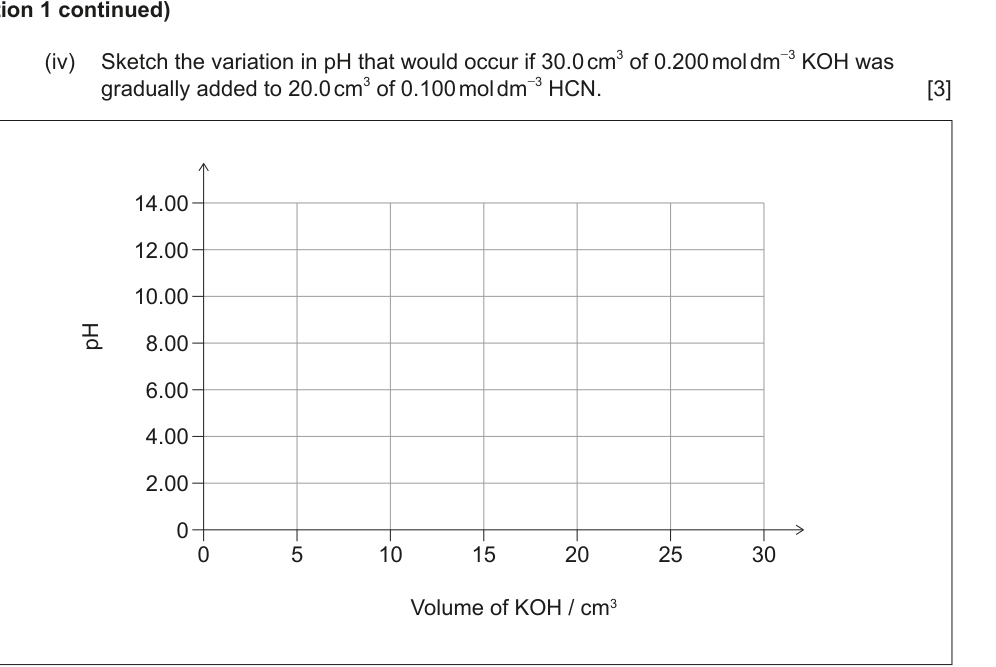
(v) Deduce the point on the graph in (b)(iv) at which the solution would only contain KCN(aq) and label it “Salt”. [1]
(vi) Calculate the temperature rise of the solution when 30.0 cm³ of 0.200 mol dm⁻³ KOH is mixed with 20.0 cm³ of 0.100 mol dm⁻³ HCN. Use enthalpy of neutralisation of HCN = –13.3 kJ mol⁻¹ and sections 1 and 2 of the data booklet. [2]
(c) The cyanide ion, CN⁻, can form complex ions, such as [Fe(CN)₆]⁴⁻.
(i) State the precise type of bond formation between the cyanide ion and the iron ion. [1]
(ii) Deduce the oxidation state of iron in the complex ion. [1]
(iii) Explain why transition element ions, such as [Fe(CN)₆]⁴⁻, are usually coloured. [3]
(iv) [Fe²⁺] is 2.20 × 10⁻⁷ mol dm⁻³ in a 1.00 mol dm⁻³ solution of the complex ion. Determine the value of the equilibrium constant, K, for the formation of [Fe(CN)₆]⁴⁻ from its constituent ions. [3]
(v) Outline, giving a reason, whether [Fe(CN)₆]³⁻ is a stronger or weaker oxidising agent than Fe³⁺(aq). Use E° [Fe(CN)₆]³⁻(aq) + e⁻ ⇌ [Fe(CN)₆]⁴⁻(aq) = +0.37 V and section 19 of the data booklet. [2]
(d) The cyanide ion reacts with iodomethane, CH₃I.
(i) Draw the structural formula of the organic product. [1]
(ii) Predict, giving a reason, whether this reaction will occur by an SN1 or SN2 mechanism. [1]
(iii) Explain how you might experimentally conclude whether the mechanism of this reaction is SN1 or SN2. [2]