- [Maximum mark: 17]
Containment walls to protect against radiation are constructed from two parallel concrete slabs that have a layer of lead between them as shown in the diagram.
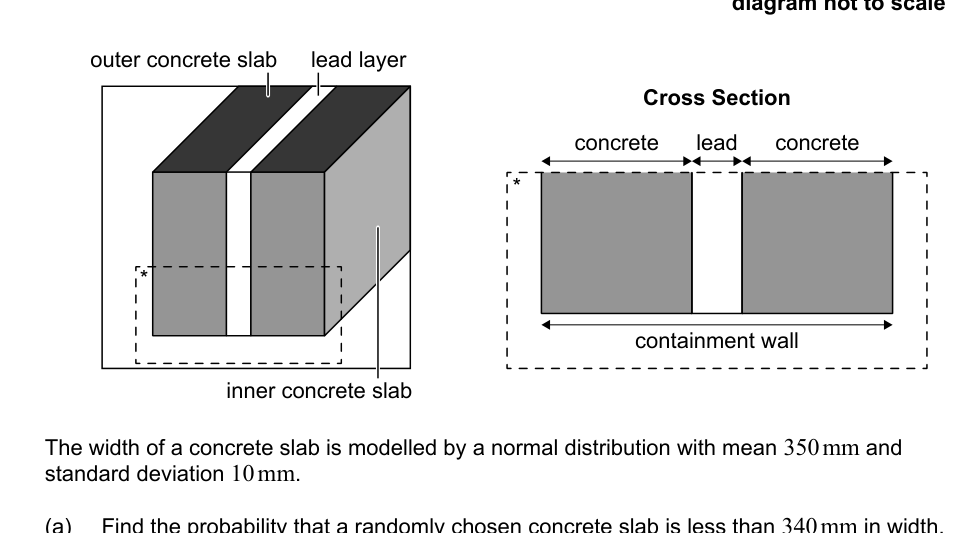
The width of a concrete slab is modelled by a normal distribution with mean 350 mm and standard deviation 10 mm.
(a) Find the probability that a randomly chosen concrete slab is less than 340 mm in width. [2]
(b) Find the endpoints of the interval, symmetric about the mean, such that 95 % of the slabs have a width that lies in this interval. [3]
Stephen assumes the lead layer is also modelled by a normal distribution, but with mean 100 mm and standard deviation 5 mm and is independent of the width of the slabs.
Let be the random variable that represents the total width of the wall, measured in mm.
(c) (i) Given that the widths of any two concrete slabs are independent, calculate Stephen’s value for the mean and standard deviation of .
(ii) Hence find . [7]
(Question 7 continued)
There are concerns that the mean and standard deviation for Stephen’s model of the lead layer are incorrect. However, his assumption that the model is normal and the width of the lead is independent of the width of the concrete slabs still holds.
On investigation it is found that the total width of the containment wall is normally distributed with mean 810 mm and standard deviation 16 mm. The model for the width of a concrete slab does not change.
(d) Use the results for the sum of independent random variables to find a revised value for
(i) the mean of the width of the lead layer.
(ii) the standard deviation of the width of the lead layer. [4]
Under this revised model, 80 % of the lead layers have a width less than mm.
(e) Calculate the value of . [1]