- [Maximum mark: 7]
A type of bacteria reproduces by dividing in two every 10 minutes.
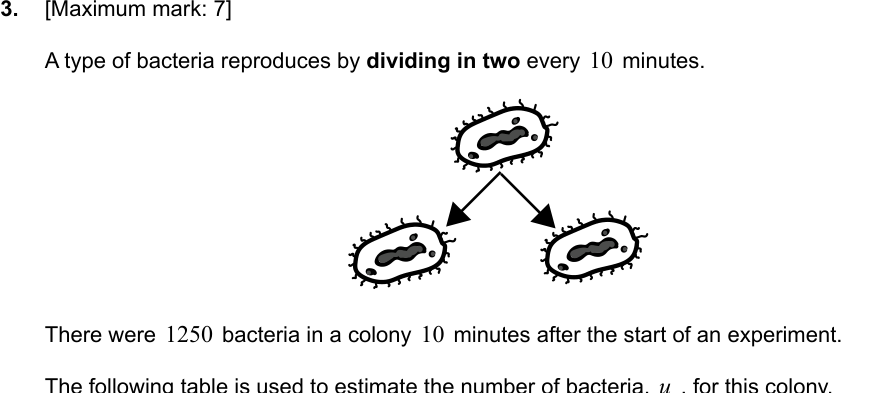
There were 1250 bacteria in a colony 10 minutes after the start of an experiment.
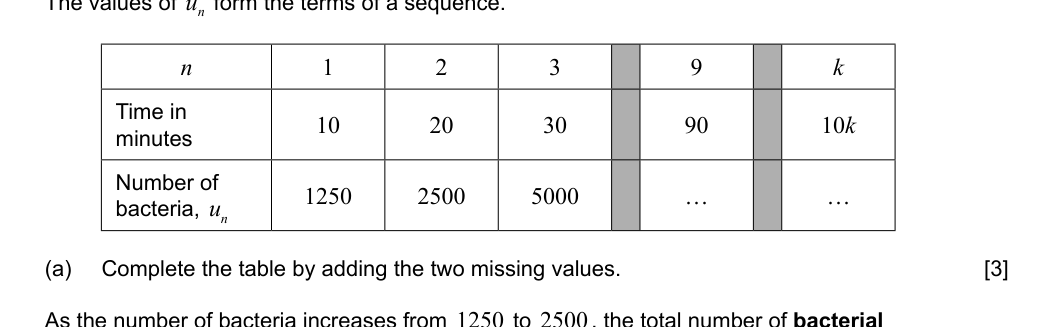
The following table is used to estimate the number of bacteria, uₙ, for this colony.
The values of uₙ form the terms of a sequence.
| n | 1 | 2 | 3 | 9 | k |
|---|---|---|---|---|---|
| Time in minutes | 10 | 20 | 30 | 90 | 10k |
| Number of bacteria, uₙ | 1250 | 2500 | 5000 | … | … |
(a) Complete the table by adding the two missing values. [3]
As the number of bacteria increases from 1250 to 2500, the total number of bacterial divisions is 1250.
(b)
(i) Find the value of n when the number of bacteria is 1.28 × 10⁶. [2]
(ii) Hence or otherwise, find the total number of bacterial divisions as the number of bacteria increases from 1250 to 1.28 × 10⁶. Give your answer correct to the nearest thousand bacterial divisions. [2]