- A ball of mass 2.7 g is released from rest from a height of 28 m above horizontal ground.
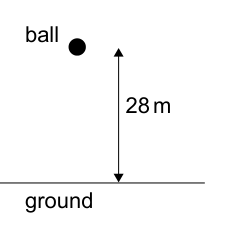
(a) Show that in the absence of air resistance the ball impacts the ground with a speed of about 23 m s⁻¹. [1]
(b) An air resistance force F acts on the ball. F can be modeled by F = kv² where v is the speed and k is a constant.
(i) Determine the unit of k in terms of fundamental units. [2]
(ii) Describe how the ball reaches terminal speed. [2]
(c) The graph shows the variation with time t of the speed v of the ball from the instant it is released until it impacts the ground.
(i) State the value of the area under the curve. [1]
(ii) Determine k. [2]
(iii) On the axes below, draw a graph to show the variation of the magnitude of the resultant force, F, on the ball with time t. No numbers are required on the axes. [1]
(iv) Calculate the average power dissipated by the air resistance force. [3]
(d) The ball rebounds from the ground with speed 7.8 m s⁻¹. The ball is in contact with the ground for a time T. The average resultant force on the ball during this time is 1.1 N. Determine T. [2]