- A student determines the resistivity of a metal that is in the form of a cylindrical wire.
The student makes the following measurements:
Length of the wire =
Readings for the diameter of the wire:
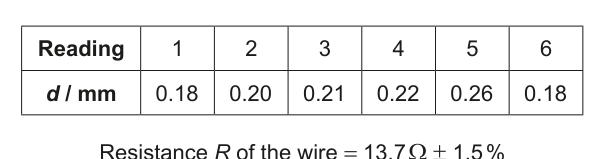
Resistance of the wire =
(a) Outline why the measurements of were made at different places along the wire. [1]
(b) Suggest suitable instruments for the measurement of
(i) [1]
(ii) [1]
(c) (i) Show that the mean diameter of the wire is about . [2]
(ii) Calculate the fractional uncertainty in the diameter of the wire. [2]
(iii) Calculate the fractional uncertainty in the length of the wire. [1]
(d) The resistivity of the wire is given by where is the cross-sectional area of the wire. Calculate the value of and its absolute uncertainty. State your answers to an appropriate number of significant figures. [3]