IB Exam Clashes vs Heavy Same-Day Schedules: What You Can Control (and What You Cannot)
If you are staring at a brutal day on your timetable, you need one thing first: diagnostic clarity.
Most students mix up three different situations:
- a true clash (same-time conflict),
- a same-day stack (multiple papers, no overlap),
- a timezone misunderstanding (wrong local start assumptions).
Each one needs a different response.
This guide gives you a field manual, not vague motivation.
Fast Reality Check (60 seconds)
Use this before you panic:
- Open the official timetable for your session and zone mapping.
- Confirm your school's exam zone and local start time.
- Mark each paper with exact start and duration.
- Identify whether any papers truly overlap in clock time.
If papers do not overlap, that is usually a load-management problem, not a rescheduling problem.
For the official zone-based schedule and local start-time table, use the IB Exam Timetable 2026 tool.
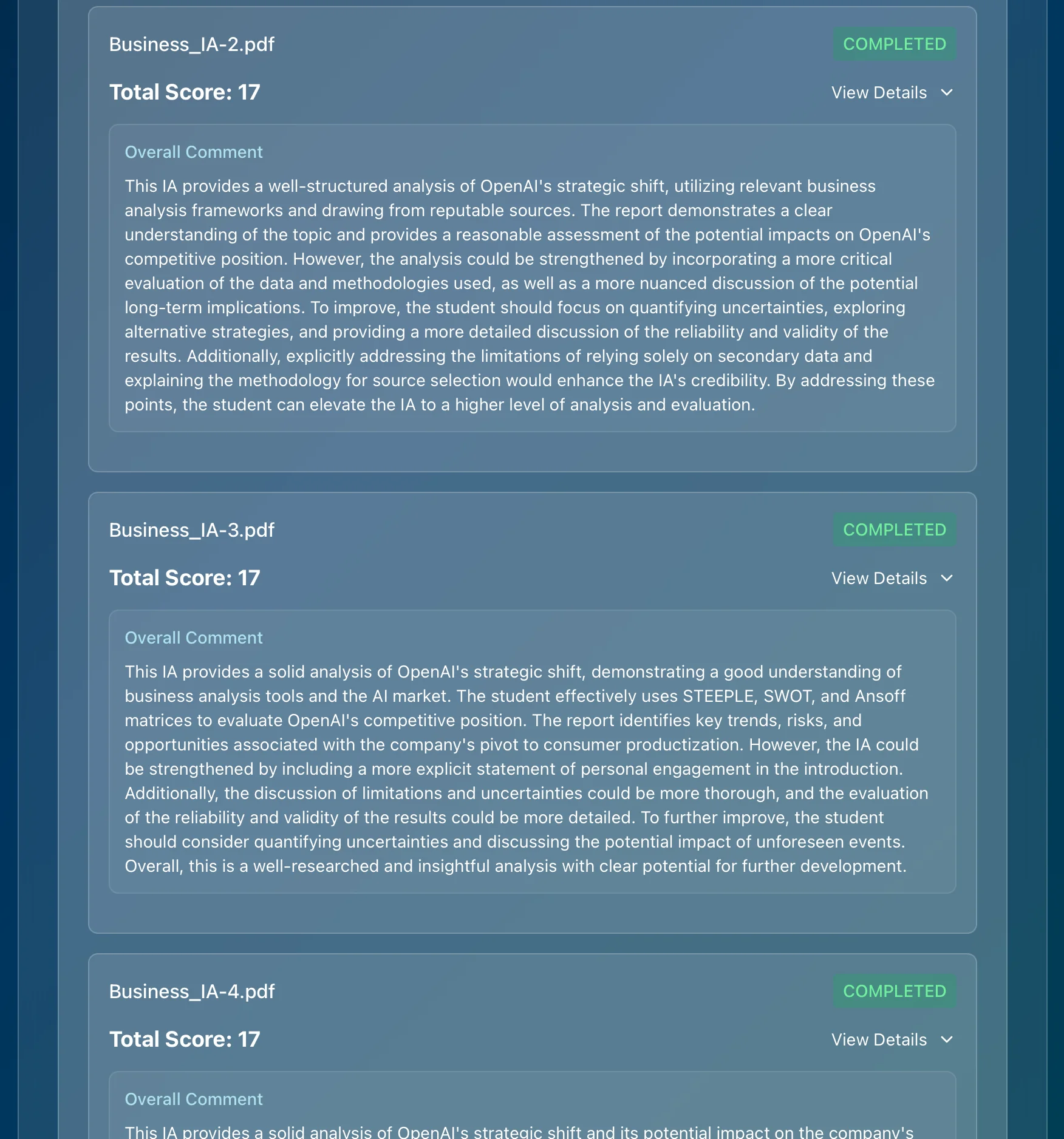
Stuck on your IB draft?
Get instant, detailed feedback on structure, evidence, and reasoning, then compare it with your current school materials.
What the IB schedule structure implies for students
From the official 2026 schedule documents, three facts matter in practice:
- IB deliberately minimizes global clashes but does not eliminate all pressure days.
- Morning/afternoon starts are fixed by exam zone and local offset table.
- Rescheduling requires IB authorization and is not a convenience tool.
Translation for students:
- You should assume your exams run as published.
- Your use is preparation design and coordinator communication quality.
- "Hard day" is not the same as "eligible reschedule case."
The two-track playbook
Track A: True clash (same-time conflict)
If two papers overlap in real clock time, do this immediately:
- Build a one-page conflict sheet for your coordinator.
- Include subject, paper, published start, duration, and overlap window.
- Attach your candidate/session details exactly as registered.
- Ask for written confirmation that the school has filed or will file through official channels.
Do not improvise policy language yourself. Keep it factual and administrative.
Track B: Same-day heavy stack (no overlap)
If your papers are sequential but exhausting, your goal is performance preservation, not reschedule hope.
You need three systems:
- pre-day cognitive taper,
- between-paper recovery loop,
- post-day error containment.
The rest of this guide is built for Track B, because that is where most students lose marks.
The Coordinator Packet (template you can actually use)
Most students send emotional messages and get vague replies. Send this instead.
Subject line
Request: timetable verification + exam-day support plan (November 2026)
Body (structure)
- Candidate details (full name, candidate number, session).
- Exact papers and times from published schedule.
- One sentence on the issue type:
- "possible same-time clash" or
- "same-day high-load sequence, requesting procedural guidance."
- Clear ask:
- verify zone/start times,
- confirm whether IB reschedule criteria are triggered,
- share school-day logistics (reporting, breaks, supervision rules).
That message gets you decisions faster than "I am stressed, can this be moved?"
Why heavy exam days destroy scores (even when revision was good)
Performance drops usually come from execution failures, not knowledge gaps:
- Context-switch fatigue: your brain carries one subject's style into another.
- Glucose timing errors: large sugar spikes before paper 2 create crashes mid-paper.
- Unplanned transition windows: no script between exams means panic scrolling and cognitive leakage.
- Overlong warmups: students spend their best pre-paper minutes on random last-minute reading.
So we fix execution.
The 14-day "pressure-day taper" protocol
This is the most reliable way to protect output on stacked days.
Days -14 to -10: Build paper-specific triggers
For each paper, prepare one half-page "activation card":
- top 5 command-term reminders,
- first 10-minute approach,
- common error traps,
- one timing checkpoint.
You are creating fast mental re-entry, not relearning content.
If you need structure for this phase, use How to Study for IB Exams: The Ultimate Revision Guide.
Days -9 to -5: Simulate subject switching
Run short blocks in the exact order of your pressure day.
Example:
- 70-90 min block for Paper A style.
- 20 min break with zero academic input.
- 70-90 min block for Paper B style.
Goal: train switching cost down.
Days -4 to -2: Reduce volume, increase precision
Cut total study hours by around 20-30%. Increase focus on:
- activation cards,
- targeted past-paper segments,
- error-type repair.
Use Past Papers for short, high-intensity reps, not full random marathons.
Day -1: Protect sleep and logistics
No heavy new content.
Finalize:
- route and reporting time,
- permitted materials,
- meal timing,
- hydration plan,
- alarm redundancy.
Between-paper recovery loop (15-25 minutes)
This is where strong students separate from exhausted students.
Minute 0-3: Hard shutdown
- Stop post-mortem discussion.
- No answer-checking with peers.
- One sentence only: "next paper now."
Minute 3-8: Physiological reset
- Water.
- Light movement (walk, stretch).
- Controlled breathing (long exhale pattern).
Minute 8-15: Cognitive re-prime
Read only your activation card for the next paper. Do not open broad notes.
Minute 15-20 (optional): narrow warmup
One micro-drill tied to an error pattern you already know. No new theory.
This loop prevents score collapse from paper 2 onward.
Exam-room time model for high-load days
Use a fixed time budget so fatigue does not hijack pacing.
For each paper:
- Opening scan (5-8% of time): map marks vs effort.
- First pass (60-65%): high-confidence marks first.
- Second pass (20-25%): harder items / deeper analysis.
- Final sweep (8-10%): command terms, units, labels, missing parts.
When tired, students usually skip phase 4 and leak easy marks.
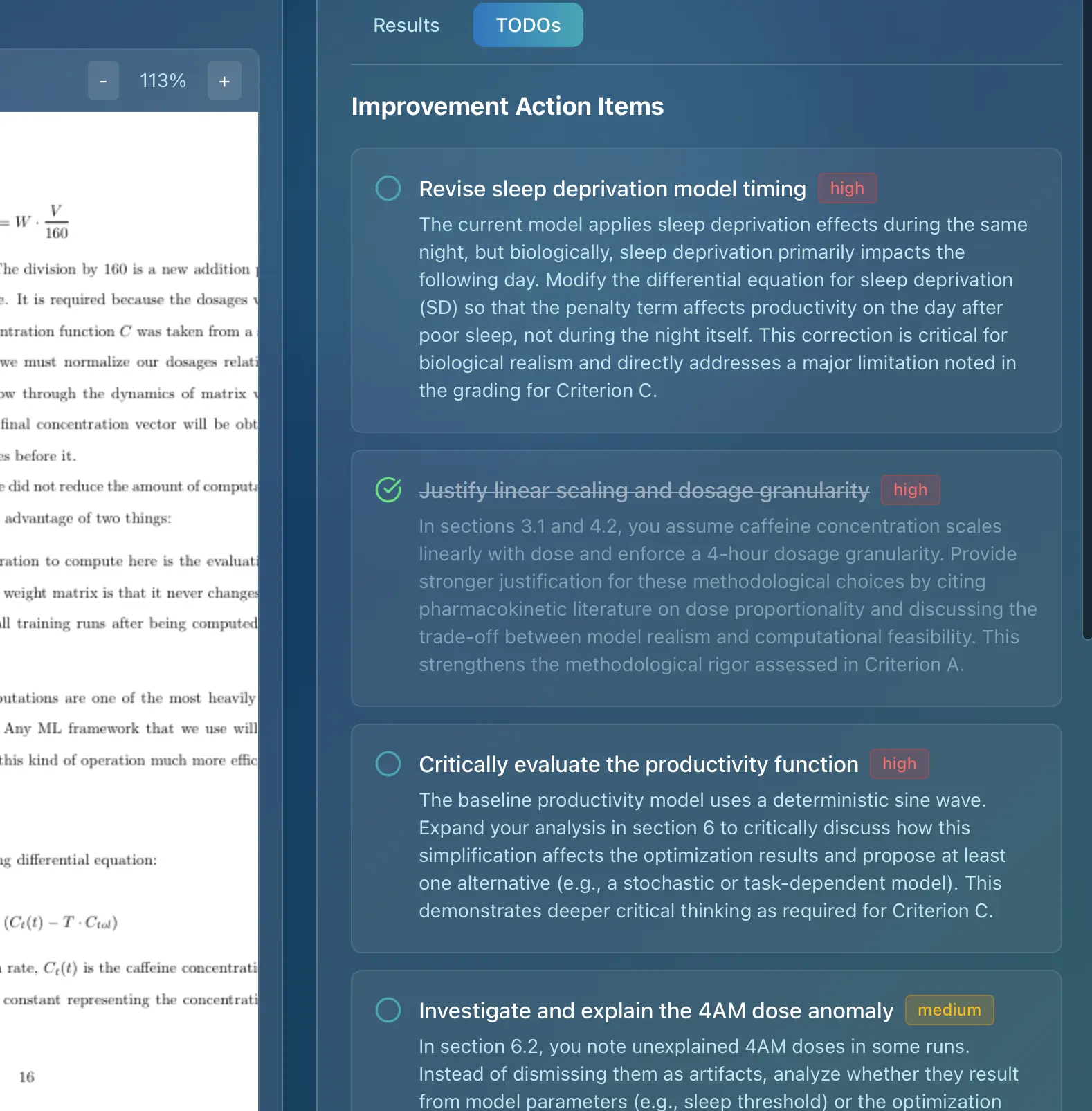
Check your own draft
Get estimated marks by criterion, comments on your writing, and a clear list of what to fix first.
Subject-switch guardrails (practical examples)
Quantitative to essay paper
Risk: writing concise formulas instead of developed arguments.
Countermeasure:
- put one reminder on activation card: "claim -> evidence -> implication."
- force topic sentence in first response paragraph.
Essay to quantitative paper
Risk: over-writing instead of calculating quickly.
Countermeasure:
- first page rule: write givens and target variable before any prose.
- if stuck >90 seconds, mark and move.
Language paper after science/maths
Risk: mechanical tone and weak textual interpretation.
Countermeasure:
- warmup: 3 bullet points on voice/register/audience before writing.
- checkpoint at one-third time: "am I analyzing, not summarizing?"
What to do if your school says "nothing can be done"
Sometimes this means "no reschedule basis," not "no support available."
Request operational support instead:
- exact report windows for each paper,
- break-space logistics,
- supervision expectations,
- permitted food/water timing,
- escalation point on exam day.
You can often improve outcomes without any timetable change.
Common myths (and the real answer)
"If I have 3-4 papers in one day, IB will move one"
Not automatically. High load alone is usually not enough.
"Zone confusion can be fixed on exam week"
Dangerous assumption. Zone assignment and local starts must be confirmed early.
"I should study maximum hours the day before"
Usually harms performance on later papers the next day.
A real example process (M26-style pressure day)
Imagine a student with four papers across two sessions.
What works:
- 10 days out: subject-order simulations.
- 4 days out: activation cards finalized.
- 1 day out: taper, sleep, logistics lock.
- Exam day: strict between-paper recovery loop.
- After final paper: debrief only after leaving school.
What fails:
- chasing reschedule rumors,
- checking Reddit between papers,
- changing strategy mid-day.
Where Marksy fits in this specific problem
For pressure-day prep, use Marksy for targeted execution, not generic browsing:
- Build short timed blocks in Past Papers.
- Use feedback to identify recurring low-value errors before exam day.
- Keep revision plan aligned with your actual exam order via IB Exam Timetable 2026.
- Stabilize high-stress writing performance with rubric-aligned grading process.
Final decision framework
Use this exact rule:
- If it is a true overlap, escalate formally via coordinator now.
- If it is a heavy non-overlap day, run the execution protocol above.
- If you are unsure, verify zone + local times first, then classify.
Most students lose marks by misclassifying the problem. You gain marks by classifying early and executing the right playbook.
Sources
- International Baccalaureate, IB Diploma Programme and IB Career-related Programme: November 2026 examination schedule: exam-zone local start times, timetable design principles, and rescheduling authorization note. https://www.ibo.org/globalassets/new-structure/programmes/dp/pdfs/november-2026-examination-schedule.pdf
- International Baccalaureate, Assessment and exams (Diploma Programme): assessment governance context and coordinator-mediated process framing. https://www.ibo.org/programmes/diploma-programme/assessment-and-exams/
Related Reading and Useful Tools
- IB Exam Timetable 2026 (November)
- How to Study for IB Exams: The Ultimate Revision Guide
- How to Use IB Past Papers to Improve Faster (Without Burning Out)
- Creating Study Schedules That Actually Work for IB
- How to Manage Exam Stress: Tips for IB Students
- Get rubric-aligned feedback
- Browse all IB blog posts