- The following data are available for the Sun when it entered the main sequence.
Mass = 2.0 × 10³⁰ kg Radius = 7.0 × 10⁸ m Surface temperature = 5800 K Core temperature = 1.5 × 10⁷ K Core density = 1.6 × 10⁵ kg m⁻³
(a) (i) State and explain which of the above features make nuclear fusion in the Sun possible. [3]
(ii) Outline how the Sun maintains its equilibrium state. [2]
(b) The following sequence of nuclear fusion reactions takes place in the Sun.
Stage 1: ¹₁H + ¹₁H → ²₁H + ⁰₁e⁺ + ⁰₀ν
Stage 2: ¹₁H + ²₁H → ³₂He + ⁰₀γ
Stage 3: ³₂He + ³₂He → ⁴₂He + 2 × ¹₁H
The nuclear mass of ¹₁H is 1.007276 u and that of ²₁H is 2.013550 u. Estimate the energy released in stage 1 of these reactions. [2]
(c) The Sun will leave the main sequence when it has converted 10 % of its hydrogen mass into helium. The total energy released in the reactions in (b) is 4.3 × 10⁻¹² J. The current luminosity of the Sun is 3.8 × 10²⁶ W. When the Sun entered the main sequence its hydrogen mass was 1.5 × 10³⁰ kg.
(i) Show that the Sun will stay on the main sequence for about 8 × 10⁹ years. [3]
(ii) State one assumption that was made in getting the answer to (c)(i). [1]
(iii) Estimate the total mass lost by the Sun in this time. [2]
(d) The surface temperature of the Sun is 5800 K. Determine the peak wavelength in the Sun’s spectrum. [2]
(e) The Sun rotates about its axis. P is a point on the Sun’s equator.
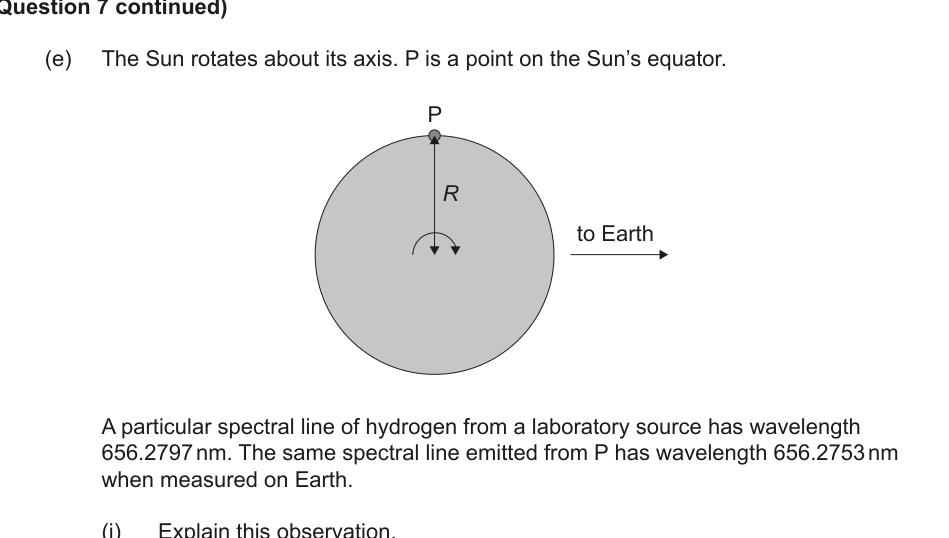
A particular spectral line of hydrogen from a laboratory source has wavelength 656.2797 nm. The same spectral line emitted from P has wavelength 656.2753 nm when measured on Earth.
(i) Explain this observation. [2]
(ii) Calculate the period of revolution of the Sun. [3]