- (a) A cylindrical spacecraft of cross‑sectional area S moves with velocity v. The spacecraft enters a region of dust of density ρ. All the dust that comes into contact with the forward cross‑sectional area of the spacecraft sticks to the spacecraft increasing its mass.
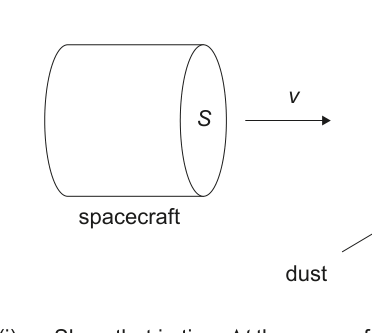
(i) Show that in time Δt the mass of the spacecraft will increase by an amount ρSvΔt. [1]
(ii) Deduce that the spacecraft will experience a drag force ρSv² opposite to its velocity. [2]
(b) A satellite of mass m is in a circular orbit of radius r around Earth. Earth has mass M.
(i) Show that the total energy of the satellite is given by Eₜ = ‑GMm/(2r). [2]
(ii) The satellite experiences a drag force due to the atmosphere of Earth. With reference to the results in (a) and (b)(i), state and explain the likely fate of this satellite. [4]
(c) The graph shows the variation with time of the height of the International Space Station (ISS) during a 30‑day period.
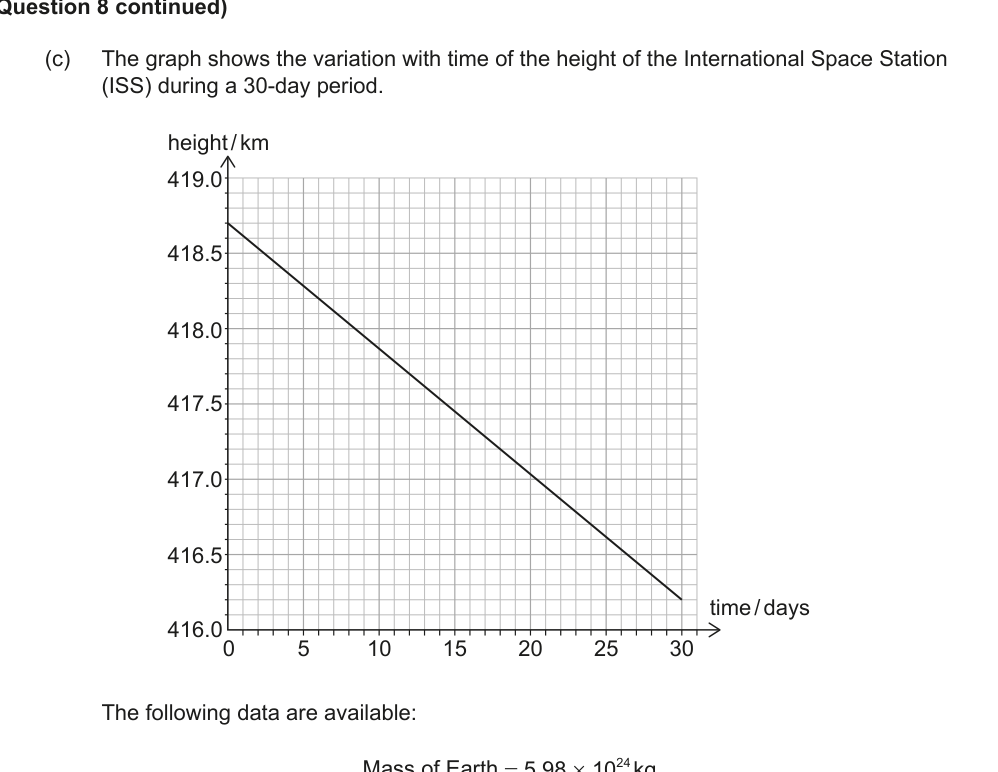
(i) Calculate the average rate at which the energy of the ISS is being dissipated. [2]
(ii) Show, using the average height during the 30‑day period, that the speed of the ISS is about 8 × 10³ m s⁻¹. [2]
(iii) Estimate the increase in the temperature of the ISS assuming all the lost energy went into thermal energy of the ISS. Take the specific heat capacity of the ISS to be 500 J kg⁻¹ K⁻¹. [2]
(iv) Estimate, using the answers to (c)(i) and (c)(ii), the average drag force that acted on the ISS. [3]
(d) At the end of the 30‑day period, rockets are fired to bring the ISS back to its initial height. The energy density of liquid hydrogen rocket fuel is 8.5 × 10³ MJ m⁻³. Estimate the volume of fuel needed. [2]