How to Relearn Essay Writing After Overusing AI in the IB
If you have used AI for so much schoolwork that writing alone now feels impossible, your ability has not disappeared. More likely, you have stopped practising several smaller skills: deciding what you think, retrieving relevant knowledge, organizing an argument, tolerating an imperfect first draft, and revising your own sentences.
Those skills can be rebuilt. The practical solution is a short period of AI-free drafting, broken into manageable exercises, followed by carefully limited feedback. You do not need to produce a brilliant full essay on day one. You need to take ownership of the thinking again.
This guide gives you a four-week reset designed around IB essays and coursework. It is not a punishment or a promise that every student will recover at the same speed. It is a way to replace avoidance with repeated, visible practice.
First: Do Not Confuse Struggle with Inability
AI-generated prose arrives clean and immediate. Your own first attempt may feel slow, repetitive, or disorganized by comparison. That contrast can make ordinary drafting feel like evidence that you “cannot write.” It is not.
A first draft is supposed to expose incomplete thinking. Its job is to give you something you can test and improve. When a chatbot has routinely supplied the outline, thesis, transitions, and polished sentences, you have been seeing a finished-looking product without practising the decisions underneath it.
Recent research has raised concerns about this kind of offloading, but it should be interpreted carefully. A 2025 study comparing unaided, search-assisted, and LLM-assisted essay writing found lower measured engagement and ownership in the LLM group. However, it involved 54 adults, only 18 completed its crossover session, and the paper was released as a preprint rather than settled evidence about every student. The useful conclusion is modest: letting a tool perform the thinking may reduce your engagement with the task. It does not prove permanent damage.
The IB’s current direction is similarly balanced. Its draft AI design principles say AI should strengthen inquiry, critical thinking, and creativity through the effort that defines learning. The aim is not to pretend AI does not exist; it is to keep the learner active. You can read the IB’s 2026 AI principles directly.
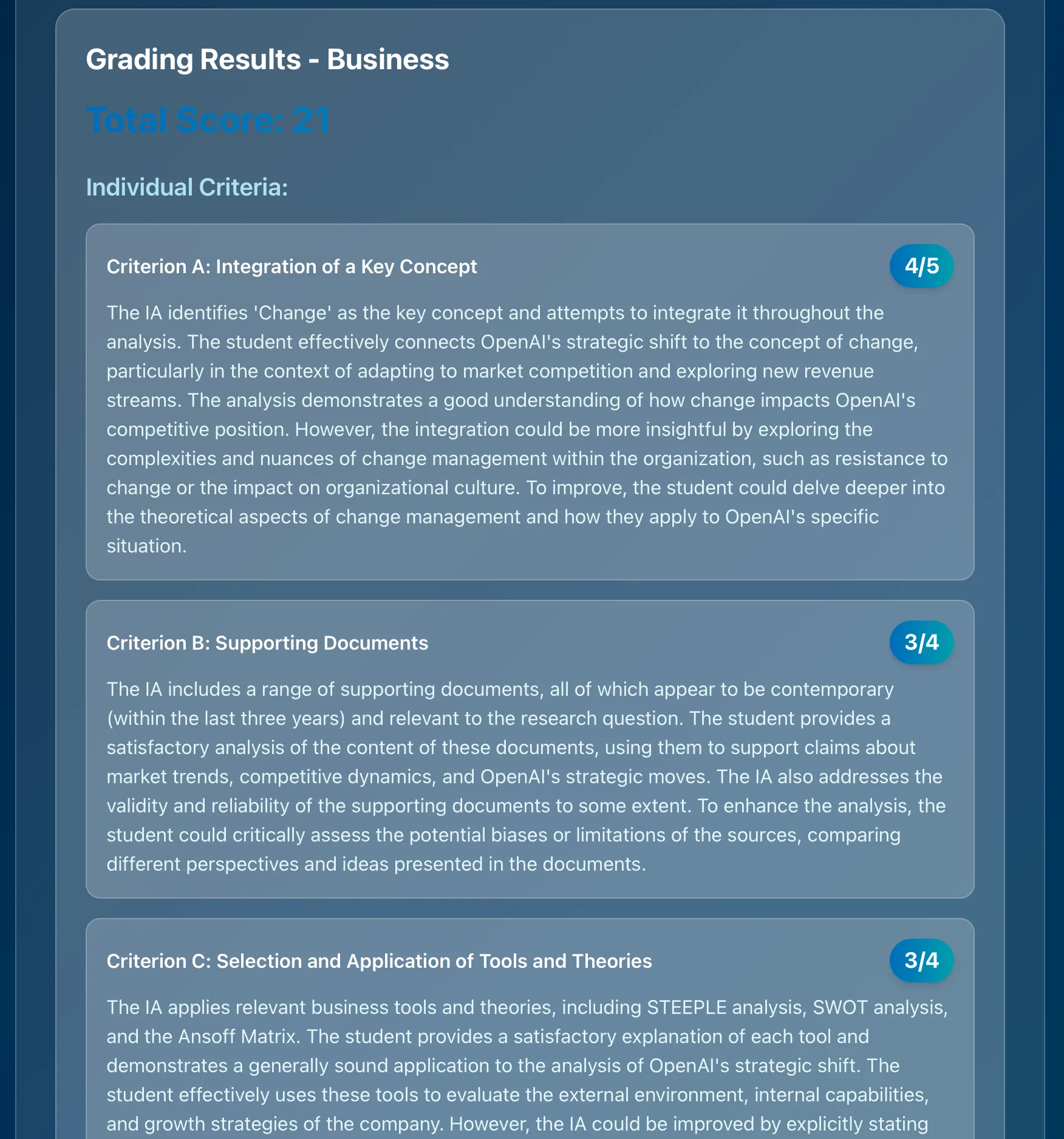
Stuck on your IB draft?
Get instant, detailed feedback on structure, evidence, and reasoning, then compare it with your current school materials.
Make an Honest Skills Inventory
Before starting the reset, take 25 minutes and answer a familiar class question without AI, notes, or a search engine. It can be a past Paper 2 prompt, a short History claim, or one paragraph explaining a scientific conclusion.
Do not grade the prose as “good” or “bad.” Diagnose the point where you become stuck:
- No ideas: you struggle to recall relevant knowledge or generate a position.
- Too many ideas: you cannot select or sequence what matters.
- No argument: you can describe content but cannot answer “so what?”
- No paragraphs: you know your point but cannot connect claim, evidence, and analysis.
- Sentence paralysis: you keep rewriting the opening line and never move forward.
- Revision dependence: you can draft, but you cannot identify what to improve without a tool.
This distinction matters. Someone with a retrieval problem needs closed-book recall practice. Someone with sentence paralysis needs timed drafting and permission to write badly. A generic instruction to “write more” will not target both problems equally well.
Keep this diagnostic. Repeat the same kind of task after four weeks so you can compare planning time, word count, clarity, and how often you stopped—not merely the grade you imagine it would receive.
Set Your AI Boundary Before You Work
For the reset to work, the boundary must be specific enough that you cannot renegotiate it whenever writing becomes uncomfortable.
For four weeks, do not use generative AI to:
- choose your argument;
- create an outline;
- write or rewrite sentences;
- generate examples or analysis;
- continue a paragraph;
- turn rough notes into prose.
Your teacher and school rules take precedence over any general advice. The IB does not treat all use of AI as automatically forbidden, but it requires use to comply with academic integrity expectations. Its academic integrity policy includes specific guidance on AI tools, acknowledgement, and authentic authorship.
During the reset, ordinary sources remain useful: your course materials, teacher feedback, dictionaries, citation tools, and reputable research databases. The point is not technological isolation. It is to stop outsourcing the intellectual moves you are trying to rebuild.
Week 1: Rebuild Thinking Before Prose
Your first week should consist of short exercises, not full essays. Complete one 20–30 minute session on five days.
1. Retrieve before reviewing
Choose a topic you have already studied. On blank paper, write everything relevant that you can remember for five minutes. Then check your notes in a different colour and add what you missed.
This separates a knowledge gap from a writing gap. If the page is almost empty before you check your notes, polished sentence practice is not yet the priority.
2. Turn a question into a decision
Underline the task words and write a one-sentence answer that takes a position. It can be provisional. For an “evaluate” prompt, decide what was effective, what was limited, and what overall judgement follows.
If selecting a precise focus is the problem, the same principle used to build a manageable IB research question applies: narrow the scope until the claim can actually be supported.
3. Build claim-evidence-reasoning units
Make three rows with these headings:
| Claim | Evidence | Why it proves the claim |
|---|---|---|
| Your answer to one part of the question | A quotation, fact, result, example, or source | The inference you can reasonably draw |
Do not draft the paragraph until all three cells contain distinct information. Students often think they lack writing skill when the real problem is that the reasoning cell is empty.
4. Explain the argument aloud
Record a two-minute voice note explaining your answer without reading a script. Listen once and write down the clearest sentence you said. Speaking can reveal the argument hidden beneath the pressure to sound academic.
By the end of week one, aim to produce a thesis and three reasoned paragraph plans in 25 minutes. They do not need elegant wording.
Week 2: Practise Deliberately Imperfect Paragraphs
Write one paragraph a day from the plans you created in week one. Set a 15-minute timer and do not edit until it ends.
Use a simple sequence:
- State a claim that answers the question.
- Introduce specific evidence.
- Explain what the evidence shows.
- Test a limitation, alternative interpretation, or consequence where the task requires it.
- Link the judgement back to the question.
This is a scaffold, not a mandatory five-sentence formula. A scientific evaluation and a Language A analysis will use evidence differently. The shared principle is that every paragraph must perform reasoning, not merely display information.
After drafting, revise in separate passes:
- Argument pass: Does every paragraph advance the answer?
- Evidence pass: Is each important claim supported?
- Analysis pass: Have you explained why the evidence matters?
- Clarity pass: Can any sentence be made more precise or direct?
Do not polish grammar while the argument is still changing. The broader guide to academic writing for IB assessments can help you review structure and evidence once you are producing your own drafts again.
Week 3: Rebuild Full-Response Stamina
Move from isolated paragraphs to connected responses. Complete two or three sessions this week:
- one 45-minute essay plan plus introduction and first body paragraph;
- one untimed full response;
- one timed response under conditions close to the relevant assessment.
For each session, keep a small process log:
| Measure | Record |
|---|---|
| Planning time | Minutes before drafting |
| Stops | Times you abandoned a sentence or opened another resource |
| Completed structure | Sections or paragraphs finished |
| Main weakness | One issue only |
| Next drill | The smallest exercise that targets it |
The “one issue only” rule prevents feedback overload. If the argument wanders, spend the next practice session writing thesis statements and topic sentences. If evidence is vague, practise retrieving examples. If paragraphs end without analysis, write only the reasoning sentences for five claim-evidence pairs.
When practising exam writing, use authentic question styles where you can. Working through IB past-paper practice is more useful than repeatedly inventing broad essay topics because the command terms and time pressure are part of the skill you need to recover.
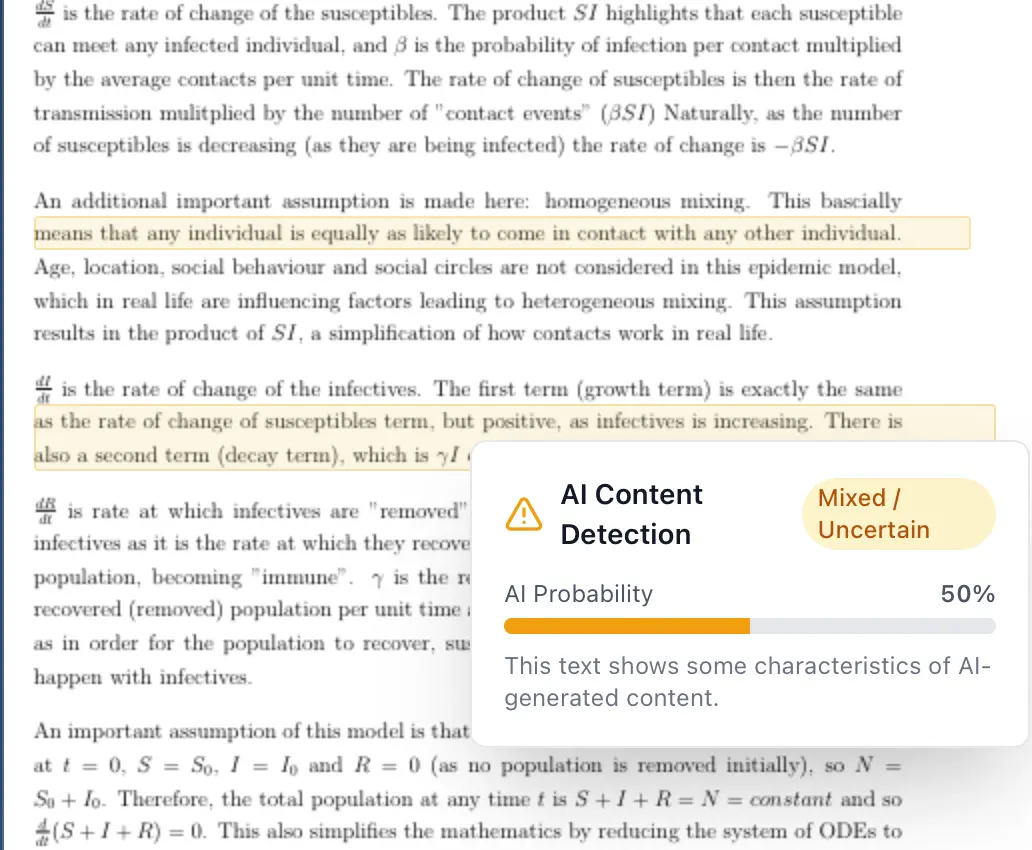
Check your own draft
Get estimated marks by criterion, comments on your writing, and a clear list of what to fix first.
Week 4: Add Feedback Without Handing Back Control
Feedback becomes useful when it points you toward your next decision. It becomes another form of dependence when it replaces that decision.
Use this order:
- Finish the draft without AI assistance.
- Annotate it yourself against the task and relevant criteria.
- Write the two weaknesses you expect a reviewer to identify.
- Ask a teacher, peer, or permitted feedback tool for critique.
- Compare that feedback with your diagnosis.
- Revise the work yourself and explain what you changed.
Ask for diagnosis rather than replacement prose. “Which paragraph has the weakest reasoning, and why?” keeps you in control. “Rewrite this to get a 7” does not.
For coursework, you can compare a self-written draft with the relevant IB assessment criteria before seeking outside feedback. If your school permits it, rubric-aligned assessment feedback can then provide a second perspective—but keep the document closed while revising so that you make each wording and reasoning decision yourself.
What Responsible AI Use Can Look Like Later
Completing the reset does not require a lifetime ban. It means you can make a deliberate choice instead of reaching for AI whenever uncertainty appears.
A useful test is: Will this use leave me doing the learning objective?
If the objective is to construct an argument, asking AI to construct it defeats the exercise. If the objective is to check whether your self-written explanation is understandable, feedback may support it—provided your school allows that use and you evaluate the response critically.
Lower-risk uses after you have completed your own thinking may include:
- asking for questions that test your understanding, without requesting answers;
- requesting feedback limited to one criterion;
- checking whether a reader can identify your thesis;
- asking a tool to flag unclear passages without rewriting them;
- comparing feedback from a tool with feedback from your teacher.
Keep a record of how AI contributed when your school requires acknowledgement. Never submit generated wording or ideas as your own, and do not upload protected IB materials into a generative system. The IB’s current intellectual-property terms prohibit using its copyrighted material as AI training data or prompts.
When to Tell Your Teacher
Talk to your teacher, coordinator, or counsellor if any of these are true:
- previously submitted work contains unacknowledged AI-generated material;
- you do not understand your school’s AI rules;
- an important deadline is close and you cannot start independently;
- anxiety, exhaustion, or perfectionism is stopping you from working;
- you are considering inventing evidence, citations, or process records to hide past use.
Do not attempt to “humanize” generated text or evade detection. That does not restore your writing skill and can deepen the academic-integrity problem. Your school is better placed to explain what must be disclosed or redone in your specific situation.
A Compact Reset Checklist
At the end of four weeks, you should be able to say:
- I can interpret a prompt without asking AI what it means.
- I can retrieve some relevant knowledge before opening my notes.
- I can state a provisional answer even when it is imperfect.
- I can connect a claim, evidence, and reasoning.
- I can complete a rough paragraph without editing every sentence immediately.
- I can identify one weakness before receiving feedback.
- I can revise from criticism without copying replacement wording.
If some items remain difficult, repeat the drill attached to that skill. Recovery is not measured by suddenly loving every essay. It is measured by needing less external help to begin, decide, and revise.
The central habit is simple: think first, draft second, diagnose third, and seek limited feedback last. Every time you complete that cycle yourself, you practise the part that AI had been doing for you.