- Voltage-gated ion channels are proteins that are embedded in the phospholipid bilayer of plasma membranes. They conduct ions at high rates, regulated by the voltage across the membrane. The diagram shows a typical voltage-gated potassium (K+) channel when it is closed and when it is open.
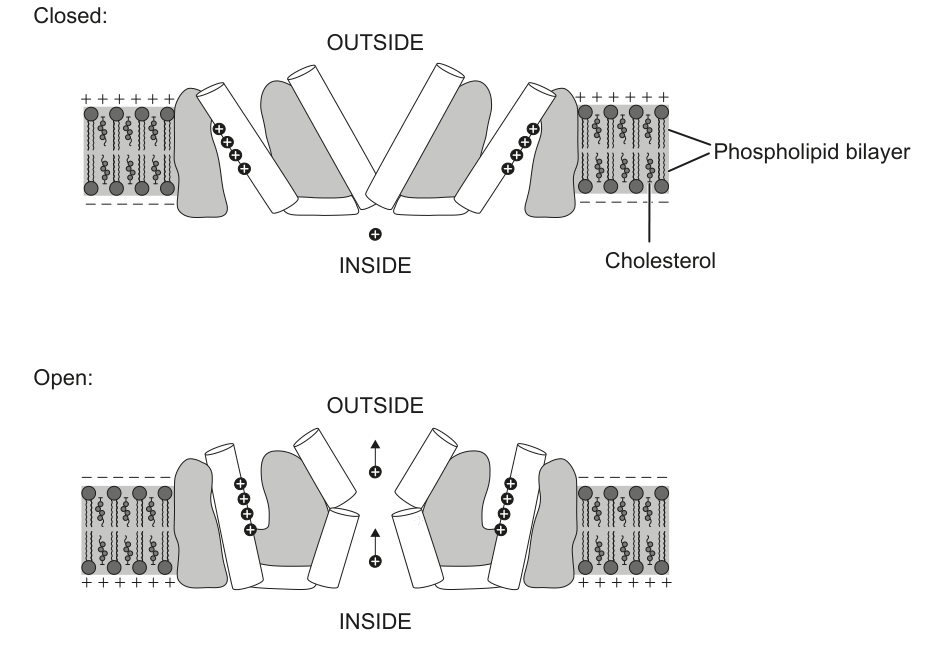
(a) Explain the action of the voltage-gated potassium channel during a nerve impulse. [3]
(b) State another type of gated ion channel. [1]
(c) Outline the amphipathic characteristic of phospholipid bilayers. [1]
(d) Outline the effect of cholesterol on the fluidity of membranes. [1]
(e) Outline the effect of fatty acids on the fluidity of membranes. [1]