Question 10

From Biology SL Paper 3 (November 2024, TZ2)

  1. The graph shows the concentration of methyl mercury during degradation by Pseudomonas putida in experimental tubes after 0, 4, 8, 12 and 24 hours of incubation. It also shows the growth of P. putida in the presence and absence of methyl mercury.
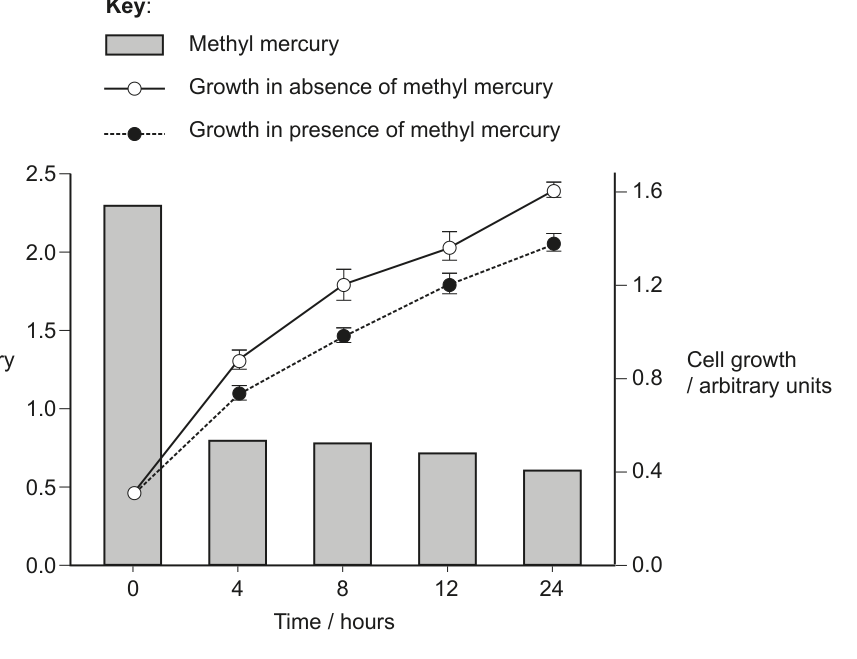
A combined bar and line graph. The bars show methyl mercury concentration (µmol dm⁻³) on the left y-axis, decreasing over time. The lines show cell growth (arbitrary units) on the right y-axis, increasing over time, both in the presence and absence of methyl mercury. The x-axis represents time in hours (0, 4, 8, 12, 24). A key identifies the data series.

(a) State one chemical other than mercury produced in the degradation of methyl mercury by P. putida. [1]

(b) Using the data, evaluate whether P. putida is an effective microorganism for methyl mercury bioremediation. [2]

Textbook topics in this question

Review the exact course sections assessed by each question part.

Mixed-topic question
10(a)5.2 Prokaryotic Cell StructureMicrobial bioremediation · legacy topic
10(b)5.2 Prokaryotic Cell StructureMicrobial bioremediation · legacy topic