- (a) Outline what is meant by a travelling wave. [2]
(b) A loudspeaker emits sound of frequency 210 Hz into a pipe with one open and one closed end. The diagram shows a representation of the standing wave established in the pipe.
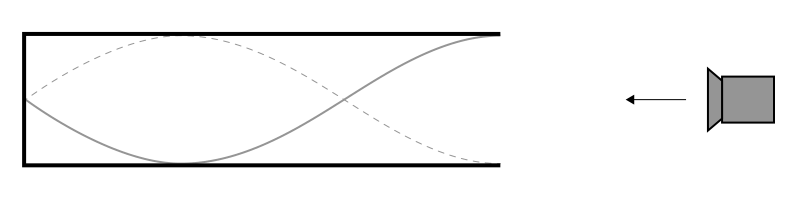
The length of the pipe is 1.20 m.
(i) Outline how the standing wave is formed in the pipe. [2]
(ii) Determine the wavelength of the wave. [1]
(iii) Calculate the speed of sound in the pipe stating the answer to an appropriate number of significant figures. [2]
(c) The solid line represents the standing wave at time t and the dotted line represents the standing wave at an instant later. The dot is the equilibrium position of a particle P in the pipe. The up arrow indicates displacements to the right and the down arrow displacements to the left.
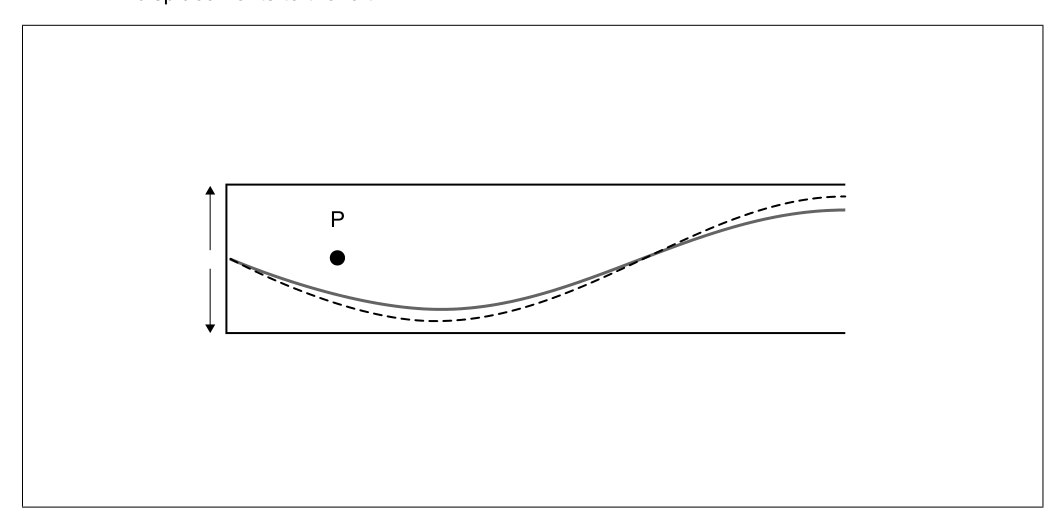
On the diagram, draw
(i) a dot to indicate the approximate position of P at time t, [1]
(ii) an arrow to indicate the velocity of P at time t. [1]
(d) The amplitude of oscillations of the standing wave in (b) is 4.2 mm. The mass of particle P in (c) is 1.8 × 10⁻⁶ kg.
Calculate
(i) the total energy of P, [2]
(ii) the displacement of P, when its kinetic energy is equal to its potential energy. [2]
(e) The frequency of sound is reduced to 140 Hz. Explain why a standing wave will not be formed in the pipe. [2]