Question 5

From Physics HL Paper 2 (May 2024, TZ2)

  1. A probe of mass m has landed on the equator of a rotating asteroid of mass M and radius R.
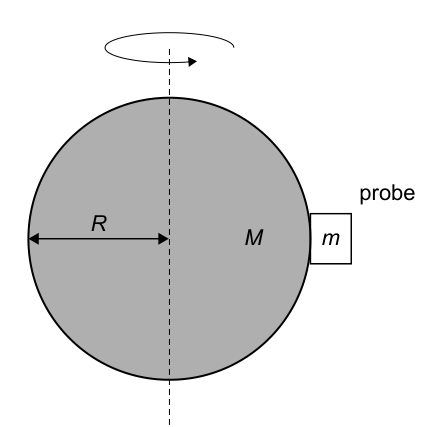
A diagram showing a spherical asteroid with mass M and radius R, rotating with angular speed ω. A small probe of mass m is shown on the equator of the asteroid. An arrow indicates the direction of rotation.

The asteroid rotates with angular speed ω.

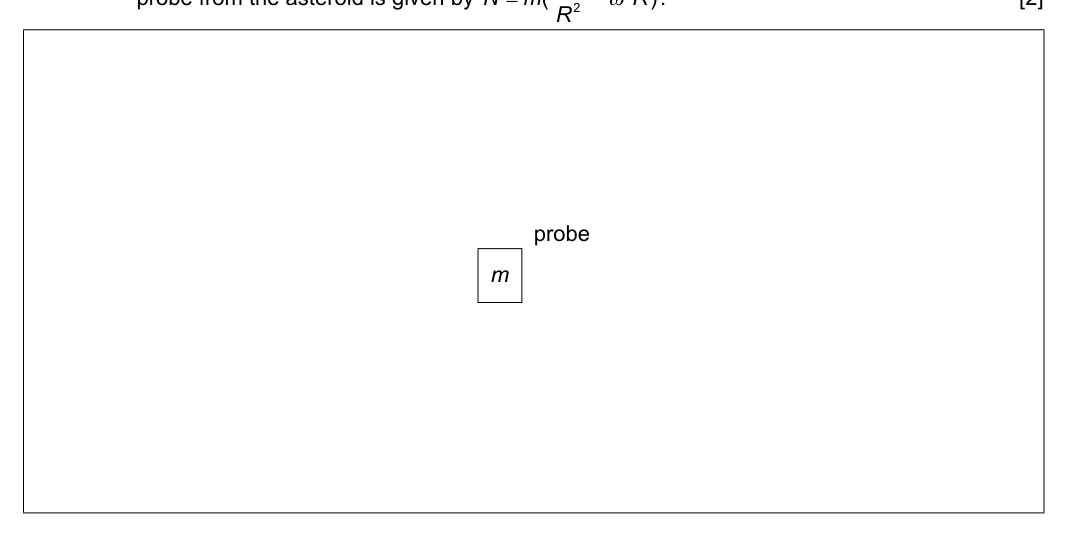
(a) By drawing a free-body diagram for the probe, show that the normal force, N, on the probe from the asteroid is given by N = m(GM/R² - ω²R). [2]
A large blank rectangular area provided for drawing a free-body diagram of the probe, with a small box labeled 'm' and 'probe' inside it.

(b) Deduce that the probe will remain on the asteroid surface only if ω ≤ √(GM/R³). [1]

(c) Another probe orbits the Sun.

(i) The distance between the probe and the Sun is 4 times the distance between the Earth and the Sun. Show that the intensity of the solar radiation at the surface of the probe is 85 W m⁻². [2]

(ii) Estimate the equilibrium temperature of the probe assuming it behaves as a black body. [2]

Textbook topics in this question

Review the exact course sections assessed by each question part.

Mixed-topic question