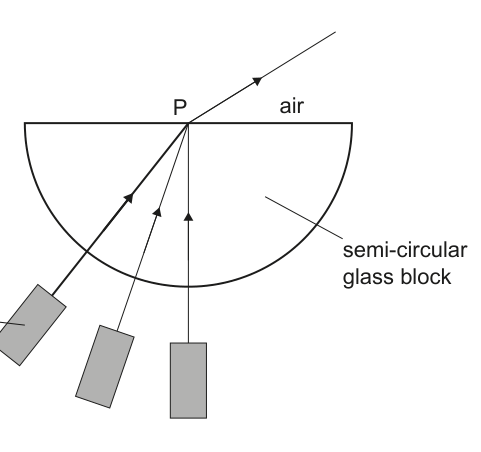
- A group of students is investigating refraction in a semi-circular glass block.
Light from a ray box enters the curved side of the block. The light passes through the block and leaves, refracted, at P.
(a) Outline how the students can ensure that the light is not deflected at the curved surface. [1]
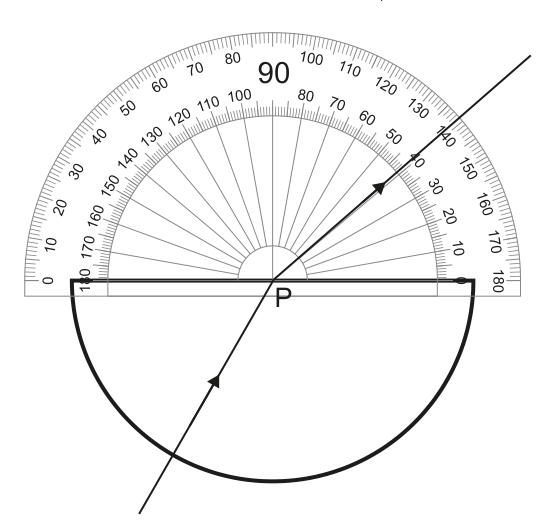
The students vary the position of the ray box to obtain data to determine the refractive index of the glass. They use a protractor to collect values for the angles of incidence θᵢ and refraction θᵣ at P and record them on a table.
(Question 2 continued)
(b) (i) One of their measurements is shown. State θᵣ for this measurement. [1]
(ii) Complete the table. [1]
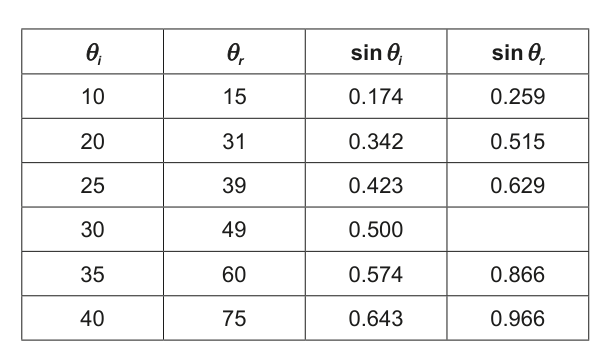
| θᵢ | θᵣ | sin θᵢ | sin θᵣ |
|---|---|---|---|
| 10 | 15 | 0.174 | 0.259 |
| 20 | 31 | 0.342 | 0.515 |
| 25 | 39 | 0.423 | 0.629 |
| 30 | 49 | 0.500 | |
| 35 | 60 | 0.574 | 0.866 |
| 40 | 75 | 0.643 | 0.966 |
(Question 2 continued)
They plot a graph of the variation with the sine of θᵢ of the sine of θᵣ.
They add uncertainty bars for sin θᵣ for the first and last data point and draw the best-fit line.
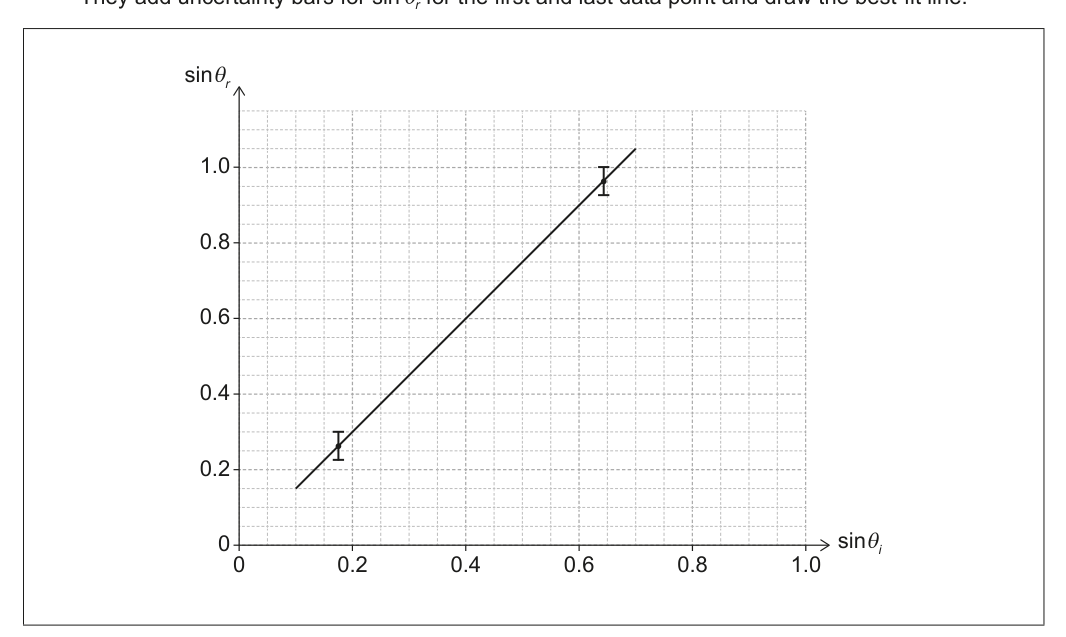
(c) (i) Determine the gradient of the students’ best-fit line. [2]
(ii) Draw on the students’ graph the line of maximum gradient. [1]
(iii) Determine the value of the refractive index of the glass with its absolute uncertainty. [2]