Question 1

From Physics HL Paper 1B (May 2025, TZ2)

  1. A student determines the resistivity ρ\rho of a metal that is in the form of a cylindrical wire.
    The student makes the following measurements:
    Length LL of the wire = (462±2)mm(462 \pm 2)\text{mm}

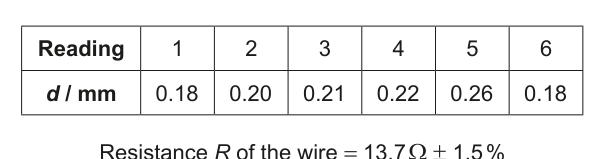
Readings for the diameter dd of the wire:

Table showing six readings for the diameter d of the wire in mm.

Resistance RR of the wire = 13.7Ω±1.5%13.7\,\Omega \pm 1.5\%

(a) Outline why the measurements of dd were made at different places along the wire. [1]

(b) Suggest suitable instruments for the measurement of
(i) LL [1]

(ii) dd [1]

(c) (i) Show that the mean diameter of the wire is about 0.2mm0.2\text{mm}. [2]

(ii) Calculate the fractional uncertainty in the diameter of the wire. [2]

(iii) Calculate the fractional uncertainty in the length of the wire. [1]

(d) The resistivity of the wire is given by ρ=RAL\rho = \frac{RA}{L} where AA is the cross-sectional area of the wire. Calculate the value of ρ\rho and its absolute uncertainty. State your answers to an appropriate number of significant figures. [3]

Textbook topics in this question

Review the exact course sections assessed by each question part.

Mixed-topic question
1(a)11.1 Potential Difference, Current, and ResistanceRandom uncertainty and repeated measurements · legacy topic
1(b)(i)Selection of measuring instruments · legacy topic
1(b)(ii)Selection of measuring instruments · legacy topic
1(c)(i)Mean value and anomalous data · legacy topic
1(c)(ii)Fractional measurement uncertainty · legacy topic
1(c)(iii)Fractional measurement uncertainty · legacy topic
1(d)11.1 Potential Difference, Current, and ResistancePropagation of measurement uncertainty · legacy topic