- A system consists of ten distinguishable particles which can exchange energy in integer multiples of a constant value E. The total energy of the system is 10E.
The diagram shows two possible energy configurations of the system. In configuration A, all particles have the same energy E. In configuration B, the particles have a range of energies from 0 to 4E.
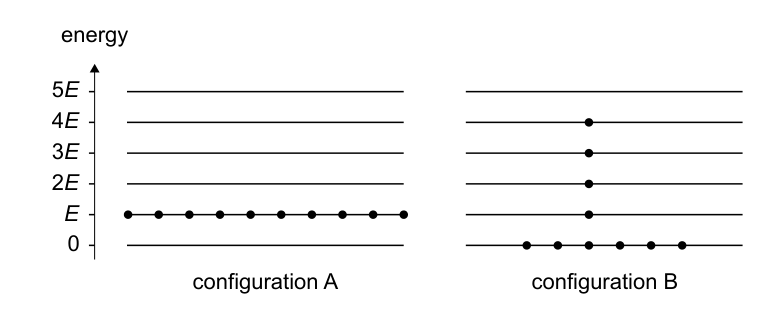
When the energy of any particle in the system changes, a new microstate of the system is formed.
(a) Outline which of the two configurations has a greater number of microstates. [2]
The system of ten particles is isolated. Two processes are considered for the overall evolution of the system.
Process 1: the system is initially in configuration A and evolves to configuration B
Process 2: the system is initially in configuration B and evolves to configuration A
(b) Explain why process 1 is more likely to occur. [3]