- An electron is accelerated from rest by an electric potential difference V. The electron reaches a speed of 9.4 × 10⁶ ms⁻¹.
(a) Calculate V. [2]
The electron now enters a region of a uniform electric field between two parallel charged plates. The electron is initially halfway between the plates and its initial velocity is parallel to the plates.
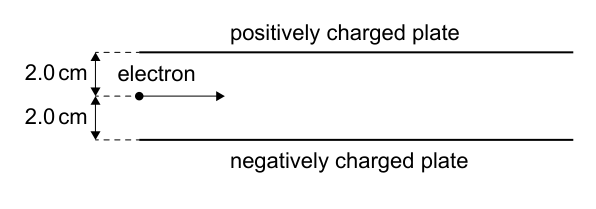
The following data are given:
Initial speed of the electron = 9.4 × 10⁶ ms⁻¹
Potential difference between the plates = 30 V
Distance between the plates = 4.0 cm
(b) (i) State the direction of the acceleration of the electron. [1]
(ii) Show that the magnitude of the acceleration of the electron is about 10¹⁴ ms⁻². [2]
(Question 6 continued)
(c) The electron collides with one of the plates. Determine the distance the electron travels parallel to the plates. [3]
In another experiment, a uniform magnetic field directed into the plane of the diagram is established between the charged plates. The initial velocity of the electron, the distance between the plates and their electric potential difference remain unchanged.
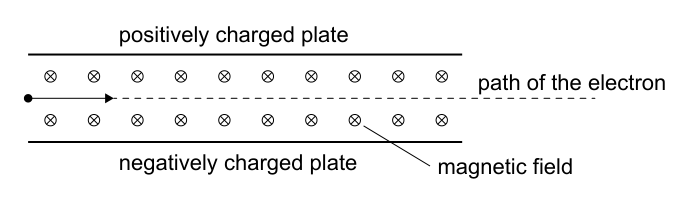
The electron passes undeflected through the region of the electric and magnetic fields.
(d) Calculate the magnetic field strength. [2]