- (a) State what is meant by the solar constant. [1]
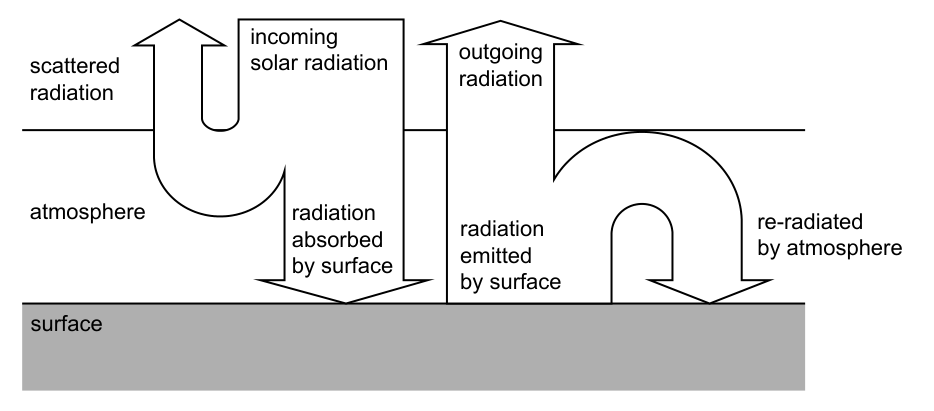
The diagram shows a simplified energy-balance model for the Earth surface–atmosphere system.
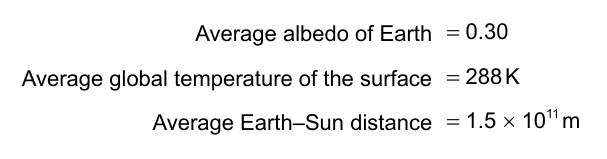
The following data are given:
(b) (i) Outline the physical mechanism by which some of the radiation emitted by the surface is absorbed by greenhouse gases in the atmosphere and re-radiated towards the surface. [2]
(Question 8 continued)
(ii) Show that the average global intensity of radiation absorbed by the surface is about 240 W m⁻². [2]
(iii) Determine the average intensity re-radiated by the atmosphere towards the surface. Assume that the emissivity of the surface is 0.90. [3]
(c) Show, with reference to the solar constant, that the total power radiated by the Sun is about 4 × 10²⁶ W. [2]
(d) The primary energy source of the Sun is the proton–proton (p–p) chain of fusion reactions. Four protons and two electrons produce a helium nucleus together with neutrinos and gamma photons. The overall reaction is:
4¹₁p + 2⁰₋₁e → ⁴₂He + 2⁰₀νₑ + 4γ
(i) The mass of the helium nucleus is 4.001506 u. Calculate, in MeV, the energy released in the reaction. [2]
(ii) Outline the role of fusion reactions in maintaining a stable radius of the Sun. [2]
(iii) Outline how the presence of helium in the Sun can be confirmed empirically. [2]
(Question 8 continued)
(e) The positions of the Sun and the star Antares are shown in the Hertzsprung-Russell (HR) diagram.
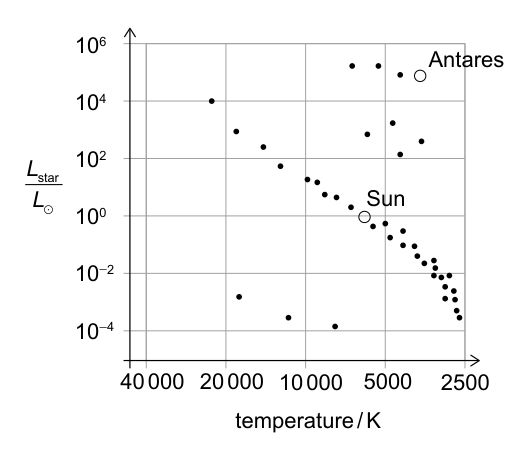
(i) State the star type of Antares. [1]
(ii) Discuss how nuclear fusion processes in Antares are different from those in the Sun. [3]