IB ESS IA Criteria Explained: What Examiners Look For
Understanding the Environmental Systems and Societies (ESS) Internal Assessment (IA) criteria is crucial for achieving a high score in this important IB component. This guide provides a detailed breakdown of each criterion, offering practical tips and insights to help you, whether you're a student, teacher, or parent, navigate the assessment process effectively. We'll delve into the specifics of the environmental systems and societies internal assessment criteria, exploring how to maximize your performance and achieve your desired grade. This guide also touches on how AI can assist in the IB environmental systems and societies grading process.
What is the Environmental Systems and Societies Internal Assessment?
The Environmental Systems and Societies Internal Assessment is a significant component of the IB ESS course, accounting for 25% of the final grade at SL and 20% at HL. It's an individual research project where students investigate an environmental issue or problem, applying the concepts and principles learned throughout the course. The IA allows students to demonstrate their understanding of ESS concepts, research skills, and ability to analyze and evaluate environmental issues. It's a chance to delve deeper into a topic that interests you and showcase your independent learning abilities.
Stuck on your IB draft?
Get instant, detailed feedback on structure, evidence, and reasoning, then compare it with your current school materials.
Understanding the Grading Criteria
The ESS IA is assessed against six criteria, each focusing on different aspects of the investigation. Each criterion has a specific mark range, and the total score contributes to the overall IA grade. Understanding these criteria is essential for planning, conducting, and writing up your investigation. The IB grading criteria are designed to be objective and consistent, ensuring fair assessment across all students. This guide will help you understand the environmental systems and societies assessment rubric in detail.
Detailed Breakdown of Environmental Systems and Societies Internal Assessment Criteria
Here's a detailed breakdown of each criterion, including what it assesses, the mark bands, and tips for success:
Criterion names, marks, and mark bands below follow the IB subject guide. The band descriptions are our own plain-English summaries, so check your subject guide for the exact wording.
Criterion A: Identifying the context (CXT) (6 marks)
What it assesses: How well you establish an environmental issue and connect it to a focused research question.
Mark bands:
- 0 marks: Nothing in the work reaches the lowest band.
- 1-2 marks: A research question is stated but lacks focus, an environmental issue is outlined, and connections between them are only listed with big gaps.
- 3-4 marks: A relevant research question and an environmental issue that gives context; connections are described with some gaps.
- 5-6 marks: A relevant, focused research question and a relevant environmental issue discussed as context; the connections are clearly explained.
What to check in your draft:
- The research question is relevant, coherent, and focused.
- A relevant environmental issue provides the context.
- The connections between the issue and the question are explained.
Criterion B: Planning (PLA) (6 marks)
What it assesses: How well your method, sampling strategy, risk assessment, and ethics let you collect enough relevant data.
Mark bands:
- 0 marks: Nothing in the work reaches the lowest band.
- 1-2 marks: The method does not suit data collection, the sampling strategy has errors, and only some risks and ethical points are listed.
- 3-4 marks: A repeatable method suits the question but will not collect enough data; the sampling strategy is described; risks and ethics are outlined.
- 5-6 marks: A repeatable method collects enough relevant data; the sampling strategy is justified; risks and ethics are described.
What to check in your draft:
- The method is repeatable and collects enough relevant data.
- The sampling strategy is justified.
- Risk assessment and ethical considerations are described.
Criterion C: Results, analysis and conclusion (RAC) (6 marks)
What it assesses: How well you present and analyse your data and reach a valid conclusion.
Mark bands:
- 0 marks: Nothing in the work reaches the lowest band.
- 1-2 marks: Diagrams or charts have significant errors, analysis has major gaps, and the conclusion is unsupported.
- 3-4 marks: Suitable diagrams with some gaps, correct but incomplete analysis, and a partly valid conclusion drawn from some trends.
- 5-6 marks: All relevant diagrams done well, complete analysis showing the patterns, and a valid conclusion drawn from the trends.
What to check in your draft:
- All relevant diagrams and charts are constructed correctly.
- Analysis is complete and shows the patterns in the data.
- The conclusion is valid and based on the trends.
Criterion D: Discussion and evaluation (DEV) (6 marks)
What it assesses: How well you discuss the conclusion in its wider context and evaluate the method.
Mark bands:
- 0 marks: Nothing in the work reaches the lowest band.
- 1-2 marks: Some links between the conclusion and the issue are described, some method strengths or weaknesses are named, and modifications are superficial.
- 3-4 marks: The conclusion is evaluated in context with gaps, some strengths and weaknesses are described, and modifications and further research are suggested.
- 5-6 marks: The conclusion is evaluated in context, method strengths and weaknesses are discussed, and modifications target the significant weaknesses.
What to check in your draft:
- The conclusion is evaluated in the context of the environmental issue.
- Strengths and weaknesses of the method are discussed.
- Modifications address the most significant weaknesses.
Criterion E: Applications (APP) (3 marks)
What it assesses: How well you justify and evaluate one application or solution based on your findings.
Mark bands:
- 0 marks: Nothing in the work reaches the lowest band.
- 1 mark: One possible application or solution is stated, with some strengths or weaknesses described.
- 2 marks: One application is described with weak justification, and some strengths and weaknesses are evaluated.
- 3 marks: One application is justified from the findings, and its relevant strengths and weaknesses are evaluated.
What to check in your draft:
- One application or solution follows from your results.
- It is justified using your findings.
- Its strengths and weaknesses are evaluated.
Criterion F: Communication (COM) (3 marks)
What it assesses: How clearly the report's structure, terminology, and logic communicate the investigation.
Mark bands:
- 0 marks: Nothing in the work reaches the lowest band.
- 1 mark: Limited structure, terminology, and clarity make the report hard to understand.
- 2 marks: The structure is not sustained, terminology or concision is good but not both, and parts are hard to follow.
- 3 marks: Well structured, with consistent terminology, concise writing, and logical, coherent reasoning.
What to check in your draft:
- The report is well structured and organized.
- Terminology is appropriate and the writing is concise.
- The reasoning is logical and coherent.
How to Excel in Your Environmental Systems and Societies Internal Assessment
- Start early: Don't wait until the last minute to start your IA. Give yourself plenty of time to plan, conduct, and write up your investigation.
- Choose a topic that interests you: Selecting a topic that genuinely interests you will make the IA process more engaging and enjoyable.
- Plan your investigation carefully: Develop a detailed plan for your investigation, including your research question, method, data collection process, and data analysis techniques.
- Seek feedback from your teacher: Regularly seek feedback from your teacher throughout the IA process to ensure that you are on the right track.
- Follow the IB guidelines: Carefully review the IB guidelines for the ESS IA and ensure that your investigation meets all the requirements.
Check your own draft
Get estimated marks by criterion, comments on your writing, and a clear list of what to fix first.
Common Mistakes to Avoid
- Choosing an overly broad research question.
- Failing to provide sufficient background information.
- Using a method that is not replicable.
- Presenting data without proper labels or units.
- Drawing conclusions that are not supported by the data.
- Ignoring methodological limitations.
- Plagiarism.
The Role of AI in Modern Assessment
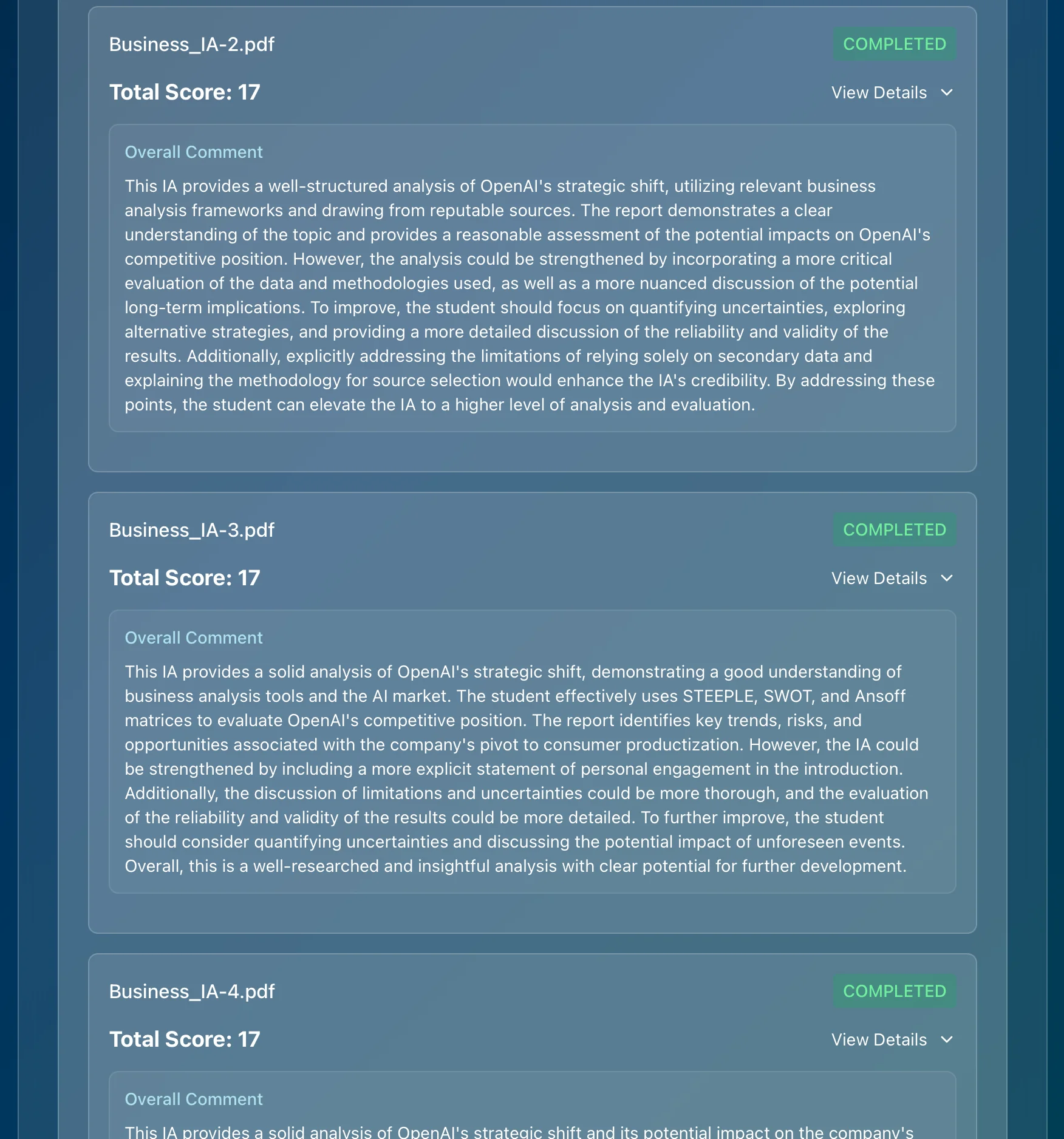
Modern technology is changing how we approach academic assessment. AI grading assistants can now help teachers maintain consistency and rubric alignment in their evaluations while saving valuable time. These tools use the same official IB criteria to provide detailed feedback and scoring, ensuring that assessments meet the high standards expected in IB programs. AI can also help students identify potential weaknesses in their work before submission.
For educators looking to simplify their internal assessment marking process while maintaining the quality and consistency that IB assessments demand, AI grading assistance can complement traditional teaching methods by organizing feedback around the relevant IB standards and assessment guidelines.
Conclusion
Mastering the Environmental Systems and Societies Internal Assessment requires a thorough understanding of the grading criteria, careful planning, and diligent execution. By following the tips and advice outlined in this guide, you can significantly improve your chances of achieving a high score. Remember to start early, seek feedback from your teacher, and follow the IB guidelines. Understanding the environmental systems and societies IA requirements is key to success.
Looking for more support with IB draft grading? Discover how AI grading assistants can help maintain consistency and rubric alignment in your evaluations while saving valuable time. Learn more about modern grading solutions designed specifically for IB educators.