IB Global Politics IA Criteria Explained: What Examiners Look For
Struggling to understand the IB Global Politics Internal Assessment (IA) grading criteria? You're not alone! This practical guide breaks down each criterion, providing clear explanations, practical tips, and useful advice to help you excel in your IA and achieve a top score. We'll also explore how AI grading assistants can support rubric-based review.
What is the Global Politics Internal Assessment?
The Global Politics Internal Assessment is a crucial component of the IB Diploma Programme, allowing students to delve into a political issue of their choice and demonstrate their understanding of key concepts and theories. It involves research, analysis, engagement with the issue, and reflection on the entire process. The IA is internally assessed by your teacher and externally moderated by the IB, making it essential to understand the IB global politics grading scheme thoroughly.
Stuck on your IB draft?
Get instant, detailed feedback on structure, evidence, and reasoning, then compare it with your current school materials.
Understanding the Grading Criteria
The Global Politics IA is assessed based on several criteria, each focusing on different aspects of your work. Understanding these criteria is paramount to structuring your IA effectively and maximizing your score. The criteria are designed to assess your understanding of the political issue, your research process, your analytical skills, your ability to evaluate and reflect, your communication skills, and, for HL students, your ability to formulate a practical recommendation.
Detailed Breakdown of Global Politics Internal Assessment Criteria
Let's dive into each criterion from the rubric, providing a detailed breakdown and practical advice for success.
Criterion names, marks, and mark bands below follow the IB subject guide. The band descriptions are our own plain-English summaries, so check your subject guide for the exact wording.
Criterion A: Explanation and justification (4 marks)
What it assesses: How clearly you explain the political issue and justify your engagement activities.
Mark bands:
- 0 marks: Nothing in the work reaches the lowest band.
- 1-2 marks: The issue is identified but not clearly explained, the project's importance is barely explained, and the activities are described without justification.
- 3-4 marks: The issue is clearly explained, the importance and suitability of the project are clear, and the activities are explained and justified.
Tips for success:
- Choose wisely: Select a political issue that genuinely interests you and has sufficient depth for analysis.
- Context is key: Provide a clear and concise explanation of the issue, its historical background, and its current relevance.
- Justify your choice: Explain why this issue is significant in the broader context of global politics.
- Connect to theory: Link your chosen issue to relevant global politics theories and concepts.
- Engagement matters: Clearly describe your engagement activities and justify why they are relevant to understanding the issue.
- Common mistakes to avoid: Vague descriptions, lack of justification, and choosing an overly broad or simplistic issue.
Criterion B: Process (3 marks)
What it assesses: How well planned and integrated your research and engagement process is.
Mark bands:
- 0 marks: Nothing in the work reaches the lowest band.
- 1 mark: The research and engagement process is limited.
- 2 marks: The research and engagement process is adequate.
- 3 marks: The process is well planned, with research and engagement integrated.
Tips for success:
- Plan ahead: Create a detailed research plan outlining your objectives, methods, and timeline.
- Document everything: Keep a record of your research process, including sources consulted, interviews conducted, and observations made.
- Show engagement: Demonstrate active engagement with the issue through interviews, surveys, or participation in relevant events.
- Logical progression: Ensure your research process follows a logical progression, building upon previous findings.
- Common mistakes to avoid: Lack of planning, inadequate documentation, and superficial engagement with the issue.
Criterion C: Analysis and synthesis (8 marks)
What it assesses: How well you analyse the issue in the context of your engagement and synthesize different stakeholder and source perspectives.
Mark bands:
- 0 marks: Nothing in the work reaches the lowest band.
- 1-2 marks: Mostly descriptive, with vague reference to course concepts, no analysis of the issue, and no synthesis of perspectives.
- 3-4 marks: Limited analysis, limited understanding of course concepts, and limited synthesis of stakeholder and source perspectives.
- 5-6 marks: Adequate analysis with adequate use of course concepts; perspectives are partly synthesized.
- 7-8 marks: Effective analysis using course concepts well, and an effective synthesis of stakeholder and source perspectives.
Tips for success:
- Go beyond description: Move beyond simply describing the issue and delve into its underlying causes, consequences, and implications.
- Apply course content: Demonstrate your understanding of relevant global politics theories and concepts by applying them to your analysis.
- Consider multiple perspectives: Explore different viewpoints on the issue, including those of stakeholders, experts, and affected individuals.
- Synthesize information: Integrate information from various sources to create a coherent and comprehensive analysis.
- Critical thinking: Evaluate the strengths and weaknesses of different arguments and perspectives.
- Common mistakes to avoid: Superficial analysis, lack of critical thinking, and ignoring alternative perspectives.
Criterion D: Evaluation and reflection (6 marks)
What it assesses: How critically you evaluate your research and engagement, and reflect on your own positions and learning.
Mark bands:
- 0 marks: Nothing in the work reaches the lowest band.
- 1-2 marks: Research and engagement are not evaluated, personal biases are not identified, and reflection on learning is limited.
- 3-4 marks: Activities are partly evaluated, some biases are identified, and reflection on learning is adequate.
- 5-6 marks: Activities are critically evaluated, personal positions and biases are explained, and reflection on learning is in depth.
Tips for success:
- Be honest: Acknowledge your own biases and assumptions.
- Evaluate your process: Assess the strengths and weaknesses of your research and engagement activities.
- Reflect on your learning: Explain how the IA has enhanced your understanding of the political issue and global politics in general.
- Critical thinking: Analyze the effectiveness and impact of your research and engagement process.
- Common mistakes to avoid: Superficial reflection, lack of self-awareness, and failing to evaluate the effectiveness of your activities.
Criterion E: Communication (3 marks)
What it assesses: How clearly the report is organized and communicated.
Mark bands:
- 0 marks: Nothing in the work reaches the lowest band.
- 1 mark: Organization and clarity are limited and do not support understanding.
- 2 marks: The report is organized well enough to help the reader follow it.
- 3 marks: The report is well organized and coherent.
Tips for success:
- Clear and concise: Use clear and concise language, avoiding jargon and overly complex sentence structures.
- Well-organized: Structure your report logically, with clear headings and subheadings.
- Coherent arguments: Present your arguments in a coherent and persuasive manner, supporting them with evidence.
- Proofread carefully: Check for grammatical errors and typos.
- Common mistakes to avoid: Poor organization, unclear language, and grammatical errors.
Criterion F: Recommendation (HL only) (6 marks)
What it assesses: How well supported and context-appropriate your recommendation is, and how well you explain its implications or challenges.
Mark bands:
- 0 marks: Nothing in the work reaches the lowest band.
- 1-2 marks: A limited, partly supported recommendation with little evidence; implications or challenges are not identified.
- 3-4 marks: An adequate recommendation supported by relevant evidence; implications or challenges are identified.
- 5-6 marks: An effective recommendation well supported by specific evidence and suited to the context; implications or challenges are explained.
Tips for success:
- Relevant recommendation: Ensure your recommendation directly addresses the political issue you have analyzed.
- Practical and feasible: Offer a recommendation that is practical and feasible to implement.
- Consider implications: Analyze the potential implications of your recommendation, both positive and negative.
- Address challenges: Identify and address potential challenges to implementing your recommendation.
- Common mistakes to avoid: Impractical recommendations, ignoring potential implications, and failing to address challenges.
Good to know:
- HL students add a separate recommendation section of up to 400 words, assessed under criterion F.
How to Excel in Your Global Politics Internal Assessment
- Start early: Don't wait until the last minute to begin working on your IA.
- Choose wisely: Select a political issue that genuinely interests you and has sufficient depth for analysis.
- Plan meticulously: Create a detailed research plan outlining your objectives, methods, and timeline.
- Engage actively: Demonstrate active engagement with the issue through interviews, surveys, or participation in relevant events.
- Analyze critically: Go beyond description and delve into the underlying causes, consequences, and implications of the issue.
- Reflect honestly: Acknowledge your own biases and assumptions and evaluate the effectiveness of your activities.
- Communicate clearly: Use clear and concise language, and structure your report logically.
- Seek feedback: Ask your teacher or peers to review your work and provide feedback.
Check your own draft
Get estimated marks by criterion, comments on your writing, and a clear list of what to fix first.
Common Mistakes to Avoid
- Choosing an overly broad or simplistic issue.
- Failing to justify the importance of the issue.
- Lack of planning and documentation.
- Superficial analysis and critical thinking.
- Ignoring alternative perspectives.
- Lack of self-awareness and reflection.
- Poor organization and communication.
- Impractical or irrelevant recommendations (HL only).
The Role of AI in Modern Assessment
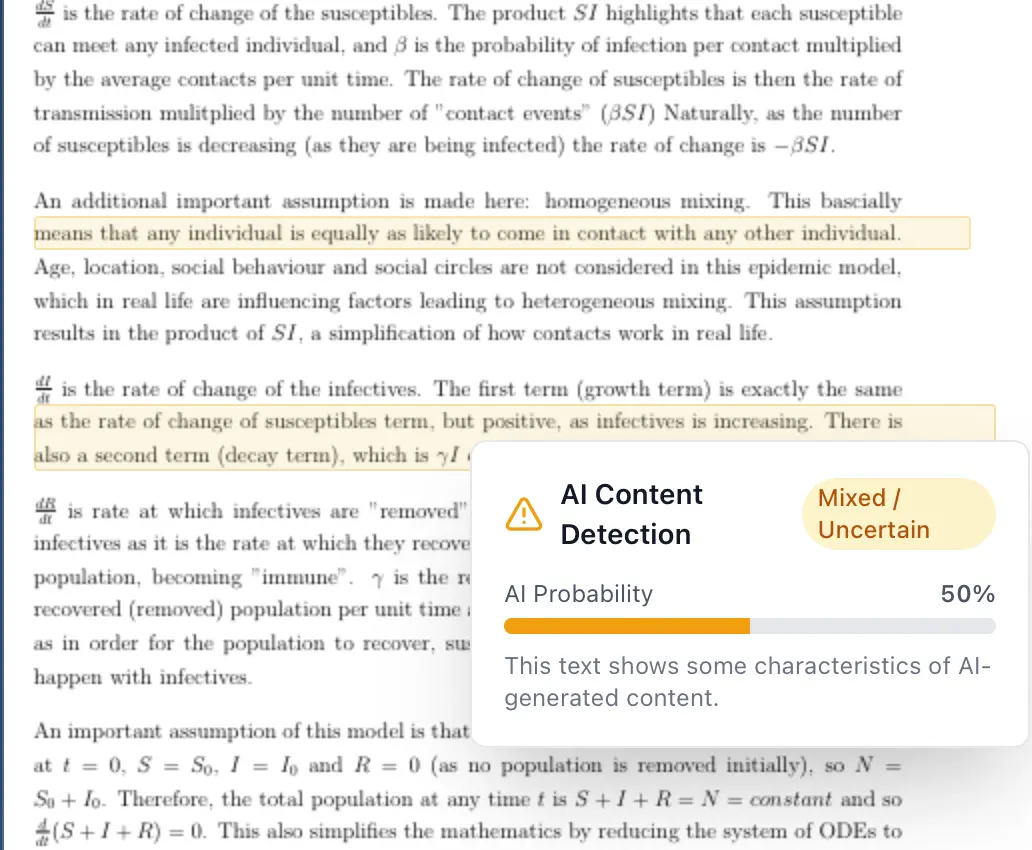
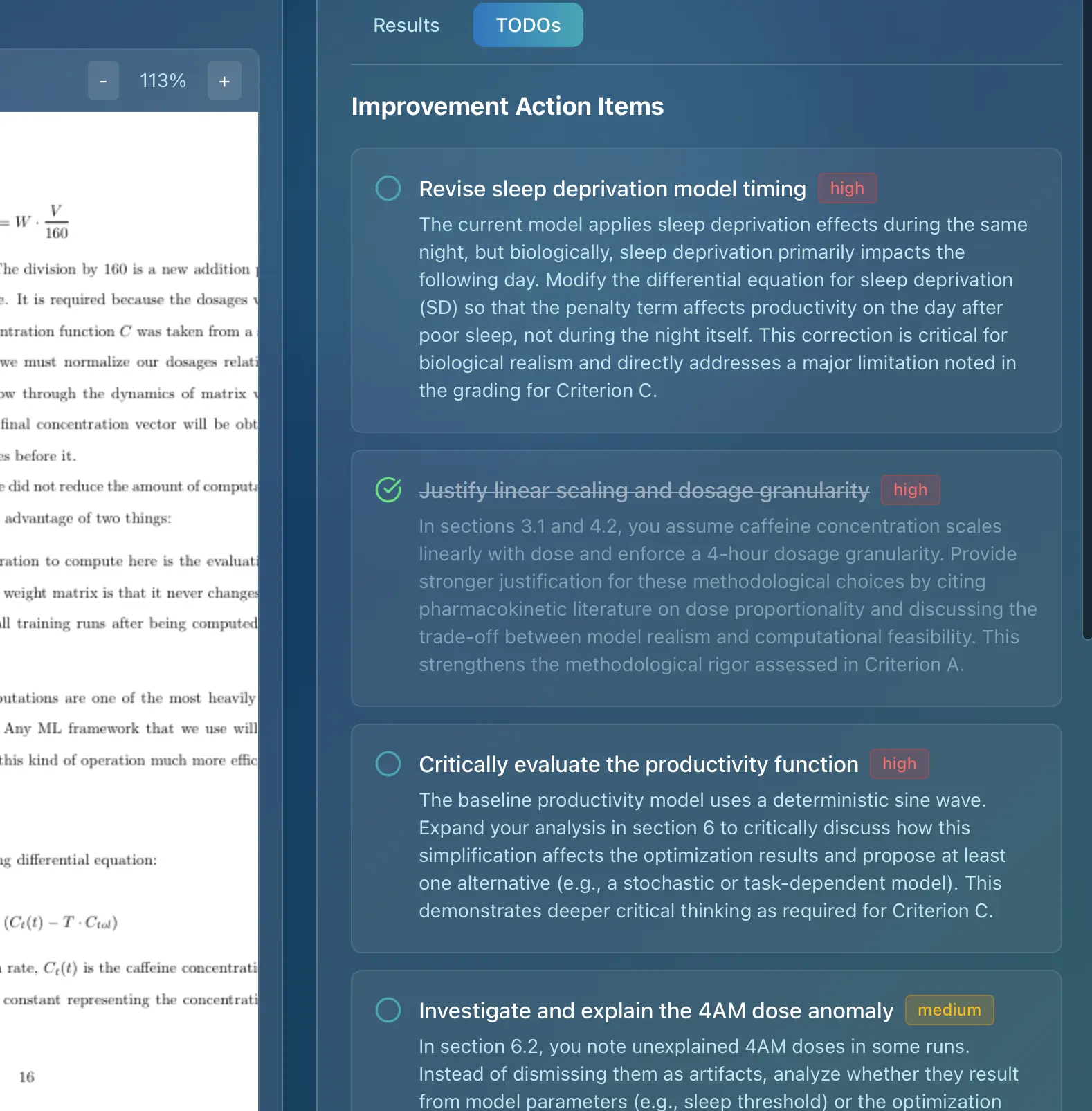
Modern technology is changing how we approach academic assessment. AI grading assistants can now help teachers maintain consistency and rubric alignment in their evaluations while saving valuable time. These tools use the same official IB criteria to provide detailed feedback and scoring, ensuring that assessments meet the high standards expected in IB programs.
For educators looking to simplify their grading process while maintaining the quality and consistency that IB assessments demand, AI grading assistance offers a powerful solution that complements traditional teaching methods.
Conclusion
Mastering the Global Politics IA requires a thorough understanding of the grading criteria, careful planning, critical analysis, and honest reflection. By following the tips and advice outlined in this guide, you can significantly improve your chances of achieving a top score. Remember to start early, choose wisely, and engage actively with the issue. Good luck!
Looking for more support with IB draft grading? Discover how AI grading assistants can help maintain consistency and rubric alignment in your evaluations while saving valuable time. Learn more about modern grading solutions designed specifically for IB educators.