IB History IA Criteria Explained: What Examiners Look For
The IB History Internal Assessment (IA) is a crucial component of the IB History course, representing 20% of the final grade at SL and 25% at HL. Understanding the history internal assessment criteria is essential for both students aiming for top marks and teachers striving to provide effective guidance. This guide provides a detailed breakdown of each criterion, offering practical tips and examples to help you navigate the IA process successfully.
What is the History Internal Assessment?
The History Internal Assessment is an independent research project where students delve into a historical topic of their choice. It allows students to demonstrate their research, analytical, and writing skills by formulating a research question), gathering and evaluating sources, and presenting a well-supported argument. The IA provides an opportunity for students to explore their historical interests in depth and develop valuable research skills applicable to future academic endeavors.
Stuck on your IB draft?
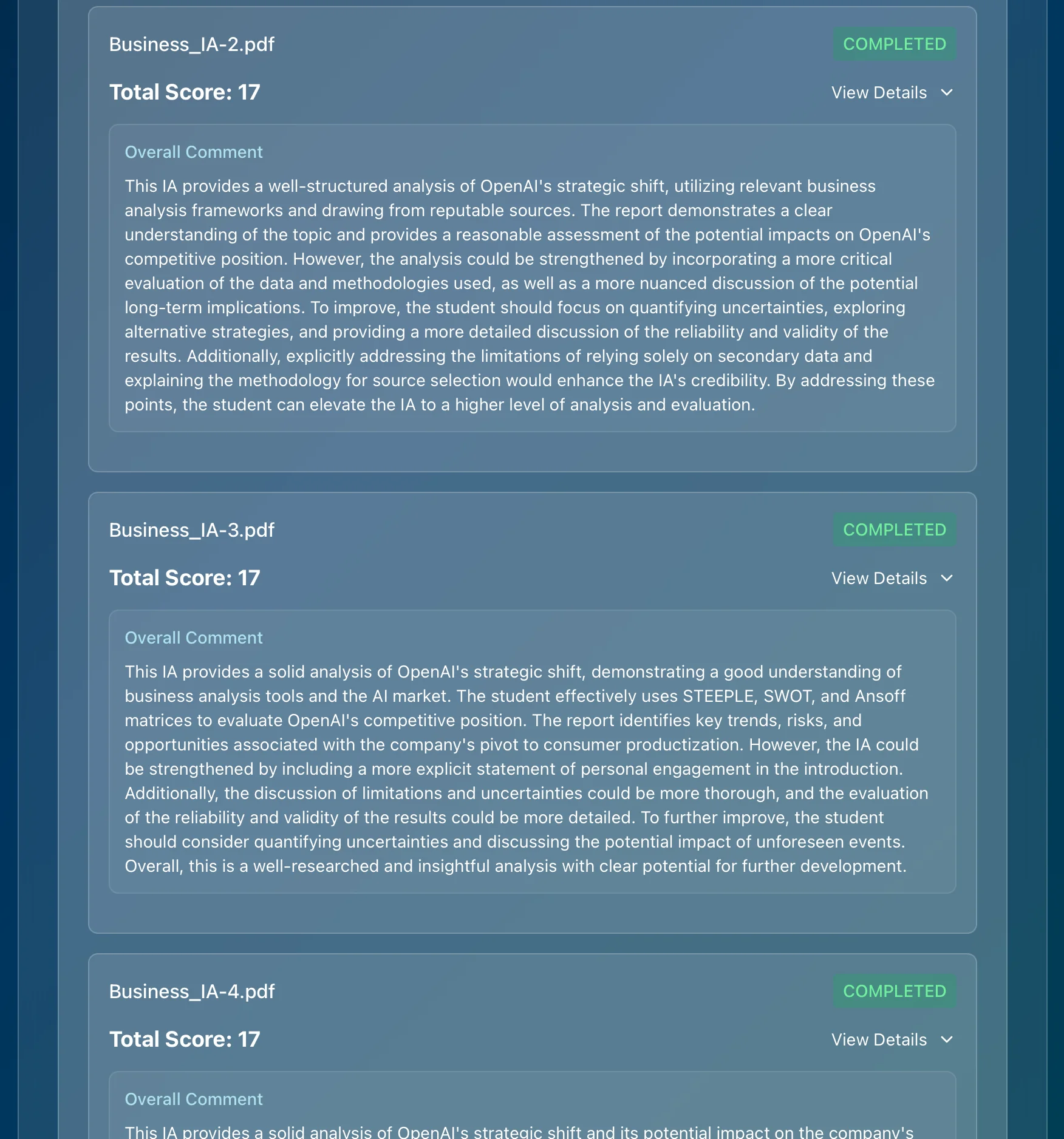
Get instant, detailed feedback on structure, evidence, and reasoning, then compare it with your current school materials.
Understanding the Grading Criteria
The History IA is assessed against three criteria: Identification and Evaluation of Sources (Criterion A), Investigation (Criterion B), and Reflection (Criterion C). Each criterion focuses on specific skills and aspects of the research process, and the marks awarded for each contribute to the overall IA grade. Understanding the nuances of each criterion is paramount to achieving success.
Detailed Breakdown of History Internal Assessment Criteria
Criterion names, marks, and mark bands below follow the IB subject guide. The band descriptions are our own plain-English summaries, so check your subject guide for the exact wording.
Criterion A: Identification and evaluation of sources (6 marks)
What it assesses: How clearly you state your question, explain why your sources are relevant, and evaluate two of them.
Mark bands:
- 0 marks: Nothing in the work reaches the lowest band.
- 1-2 marks: The question is stated and suitable sources are selected, but their relevance is barely explained and two sources are described rather than analysed.
- 3-4 marks: A suitable question is stated, source relevance is partly explained, and two sources are analysed and evaluated with limited discussion of value and limitations.
- 5-6 marks: A suitable question is clearly stated, source relevance is clearly explained, and two sources are analysed in detail, discussing value and limitations with reference to origin, purpose, and content.
Tips for success:
- Choose a focused question: Avoid overly broad questions that are difficult to address within the word limit.
- Select relevant sources: Ensure your sources directly relate to your research question and provide diverse perspectives.
- Analyze, don't just describe: Go beyond simply summarizing the source. Evaluate its origin, purpose, and content to determine its value and limitations in answering your research question. Consider the author's bias, intended audience, and historical context.
- Use the OPVL framework: Origin, Purpose, Value, Limitations. This provides a structured approach to source evaluation.
Common mistakes to avoid:
- Choosing sources that are too general or irrelevant.
- Failing to identify the origin, purpose, value, and limitations of the sources.
- Providing a superficial or descriptive analysis instead of a critical evaluation.
- Not connecting the source analysis back to the research question.
Criterion B: Investigation (15 marks)
What it assesses: How clearly organized and critically analytical the investigation is, and how well evidence and perspectives support a reasoned conclusion.
Mark bands:
- 0 marks: Nothing in the work reaches the lowest band.
- 1-3 marks: Unclear and poorly organized, with little focus and little or no critical analysis; mostly generalizations; evidence is mentioned but not analysed.
- 4-6 marks: Partly organized but unclear; mainly narrative with limited critical analysis; evidence is included but not integrated.
- 7-9 marks: Generally clear and organized; some analysis that is not sustained; some attempt to integrate evidence; perspectives noted but not evaluated.
- 10-12 marks: Generally clear and organized; critical analysis that may lack development; evidence from a range of sources supports the argument; some evaluation of perspectives; a reasoned conclusion.
- 13-15 marks: Clear, coherent, and well organized; well-developed critical analysis focused on the question; effective use of evidence; perspectives evaluated; a reasoned conclusion consistent with the evidence.
Tips for success:
- Develop a clear thesis statement: Your thesis should directly answer your research question and provide a roadmap for your investigation.
- Organize your essay logically: Use a clear structure with an introduction, body paragraphs, and a conclusion. Each paragraph should focus on a specific aspect of your argument.
- Use a variety of sources: Incorporate primary and secondary sources to provide a comprehensive and nuanced perspective.
- Analyze and synthesize evidence: Don't just present information; analyze its significance and connect it to your argument. Synthesize information from different sources to create a coherent narrative.
- Consider different perspectives: Acknowledge and address alternative viewpoints to demonstrate a balanced and critical understanding of the topic.
- Cite your sources accurately: Use a consistent citation style (e.g., MLA, Chicago) to avoid plagiarism and give credit to your sources.
Common mistakes to avoid:
- Lacking a clear thesis statement.
- Presenting information without analysis.
- Failing to consider different perspectives.
- Relying too heavily on one source.
- Plagiarizing material.
- Poor organization and lack of coherence.
Criterion C: Reflection (4 marks)
What it assesses: How well you reflect on what the investigation showed you about historians' methods and their challenges.
Mark bands:
- 0 marks: Nothing in the work reaches the lowest band.
- 1-2 marks: Some discussion of what you learned about historians' methods, little awareness of their challenges or limits, and only an implied link to the investigation.
- 3-4 marks: A clear focus on historians' methods, clear awareness of their challenges or limits, and an explicit link to the investigation.
Tips for success:
- Connect your reflections to your own experience: Discuss specific challenges you faced during the research process and how you overcame them.
- Consider the limitations of your sources: Reflect on the biases, perspectives, and gaps in your sources and how they might have affected your interpretation of the past.
- Discuss the challenges of historical interpretation: Acknowledge that history is not a fixed narrative but is subject to interpretation and debate.
- Reflect on the broader implications of your research: Consider how your findings contribute to our understanding of the past and its relevance to the present.
- Integrate reflection throughout the IA: Don't just add a separate "reflection" section. Weave your reflections into the introduction, body paragraphs, and conclusion.
Common mistakes to avoid:
- Providing a generic or superficial reflection.
- Failing to connect the reflection to your own experience.
- Ignoring the limitations of your sources.
- Treating history as a fixed and objective narrative.
- Leaving the reflection until the last minute.
How to Excel in Your History Internal Assessment
- Start early: Don't wait until the last minute to begin your research.
- Choose a topic you are genuinely interested in: This will make the research process more engaging and rewarding.
- Develop a clear research question: A well-defined question will guide your research and ensure that your investigation remains focused.
- Seek feedback from your teacher: Regularly discuss your progress with your teacher and ask for guidance on your research, analysis, and writing.
- Proofread carefully: Errors in grammar and spelling can detract from the overall quality of your IA.
Check your own draft
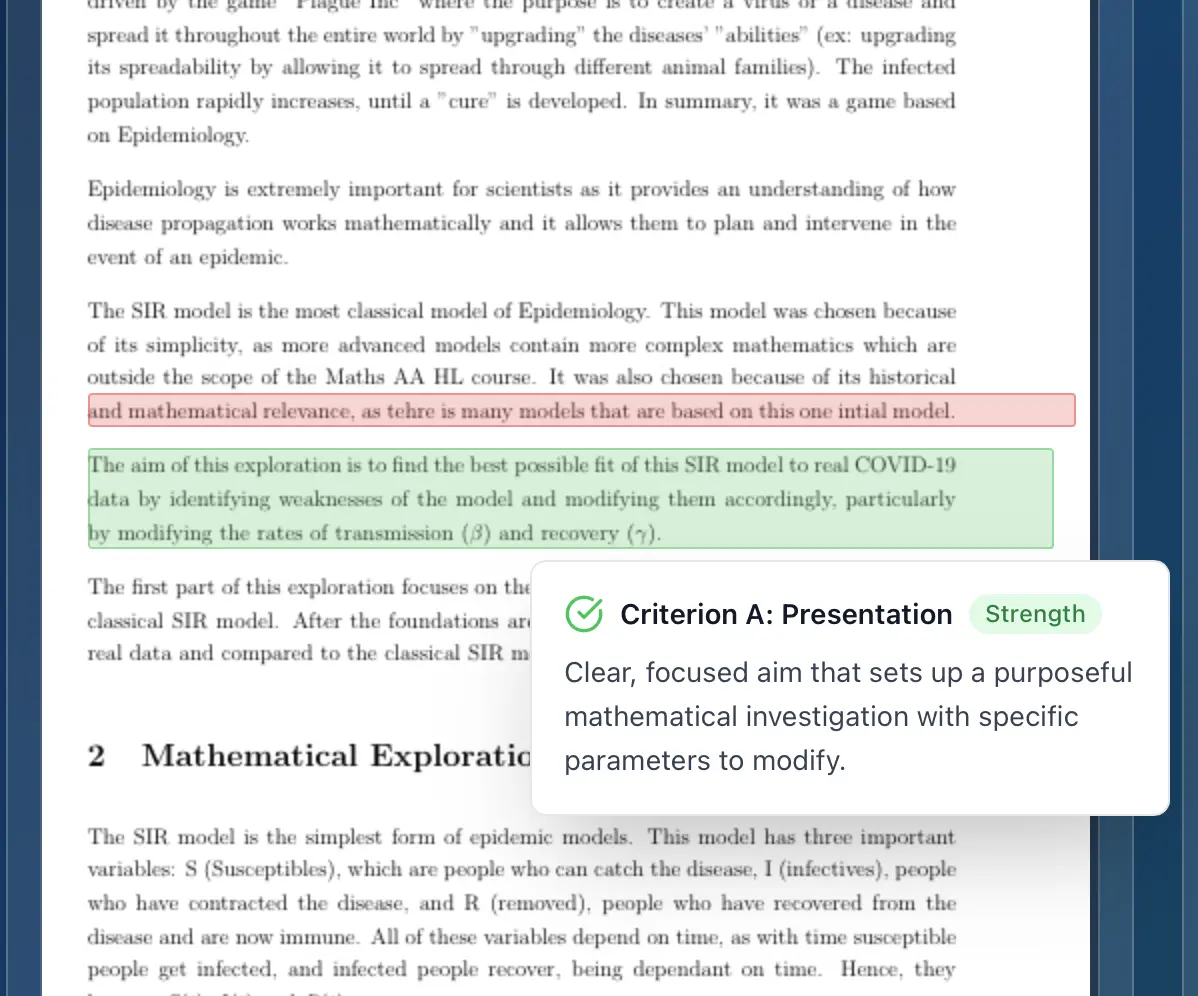
Get estimated marks by criterion, comments on your writing, and a clear list of what to fix first.
Common Mistakes to Avoid
- Plagiarism: Always cite your sources properly to avoid plagiarism.
- Lack of focus: Ensure that your investigation remains focused on your research question.
- Superficial analysis: Go beyond simply summarizing information; analyze its significance and connect it to your argument.
- Poor organization: Use a clear and logical structure to present your ideas effectively.
- Ignoring different perspectives: Acknowledge and address alternative viewpoints to demonstrate a balanced understanding of the topic.
The Role of AI in Modern Assessment
Modern technology is changing how we approach academic assessment. AI grading assistants can now help teachers maintain consistency and rubric alignment in their evaluations while saving valuable time. These tools use the same official IB criteria to provide detailed feedback and scoring, ensuring that assessments meet the high standards expected in IB programs.
For educators looking to simplify their grading process while maintaining the quality and consistency that IB assessments demand, AI grading assistance offers a powerful solution that complements traditional teaching methods.
Conclusion
Mastering the IB History Internal Assessment criteria is crucial for achieving success in the IB History course. By understanding the requirements of each criterion, following the tips provided, and avoiding common mistakes, you can produce a high-quality IA that demonstrates your research, analytical, and writing skills. Remember to start early, seek feedback from your teacher, and choose a topic you are genuinely interested in.
Looking for more support with IB draft grading? Discover how AI grading assistants can help maintain consistency and rubric alignment in your evaluations while saving valuable time. Learn more about modern grading solutions designed specifically for IB educators.