IB Interdisciplinary EE: Mathematics and Psychology (2027 Guide)
For Extended Essays first assessed in May 2027, you can use the interdisciplinary pathway to combine Mathematics and Psychology. The goal is not to write one mathematics section and one psychology section, or to force an exact 50/50 split. The two subjects must work together to answer a question that neither could answer as effectively on its own.
A topic such as human reasoning and Bayes' theorem can suit this pathway. Mathematics can establish what a Bayesian model predicts; psychology can explain and evaluate how people actually reason under uncertainty. The essay becomes interdisciplinary when those two lenses interact throughout the argument.
What Changed for the 2027 Extended Essay?
The revised Extended Essay has two clearly defined routes: subject-focused and interdisciplinary. The former World Studies option has been absorbed into the broader interdisciplinary pathway. The official IB Extended Essay update confirms that the new course was launched in 2025 and is first assessed in May 2027.
Under the interdisciplinary pathway, you select two DP subjects and integrate their knowledge, concepts, theories, perspectives, or methods. The official 2027 Extended Essay guide says that successful integration should create a new or deeper understanding that would not be possible through one subject alone.
The assessment model also changed:
| Criterion | Marks |
|---|---|
| A: Framework for the essay | 6 |
| B: Knowledge and understanding | 6 |
| C: Analysis and line of argument | 6 |
| D: Discussion and evaluation | 8 |
| E: Reflection | 4 |
Do not use an older criteria guide without checking its assessment year. In the previous rubric, Criterion D meant presentation; from May 2027, it means discussion and evaluation.
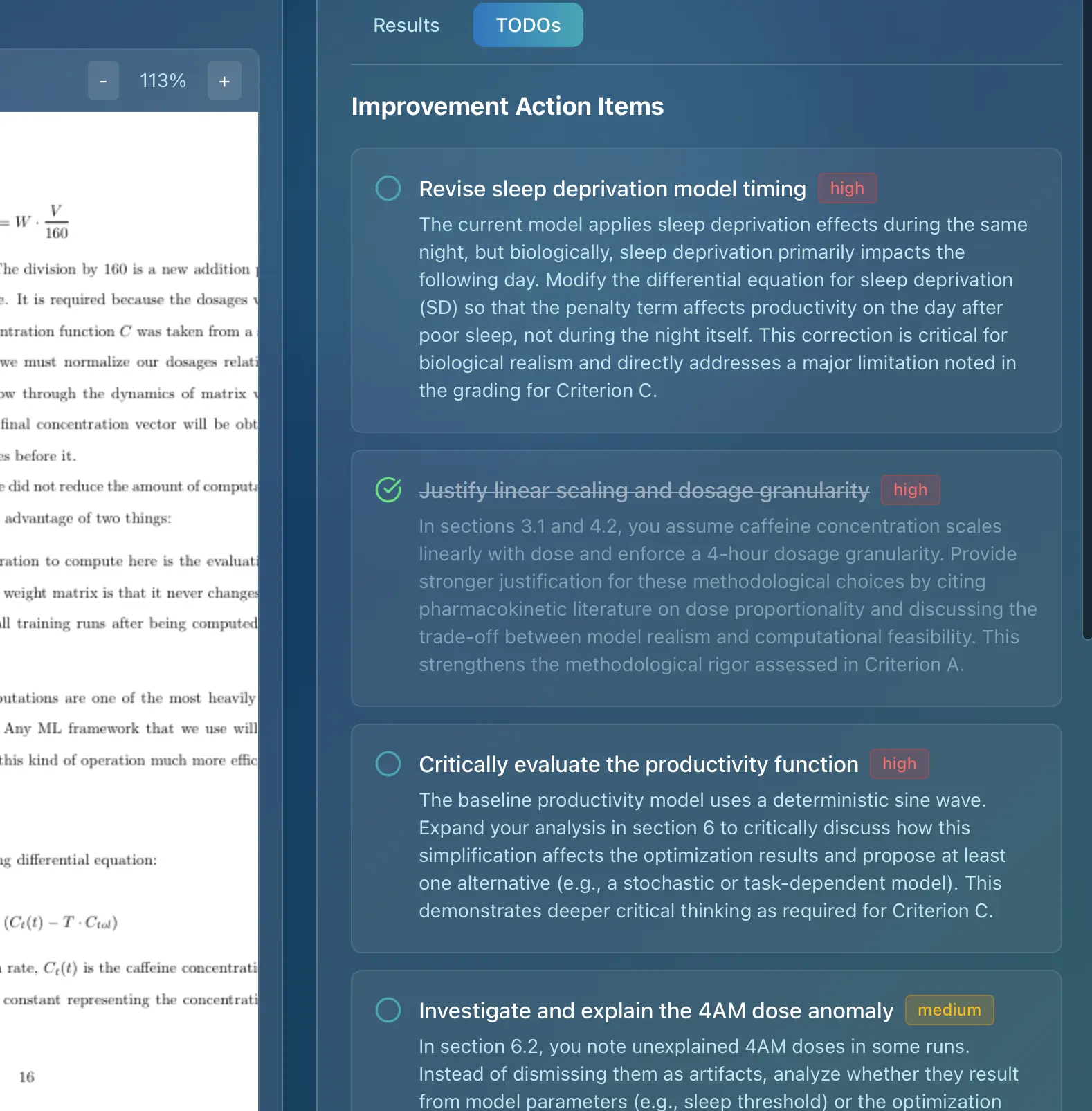
Stuck on your IB draft?
Get instant, detailed feedback on structure, evidence, and reasoning, then compare it with your current school materials.
Does the Essay Need to Be 50% Mathematics and 50% Psychology?
No. The official guide explicitly states that the two subjects do not need to be evenly balanced. Their relative weight depends on the topic and research question.
This does not mean that one subject can be decorative. If removing Psychology leaves the mathematical answer unchanged, the psychology lens is not doing enough. If removing Mathematics leaves a conventional literature review about decision-making, the mathematical lens is not doing enough.
A better test is:
What becomes possible because these two subjects are being used together?
For a Bayes-and-reasoning essay, the mathematical work might define a normative model, calculate posterior probabilities, or compare model predictions. The psychological work might use theories of heuristics, biases, dual-process reasoning, or empirical findings to explain departures from that model. Integration occurs when the essay uses the gap between model and behaviour to develop and evaluate its answer.
Build a Research Question That Requires Both Subjects
A strong interdisciplinary question names a focused phenomenon and gives both subjects a necessary job. General advice on narrowing an Extended Essay research question still applies, but you also need to test whether the question truly requires integration.
Consider three versions of the same idea:
Too broad:
Why are humans irrational?
This is too large for 4,000 words, uses an undefined judgment, and does not identify a workable body of evidence.
Two subjects mentioned but not integrated:
What is Bayes' theorem, and what are cognitive biases?
This invites two descriptive mini-essays. It does not establish a relationship that can drive an argument.
More workable:
To what extent can base-rate neglect in selected medical-diagnosis problems be explained by differences between Bayesian probability and heuristic reasoning?
This version is not a ready-made question to copy. It shows the useful features of an interdisciplinary question: a defined psychological phenomenon, a mathematical benchmark, a bounded context, and an evaluative command.
Before committing, ask:
- Can I explain and apply the mathematics rather than merely quote a formula?
- Is there a suitable body of psychological research addressing the same kind of reasoning task?
- Will the comparison help answer the question, rather than simply place two accounts beside each other?
- Can I handle the question with enough depth in 4,000 words?
- Does it avoid duplicating work from my Mathematics or Psychology IA?
If the answer to any of these is no, narrow or redesign the question before collecting large amounts of material. A title can change as research develops; Marksy's IB essay title checker can help you test scope and clarity, but your supervisor should approve the final direction.
Decide What Each Subject Contributes
Plan contributions, not page quotas.
Mathematics may contribute
- conditional probability and Bayes' theorem;
- prior, likelihood, and posterior probability;
- worked calculations for the chosen task;
- comparison between normative predictions and observed responses;
- a model's assumptions, sensitivity, and limitations;
- suitable tables, graphs, or simulations.
The mathematics must be explained at a level you understand. A successful Mathematics Extended Essay does mathematics rather than describing mathematics, and the interdisciplinary route does not remove that expectation.
Psychology may contribute
- a precise operational definition of the behaviour being studied;
- relevant cognitive theories or models;
- peer-reviewed empirical studies;
- evaluation of samples, tasks, validity, and alternative explanations;
- analysis of when and why human judgments differ from a normative model.
Psychology is not a collection of common-sense claims about how people think. Use the same source discipline and critical evaluation expected in a strong Psychology Extended Essay.
Integration may look like
- applying the Bayesian calculation to the exact task used in a psychological study;
- comparing the model's posterior probability with participants' judgments;
- using psychological theory to explain the direction or size of the difference;
- testing whether a change in information format improves Bayesian reasoning;
- evaluating whether the mathematical model is a fair benchmark for the specific task;
- synthesizing both lenses into a qualified answer.
These moves belong in the main analysis, not only in the introduction and conclusion.
A Structure That Keeps the Subjects Integrated
There is no compulsory chapter template, but the following structure prevents the essay from becoming two disconnected halves.
1. Introduction and framework
State the research question, explain why the interdisciplinary pathway is appropriate, define the scope, and identify the mathematical and psychological methods you will use.
2. Shared conceptual foundation
Define only the concepts needed for the argument. For example, explain the relevant probability model and the psychological construct being investigated. Make their relationship clear from the start.
3. First analytical case or evidence set
Present the task or study, work through the relevant mathematics, compare the result with the behavioural evidence, and discuss what the comparison means.
4. Second analytical case or competing explanation
Test whether the first finding holds in another context, information format, or study. Introduce a relevant alternative explanation and evaluate it using evidence from both subjects.
5. Synthesis and evaluation
Bring the cases together. Judge what the integrated approach explains well, where its assumptions or evidence limit the answer, and whether the combination of subjects produced a deeper understanding.
6. Conclusion
Answer the research question directly and at the level of certainty supported by the evidence. Do not merely recap the Mathematics section and the Psychology section.
The organizing principle should be the argument or evidence, not the school timetable. Headings such as “Mathematics” followed by “Psychology” often reveal that synthesis has been postponed until too late.
Check your own draft
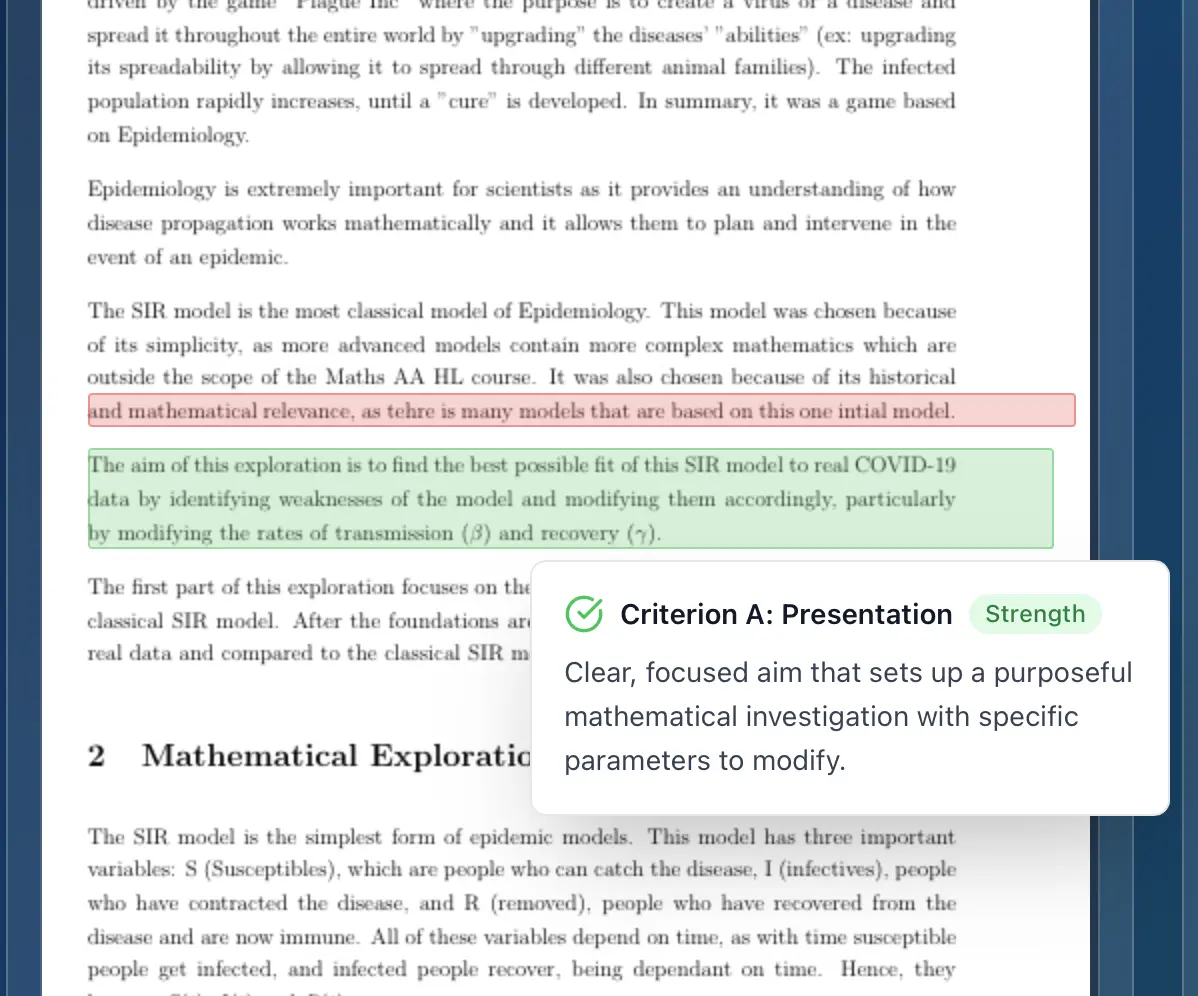
Get estimated marks by criterion, comments on your writing, and a clear list of what to fix first.
How the 2027 Criteria Apply
Criterion A: Framework for the essay
Your question, methods, and structure must form an effective framework. For an interdisciplinary essay, explain why the selected mathematical approach and psychological evidence are appropriate for the same inquiry.
Criterion B: Knowledge and understanding
Use terminology, concepts, and sources accurately in both subjects. You do not need to display every advanced idea you encountered; include what is necessary to answer the question.
Criterion C: Analysis and line of argument
Calculations and study summaries are evidence, not an argument by themselves. Explain how each result advances, qualifies, or challenges the answer to the research question.
Criterion D: Discussion and evaluation
This is the largest criterion at 8 marks. Discuss the significance of the findings and evaluate relevant strengths and limitations. In a Mathematics–Psychology essay, that could mean evaluating the assumptions of the probability model alongside the validity and generalizability of the behavioural evidence.
Criterion E: Reflection
Use the reflection process to show how the project changed you as a researcher. Useful reflections might address why one disciplinary lens proved insufficient, how evidence forced a change in the question, or how you learned to reconcile different standards of evidence. The Extended Essay reflection sessions should document real decisions, not a polished success story written after the fact.
Common Failure Modes
Treating 50/50 as the goal
Equal word counts do not prove integration. A purposeful 60/40 balance can be stronger than two equal but disconnected sections.
Using mathematics as decoration
One Bayes' theorem formula followed by pages of psychology does not establish a mathematical lens. Show the reasoning, apply it, interpret it, and evaluate its assumptions.
Treating the mathematical model as unquestionable truth
A normative model can provide a useful benchmark without capturing every feature of real decision-making. Evaluate whether the priors, likelihoods, task wording, and assumptions fit the context.
Reporting psychology studies without evaluating them
Sample characteristics, task design, measurement, replication, and ecological validity affect what you may conclude. A study result is not automatically a universal fact about human reasoning.
Saving integration for the conclusion
If the subjects first meet in the final 300 words, the essay has probably been multidisciplinary rather than interdisciplinary. Make connections during each major analytical step.
Reusing IA work
The Extended Essay must not duplicate another Diploma Programme submission. A related interest is possible, but reusing the same mathematical exploration, dataset, analysis, or psychological investigation creates a serious academic-integrity risk. Confirm boundaries with both subject teachers and your supervisor.
Final Planning Checklist
Before drafting, confirm that:
- the May 2027 rubric applies to your examination session;
- the question cannot be answered as effectively through one subject alone;
- Mathematics and Psychology each make a necessary, identifiable contribution;
- your evidence allows the two lenses to interact repeatedly;
- you can explain every mathematical step you use;
- your psychological claims rely on appropriate academic research;
- the scope is realistic for 4,000 words;
- no part duplicates an IA or another submitted task;
- your supervisor agrees that the interdisciplinary pathway fits the question.
The strongest Mathematics–Psychology EE is not the one with the most complicated formula or the longest list of studies. It is the one in which a focused question, appropriate evidence, and genuine integration produce a defensible insight that neither subject could provide alone.