IB Math IA Criteria Explained: What Examiners Look For
The Mathematics Internal Assessment (IA) is a crucial component of your IB Mathematics course, contributing significantly to your final grade. Understanding the mathematics internal assessment criteria is the key to success. This guide provides a clear breakdown of each criterion, offering practical tips and examples to help you excel. We’ll explore the IB mathematics grading system, the mathematics assessment rubric, and provide useful advice to maximize your score.
What is the Mathematics Internal Assessment?
The Mathematics Internal Assessment is an independent piece of work where you explore a mathematical topic of your choice. It allows you to demonstrate your understanding of mathematical concepts, apply them to real-world situations, and showcase your problem-solving skills. It's an opportunity to delve deeper into an area of mathematics that interests you and present your findings in a clear and concise manner.
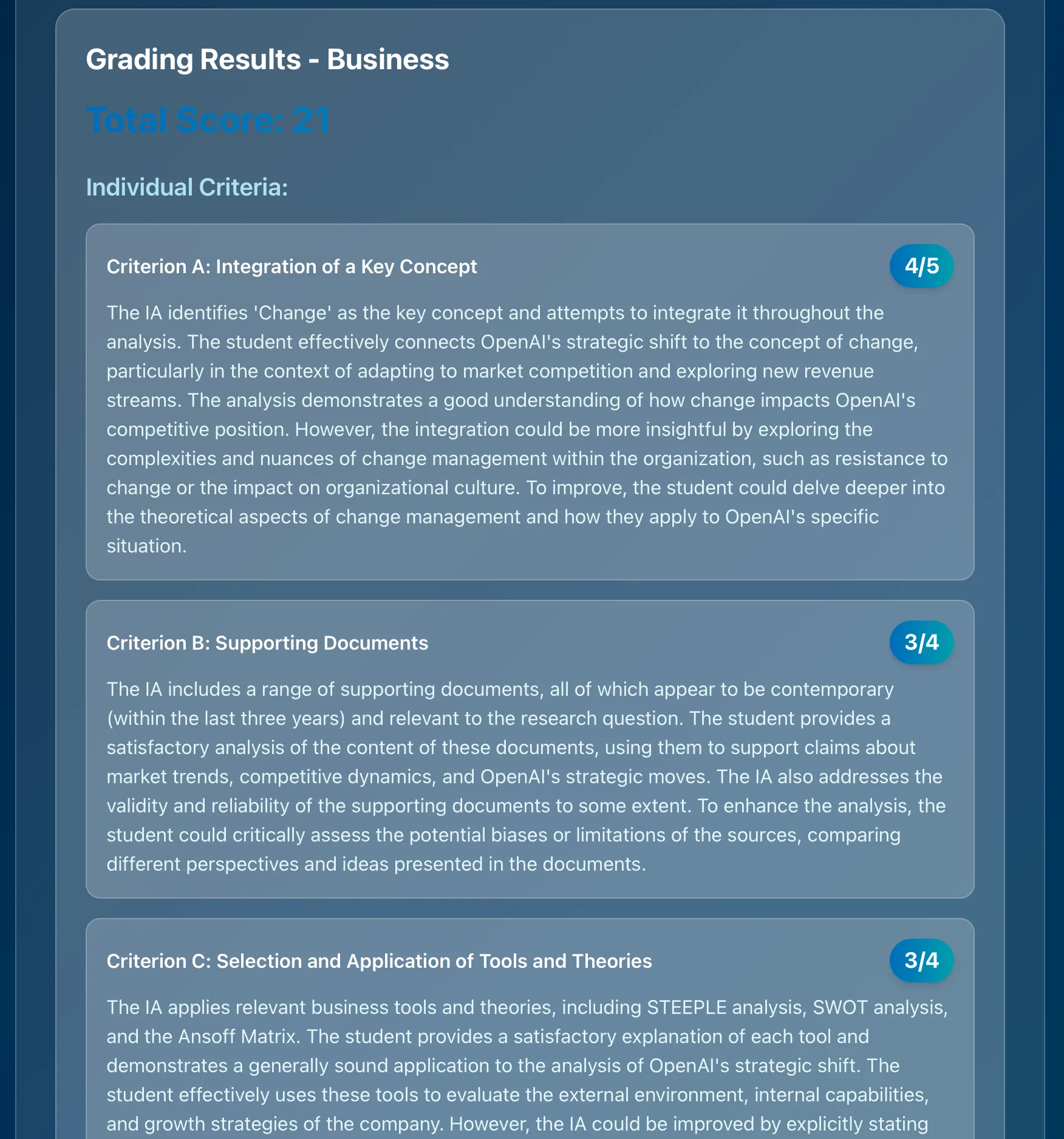
Stuck on your IB draft?
Get instant, detailed feedback on structure, evidence, and reasoning, then compare it with your current school materials.
Understanding the Grading Criteria
The IB Mathematics IA is assessed against five criteria: Presentation, Mathematical Communication, Personal Engagement, Reflection, and Use of Mathematics. Each criterion is worth a specific number of marks, and the total score contributes to your overall IB grade. Understanding how each criterion is assessed is essential for planning and executing a successful IA.
Detailed Breakdown of Mathematics Internal Assessment Criteria
Let's delve into each criterion with detailed explanations, mark bands, and tips for success.
Criterion names, marks, and mark bands below follow the IB subject guide. The band descriptions are our own plain-English summaries, so check your subject guide for the exact wording.
Criterion A: Presentation (4 marks)
What it assesses: How coherent, well organized, and concise the exploration is.
Mark bands:
- 0 marks: Nothing in the work reaches the lowest band.
- 1 mark: The exploration shows either some logical flow or some organization, not both.
- 2 marks: The exploration has some logical flow and some organization.
- 3 marks: The exploration develops logically and is well organized.
- 4 marks: The exploration develops logically, is well organized, and is concise, with nothing unnecessary.
Tips for success:
- Plan your structure: Before you start writing, create an outline to ensure a logical flow.
- Use headings and subheadings: This helps break up the text and makes it easier for the reader to follow.
- Write a clear introduction: Clearly state your research question) and objectives.
- Be concise: Avoid unnecessary jargon or lengthy explanations.
- Proofread carefully: Ensure your work is free of grammatical errors and typos.
Criterion B: Mathematical Communication (4 marks)
What it assesses: How relevant, appropriate, and consistent the notation, terminology, and representations are.
Mark bands:
- 0 marks: Nothing in the work reaches the lowest band.
- 1 mark: Some relevant notation and terminology, but only partly appropriate.
- 2 marks: Some relevant, appropriate notation, terminology, and representations.
- 3 marks: Relevant, appropriate mathematical communication that is mostly consistent.
- 4 marks: Relevant, appropriate mathematical communication that is consistent from start to finish.
Tips for success:
- Define key terms: Clearly define any mathematical terms that may be unfamiliar to the reader.
- Explain your calculations: Don't just present the results; explain the steps you took to arrive at them.
- Use appropriate notation: Use standard mathematical notation consistently and accurately.
- Label your diagrams and graphs: Ensure all diagrams and graphs are clearly labeled with appropriate titles and axes.
- Use multiple representations: Present your findings using different forms of representation, such as equations, graphs, tables, and diagrams.
Criterion C: Personal Engagement (3 marks)
What it assesses: How clearly the exploration shows your own thinking, choices, and ownership of the mathematics.
Mark bands:
- 0 marks: Nothing in the work reaches the lowest band.
- 1 mark: Some signs of personal engagement are visible.
- 2 marks: Clear, significant personal engagement runs through the work.
- 3 marks: Outstanding personal engagement: independent thinking and creativity shape the exploration.
Tips for success:
- Choose a topic you're interested in: This will make the exploration more enjoyable and engaging.
- Explain your interest: Clearly explain why you chose the topic and how it relates to your personal interests.
- Formulate predictions: Make predictions about the outcome of your exploration and explain your reasoning.
- Conduct tests: Design and conduct tests to validate your predictions.
- Explore different perspectives: Consider different approaches to the problem and discuss their strengths and weaknesses.
Criterion D: Reflection (3 marks)
What it assesses: How critically you review, interpret, and question your results and methods.
Mark bands:
- 0 marks: Nothing in the work reaches the lowest band.
- 1 mark: Reflection is limited, often just restating results.
- 2 marks: Reflection is meaningful, for example linking results to the aim or noting limitations.
- 3 marks: Critical reflection appears throughout, questioning results, methods, and their implications.
Tips for success:
- Discuss the strengths and weaknesses of your approach: Be honest about the limitations of your methods.
- Evaluate the impact of your results: Discuss the implications of your findings and their significance.
- Propose extensions to the study: Suggest further research that could be conducted to build upon your findings.
- Link your conclusion to the research question: Clearly state how your results answer your research question.
Criterion E: Use of Mathematics (SL) (6 marks)
What it assesses: How relevant and correct the mathematics is at the level of the SL course, and how well you understand it.
Mark bands:
- 0 marks: Nothing in the work reaches the lowest band.
- 1 mark: Some relevant mathematics is used.
- 2 marks: Some relevant mathematics, with limited understanding.
- 3 marks: Mathematics at the level of the SL course, with limited understanding.
- 4 marks: Mathematics at the level of the SL course that is partly correct, with some understanding.
- 5 marks: Mathematics at the level of the SL course that is mostly correct, with good understanding.
- 6 marks: Mathematics at the level of the SL course that is correct, with thorough understanding.
Tips for success:
- Use relevant mathematics: Ensure the mathematics you use is appropriate for the topic and at the correct level.
- Show your understanding: Explain the mathematical concepts you are using and how they apply to your exploration.
- Avoid unnecessary complexity: Don't try to use overly complicated mathematics just for the sake of it.
- Check your calculations: Ensure your calculations are accurate and free of errors.
- Explain any mathematics beyond the syllabus: If you use any mathematics that is not covered in the syllabus, be sure to explain it clearly.
Criterion E: Use of Mathematics (HL) (6 marks)
What it assesses: How relevant, correct, precise, and sophisticated or rigorous the HL mathematics is, and how well you understand it.
Mark bands:
- 0 marks: Nothing in the work reaches the lowest band.
- 1 mark: Some relevant mathematics, with limited understanding.
- 2 marks: Some relevant mathematics that is partly correct, with some understanding.
- 3 marks: Mathematics at the level of the HL course that is correct, with some understanding.
- 4 marks: Mathematics at the level of the HL course that is correct, with good understanding.
- 5 marks: Correct HL-level mathematics that shows sophistication or rigour, with thorough understanding.
- 6 marks: Precise HL-level mathematics that shows both sophistication and rigour, with thorough understanding.
Tips for success:
- Use relevant mathematics: Ensure the mathematics you use is appropriate for the topic and at the correct level.
- Show your understanding: Explain the mathematical concepts you are using and how they apply to your exploration.
- Avoid unnecessary complexity: Don't try to use overly complicated mathematics just for the sake of it.
- Check your calculations: Ensure your calculations are accurate and free of errors.
- Explain any mathematics beyond the syllabus: If you use any mathematics that is not covered in the syllabus, be sure to explain it clearly.
Good to know:
- The exploration is marked out of 20.
How to Excel in Your Mathematics Internal Assessment
- Start early: Don't wait until the last minute to start working on your IA.
- Choose a topic that interests you: This will make the process more enjoyable and engaging.
- Plan your investigation carefully: Create an outline and timeline to stay on track.
- Seek feedback from your teacher: Ask your teacher for guidance and feedback throughout the process.
- Proofread your work carefully: Ensure your work is free of grammatical errors and typos.
- Manage your time effectively: Allocate sufficient time to each stage of the investigation.
- Be organized: Keep your work organized and easy to follow.
- Be creative: Don't be afraid to think outside the box and explore new ideas.
- Be persistent: Don't give up if you encounter challenges.
- Have fun! The IA is an opportunity to explore a topic you're passionate about, so enjoy the process.
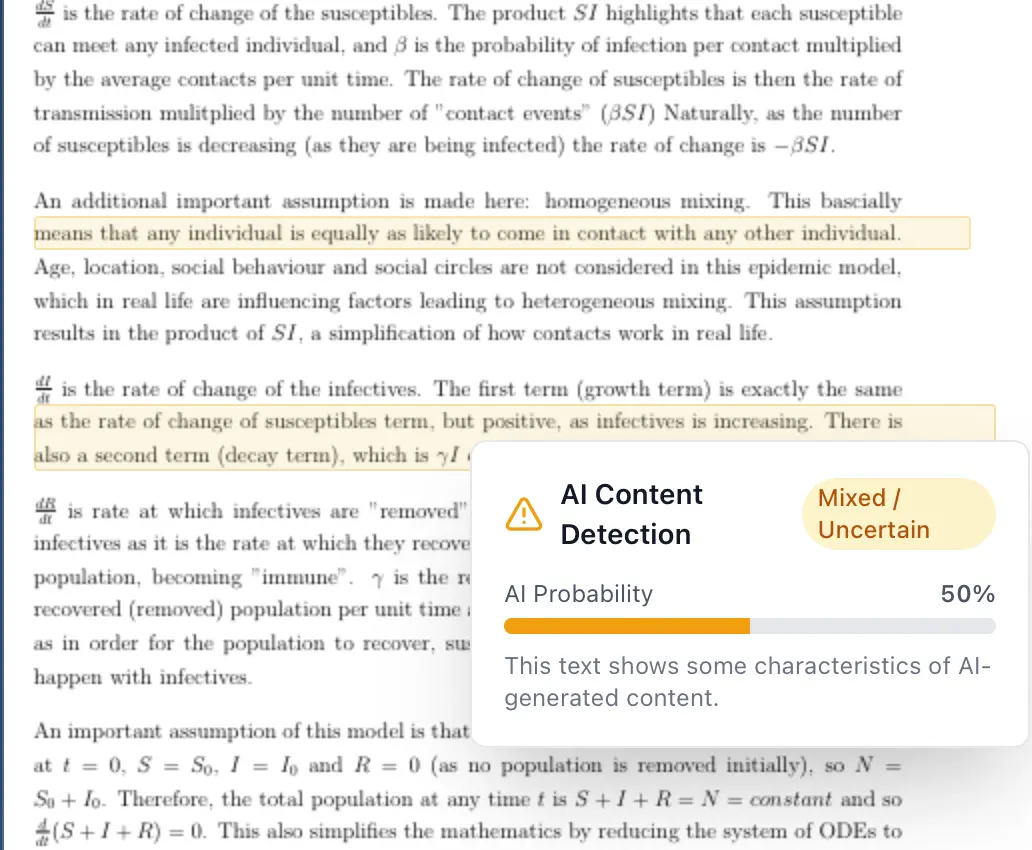
Check your own draft
Get estimated marks by criterion, comments on your writing, and a clear list of what to fix first.
Common Mistakes to Avoid
- Choosing a topic that is too broad or too narrow.
- Failing to plan the investigation properly.
- Using mathematics that is too simple or too complex.
- Failing to explain your calculations clearly.
- Not reflecting on the process or results of the investigation.
- Plagiarism.
- Poor presentation and organization.
- Incorrect use of mathematical notation.
- Failing to meet the word count requirements.
- Missing deadlines.
The Role of AI in Modern Assessment
Modern technology is changing how we approach academic assessment. AI grading assistants can now help teachers maintain consistency and rubric alignment in their evaluations while saving valuable time. These tools use the same official IB criteria to provide detailed feedback and scoring, ensuring that assessments meet the high standards expected in IB programs.
For educators looking to simplify their grading process while maintaining the quality and consistency that IB assessments demand, AI grading assistance offers a powerful solution that complements traditional teaching methods.
Conclusion
Understanding the mathematics internal assessment criteria is paramount to achieving a high score. By carefully considering each criterion and following the tips outlined in this guide, you can maximize your chances of success. Remember to choose a topic that interests you, plan your investigation carefully, and seek feedback from your teacher. Good luck!
Looking for more support with IB draft grading? Discover how AI grading assistants can help maintain consistency and rubric alignment in your evaluations while saving valuable time. Learn more about modern grading solutions designed specifically for IB educators.