IB Philosophy IA Criteria Explained: What Examiners Look For
Understanding the IB Philosophy Internal Assessment (IA) grading criteria is crucial for achieving a high score. This guide breaks down each criterion, providing clear explanations, practical tips, and examples to help you excel. We'll delve into how examiners assess your work, ensuring you know exactly what's expected to maximize your marks.
What is the Philosophy Internal Assessment?
The Philosophy Internal Assessment is a 2000-word philosophical analysis of a non-philosophical stimulus. It's your opportunity to demonstrate your understanding of philosophical concepts and your ability to apply them to real-world situations. This assessment is marked out of 25, based on five criteria that evaluate your ability to identify philosophical issues, present clear arguments, and critically analyze different perspectives. Both Standard Level (SL) and Higher Level (HL) students complete the same assessment and are graded using the same criteria.
Stuck on your IB draft?
Get instant, detailed feedback on structure, evidence, and reasoning, then compare it with your current school materials.
Understanding the Grading Criteria
The IB Philosophy IA-a-successful-ib-philosophy-internal-assessment) grading criteria are designed to assess your philosophical thinking skills, not just your knowledge of philosophical theories. Each criterion focuses on a specific aspect of your analysis, from identifying the philosophical issue to evaluating different perspectives. Familiarizing yourself with these criteria is the first step towards crafting a successful IA.
Detailed Breakdown of Philosophy Internal Assessment Criteria
Let's break down each criterion to understand what the examiners are looking for.
Criterion names, marks, and mark bands below follow the IB subject guide. The band descriptions are our own plain-English summaries, so check your subject guide for the exact wording.
Criterion A: Identification of issue and justification (3 marks)
What it assesses: How clearly you name the philosophical issue in the stimulus and justify why the stimulus raises it.
Mark bands:
- 0 marks: Nothing in the work reaches the lowest band.
- 1 mark: The issue is implied rather than stated, and the link to the stimulus is not justified.
- 2 marks: The issue is clearly identified, with some justification of the link to the stimulus.
- 3 marks: The issue is identified explicitly, with a clear justification of the link to the stimulus.
Tips for success:
- Be specific: Don't just identify a general topic; pinpoint the precise philosophical issue you'll be exploring. For example, instead of "ethics," identify the issue as "the ethical implications of artificial intelligence in healthcare."
- Justify thoroughly: Explain why the issue is philosophically significant and how it arises from the stimulus. Provide concrete examples from the stimulus to support your justification.
- Start strong: Clearly state the issue in your introduction to set the stage for your analysis.
Common mistakes to avoid:
- Choosing an issue that is too broad or vague.
- Failing to connect the issue directly to the stimulus.
- Providing a superficial justification without delving into the philosophical significance.
Criterion B: Clarity (4 marks)
What it assesses: How well structured, focused, and clear the response is.
Mark bands:
- 0 marks: Nothing in the work reaches the lowest band.
- 1 mark: Poorly structured, or structured but barely focused on the task.
- 2 marks: Some structure, though the point is not always clear.
- 3 marks: Structured, generally organized, and easy to follow.
- 4 marks: Well structured, focused, clear, and coherent.
Tips for success:
- Plan your structure: Create an outline before you start writing to ensure a logical flow of ideas.
- Use clear transitions: Connect your paragraphs and ideas with transition words and phrases to guide the reader.
- Stay focused: Ensure that every paragraph contributes to your overall argument and avoids digressions.
- Proofread carefully: Check for grammatical errors and typos that can detract from the clarity of your writing.
Common mistakes to avoid:
- Presenting ideas in a disorganized or random order.
- Using jargon or overly complex language that obscures your meaning.
- Failing to provide clear transitions between paragraphs.
Criterion C: Knowledge and understanding (4 marks)
What it assesses: How accurate and relevant your philosophical knowledge is, how well you explain the issue, and how you use philosophical vocabulary.
Mark bands:
- 0 marks: Nothing in the work reaches the lowest band.
- 1 mark: Little relevant knowledge, a minimal explanation of the issue, and missing or misused philosophical vocabulary.
- 2 marks: Some knowledge with gaps in accuracy or relevance, a basic explanation, and vocabulary used only sometimes appropriately.
- 3 marks: Mostly accurate, relevant knowledge and a satisfactory explanation; vocabulary is used, though not always appropriately.
- 4 marks: Relevant, accurate, detailed knowledge, a well-developed explanation, and appropriate vocabulary throughout.
Tips for success:
- Research thoroughly: Familiarize yourself with the key philosophical concepts and theories related to your chosen issue.
- Use philosophical terminology correctly: Demonstrate your understanding of philosophical terms by using them accurately and appropriately.
- Provide context: Explain the philosophical concepts you're using and how they relate to your argument.
- Cite your sources: Properly cite any sources you use to support your claims.
Common mistakes to avoid:
- Using philosophical terms incorrectly or out of context.
- Presenting inaccurate or outdated information.
- Failing to demonstrate a deep understanding of the philosophical concepts you're using.
Criterion D: Analysis (8 marks)
What it assesses: How developed your critical analysis is, how well examples support it, and how you handle counter-arguments.
Mark bands:
- 0 marks: Nothing in the work reaches the lowest band.
- 1-2 marks: Mostly descriptive, with little analysis and few or no examples.
- 3-4 marks: Limited analysis, more description than analysis, with some suitable examples.
- 5-6 marks: Analysis that lacks development, suitable examples, and counter-arguments identified.
- 7-8 marks: Well-developed critical analysis, well-chosen examples, and counter-arguments analysed convincingly.
Tips for success:
- Go beyond description: Don't just summarize philosophical theories; analyze them critically.
- Use concrete examples: Support your arguments with specific examples from the stimulus or real-world situations.
- Consider counterarguments: Acknowledge and address opposing viewpoints to strengthen your argument.
- Develop your analysis: Explore the implications of your arguments and consider different perspectives.
Common mistakes to avoid:
- Providing a purely descriptive account of philosophical theories without engaging in critical analysis.
- Failing to support your arguments with concrete examples.
- Ignoring or dismissing counterarguments without proper consideration.
Criterion E: Evaluation (6 marks)
What it assesses: How well you evaluate other interpretations, justify your points, and reach a consistent conclusion.
Mark bands:
- 0 marks: Nothing in the work reaches the lowest band.
- 1-2 marks: Little evaluation of other views, some main points justified, and no relevant conclusion.
- 3-4 marks: Some evaluation of other views, many points justified, and a conclusion that may not fully match the argument.
- 5-6 marks: Clear evaluation of other views, nearly all points justified, a consistent position, and a clear conclusion that matches the argument.
Tips for success:
- Evaluate different viewpoints: Consider the strengths and weaknesses of different perspectives on the issue.
- Justify your points: Provide clear and logical justifications for your claims.
- Draw a coherent conclusion: Summarize your main arguments and draw a conclusion that is consistent with your analysis.
- Address limitations: Acknowledge any limitations of your analysis and suggest areas for further research.
Common mistakes to avoid:
- Failing to evaluate different viewpoints or perspectives.
- Drawing a conclusion that is inconsistent with your analysis.
- Providing unsupported claims or generalizations.
How to Excel in Your Philosophy Internal Assessment
Here are some practical tips to help you excel in your Philosophy IA:
- Choose a stimulus that genuinely interests you: This will make the research and writing process more engaging.
- Start early: Give yourself plenty of time to research, plan, write, and revise your IA.
- Seek feedback: Ask your teacher or a peer to review your work and provide constructive criticism.
- Revise and edit carefully: Pay attention to grammar, spelling, and clarity.
- Stay within the word limit: Exceeding the word limit can negatively impact your score.
- Follow the IB guidelines: Ensure that you meet all the requirements outlined in the IB Philosophy guide.
Check your own draft
Get estimated marks by criterion, comments on your writing, and a clear list of what to fix first.
Common Mistakes to Avoid
- Plagiarism: Always cite your sources properly to avoid plagiarism.
- Descriptive writing: Focus on analysis and evaluation, not just description.
- Lack of focus: Stay focused on the philosophical issue and avoid digressions.
- Poor structure: Organize your ideas logically and use clear transitions.
- Ignoring counterarguments: Acknowledge and address opposing viewpoints.
The Role of AI in Modern Assessment
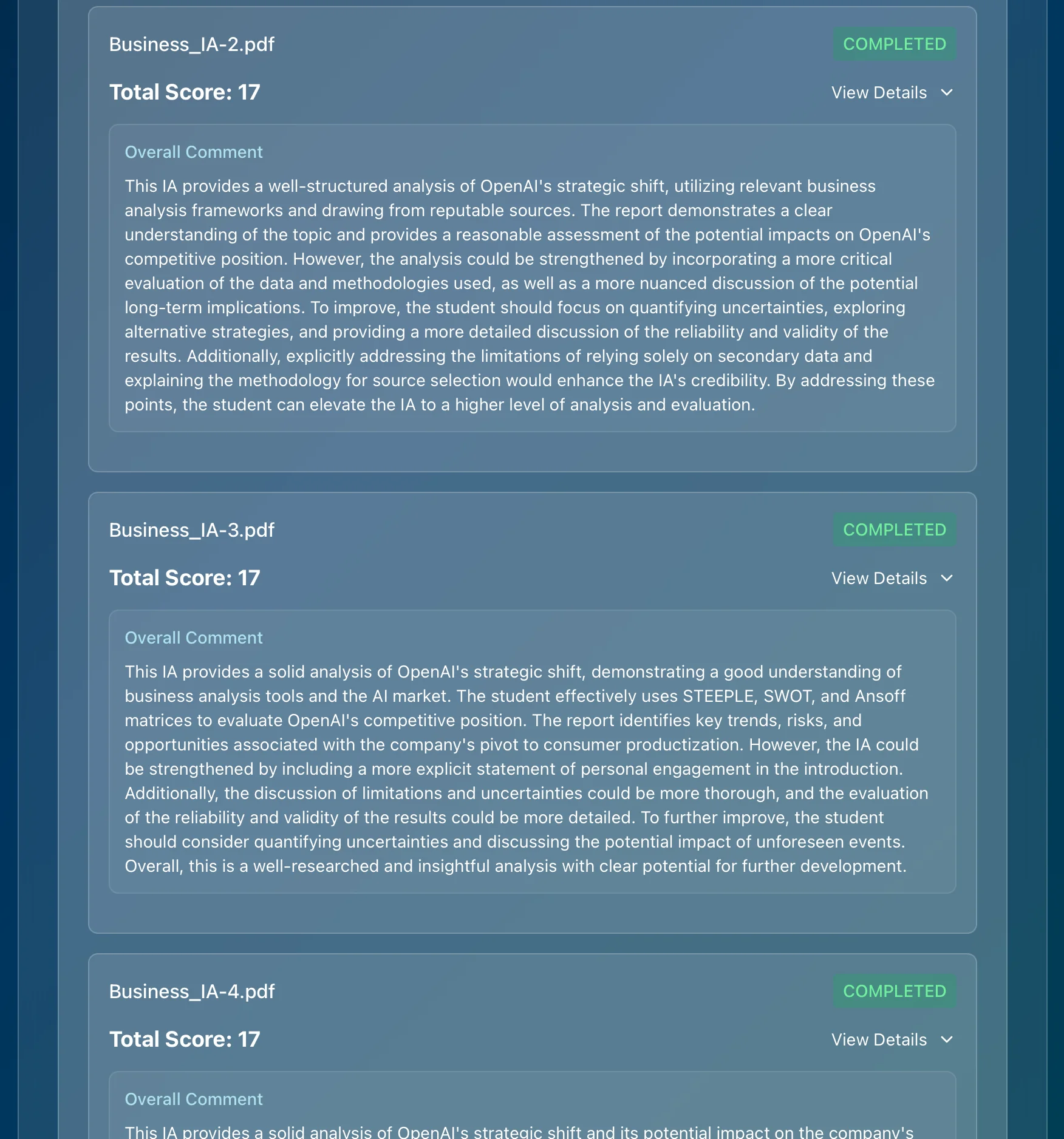
Modern technology is changing how we approach academic assessment. AI grading assistants can now help teachers maintain consistency and rubric alignment in their evaluations while saving valuable time. These tools use the same official IB criteria to provide detailed feedback and scoring, ensuring that assessments meet the high standards expected in IB programs.
For educators looking to simplify their grading process while maintaining the quality and consistency that IB assessments demand, AI grading assistance offers a powerful solution that complements traditional teaching methods.
Conclusion
Mastering the IB Philosophy Internal Assessment requires a thorough understanding of the grading criteria and a commitment to critical thinking and clear communication. By following the tips and advice outlined in this guide, you can significantly improve your chances of achieving a high score. Remember to choose a compelling stimulus, plan your structure carefully, and engage in deep philosophical analysis.
Looking for more support with IB draft grading? Discover how AI grading assistants can help maintain consistency and rubric alignment in your evaluations while saving valuable time. Learn more about modern grading solutions designed specifically for IB educators.