IB Psychology IA Criteria Explained: What Examiners Look For
Understanding the IB Psychology Internal Assessment (IA) criteria is crucial for achieving a high score. This guide provides a detailed breakdown of each criterion, offering practical tips, examples, and useful advice to help you excel. We'll explore the psychology assessment rubric, explain how the IB grading criteria are applied, and offer strategies for success.
What is the Psychology Internal Assessment?
The Psychology Internal Assessment is a research report that forms a significant part of your overall IB Psychology grade. It requires you to conduct your own psychological investigation, analyze the data, and evaluate your findings. It's a chance to apply your knowledge of research methods and psychological theories to a real-world scenario.
Stuck on your IB draft?
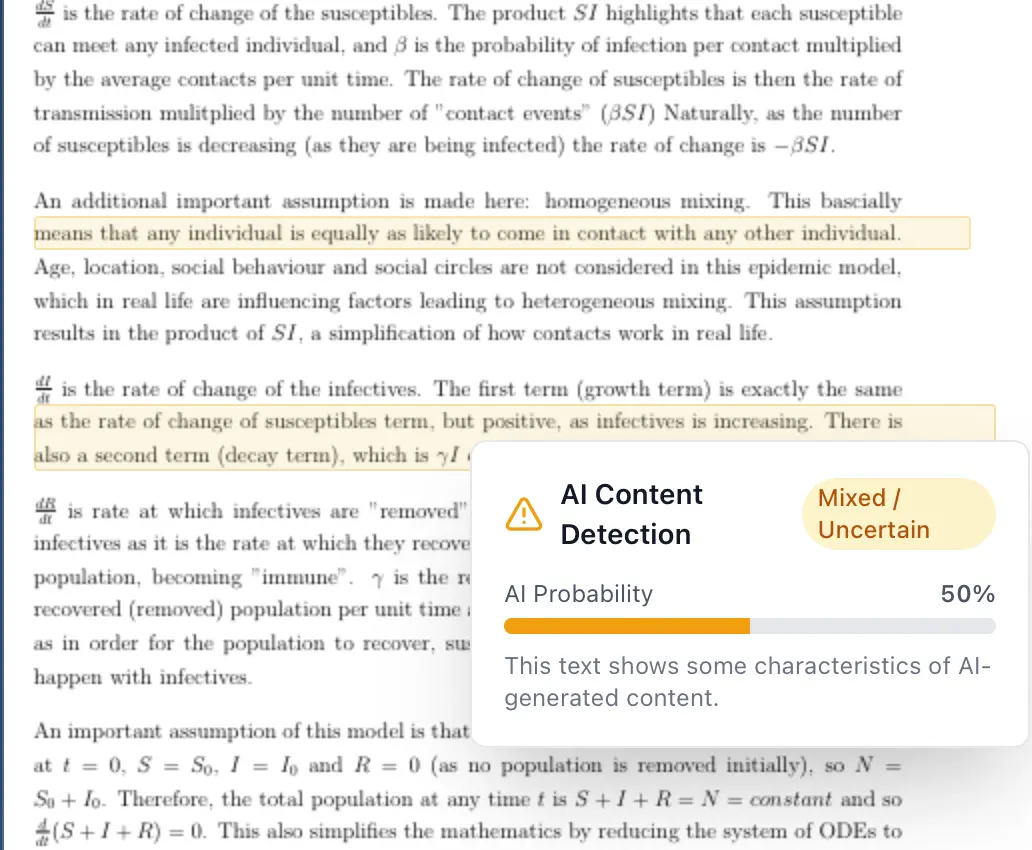
Get instant, detailed feedback on structure, evidence, and reasoning, then compare it with your current school materials.
Understanding the Grading Criteria
The IB Psychology IA is assessed against four criteria: Introduction, Exploration, Analysis, and Evaluation. Each criterion is worth a certain number of marks, and your overall score is determined by the sum of your marks in each area. Understanding the specific requirements of each criterion is essential for planning your investigation and writing your report.
Detailed Breakdown of Psychology Internal Assessment Criteria
Let's delve into each criterion in detail, providing a clear explanation of what's expected and how to maximize your score.
Criterion names, marks, and mark bands below follow the IB subject guide. The band descriptions are our own plain-English summaries, so check your subject guide for the exact wording.
Criterion I: Introduction (6 marks)
What it assesses: How clearly you state the aim and its relevance, link your study to a theory or model, and write operationalized hypotheses.
Mark bands:
- 0 marks: Nothing in the work reaches the lowest band.
- 1-2 marks: The aim is stated without its relevance, the theory or model is incompletely or wrongly described, and the hypothesis misidentifies the IV or DV.
- 3-4 marks: The aim's relevance is identified but not explained, the theory is described without linking it to your study, and the IV and DV are correct in the hypothesis but not operationalized.
- 5-6 marks: The aim's relevance is explained, the theory is described and linked to your study, and the IV and DV are stated and operationalized in the hypothesis.
Tips for success:
- Clearly state your aim: What are you trying to investigate? Be specific.
- Connect to theory: Explain the psychological theory or model that your investigation is based on. Why is this theory relevant to your research question)?
- Define variables: Clearly state your independent and dependent variables, and operationalize them (explain how you will measure them).
- Formulate a hypothesis: State your null and research hypotheses clearly.
- Example: If you're investigating the effect of sleep deprivation on memory recall, clearly state the relevant cognitive psychology theory (e.g., multi-store model of memory), define sleep deprivation (e.g., "less than 6 hours of sleep"), and memory recall (e.g., "number of words correctly recalled from a list").
Common mistakes to avoid:
- Vague or unclear aim.
- Superficial or missing link to psychological theory.
- Poorly defined variables.
- Incorrect or missing hypotheses.
Criterion II: Exploration (4 marks)
What it assesses: Whether you explain, not just describe, your design, sampling, participants, controlled variables, and materials.
Mark bands:
- 0 marks: Nothing in the work reaches the lowest band.
- 1-2 marks: The design, sampling technique, participants, controlled variables, and materials are described.
- 3-4 marks: The design, sampling technique, choice of participants, controlled variables, and choice of materials are explained.
Tips for success:
- Choose an appropriate research design: Experimental, correlational, or descriptive? Justify your choice.
- Explain your sampling technique: How did you select your participants? Why did you choose this method?
- Describe your participants: Provide relevant details about your sample (e.g., age, gender, background).
- Identify and control variables: List the variables you controlled and explain how you controlled them. Why were these controls necessary?
- Justify your materials: Explain why you chose the materials you used.
- Example: If you're using a questionnaire, explain why you chose specific questions and how they relate to your research question. If you're using a standardized test, explain its reliability and validity.
Common mistakes to avoid:
- Poorly described methodology.
- Lack of justification for research design, sampling technique, or materials.
- Inadequate control of variables.
- Ethical considerations not addressed.
Criterion III: Analysis (6 marks)
What it assesses: How accurately you apply descriptive and inferential statistics, graph the results, and interpret the findings.
Mark bands:
- 0 marks: Nothing in the work reaches the lowest band.
- 1-2 marks: Only descriptive or only inferential statistics; the graph type is right but does not address the hypothesis; findings are not clearly stated.
- 3-4 marks: Suitable descriptive and inferential statistics with errors; the graph addresses the hypothesis but has errors; findings are stated but not interpreted or not linked to the hypothesis.
- 5-6 marks: Correct descriptive and inferential statistics, a correct graph that addresses the hypothesis, and findings interpreted and linked to the hypothesis.
Tips for success:
- Choose appropriate statistical tests: Select the correct statistical test based on your research design and data type.
- Present data clearly: Use graphs and tables to present your data in a clear and understandable way.
- Interpret your findings: Explain what your statistical results mean in relation to your hypothesis.
- Discuss statistical significance: Is your result statistically significant? What does this mean for your hypothesis?
- Example: If you're using a t-test, report the t-value, degrees of freedom, and p-value. Explain what the p-value means in terms of statistical significance.
Common mistakes to avoid:
- Using incorrect statistical tests.
- Presenting data poorly.
- Misinterpreting statistical results.
- Failing to link findings to the hypothesis.
Criterion IV: Evaluation (6 marks)
What it assesses: How well you discuss findings against the theory, evaluate your design, and justify modifications.
Mark bands:
- 0 marks: Nothing in the work reaches the lowest band.
- 1-2 marks: Findings are described without reference to the theory, strengths and limitations are stated but not relevant to the hypothesis, and modifications are stated.
- 3-4 marks: Findings are described with reference to the theory, relevant strengths and limitations are described, and modifications are described but not tied to your study's limitations.
- 5-6 marks: Findings are discussed with reference to the theory, relevant strengths and limitations are explained, and modifications are tied to your limitations and justified.
Tips for success:
- Draw conclusions: What did you find? Do your results support your hypothesis?
- Discuss strengths and limitations: What were the strengths of your investigation? What were the limitations?
- Suggest modifications: How could you improve your investigation in the future?
- Link to theory: How do your findings relate to the psychological theory or model you discussed in your introduction?
- Example: If a limitation was a small sample size, suggest increasing the sample size in future research. Explain how this would improve the generalizability of your findings.
Common mistakes to avoid:
- Superficial evaluation.
- Failing to link conclusions to findings.
- Ignoring limitations.
- Suggesting irrelevant modifications.
How to Excel in Your Psychology Internal Assessment
- Start early: Don't leave the IA until the last minute.
- Choose a topic you're interested in: This will make the process more enjoyable and engaging.
- Plan carefully: Develop a detailed research plan before you start collecting data.
- Follow ethical guidelines: Ensure your investigation is ethical and protects the rights of your participants.
- Seek feedback: Ask your teacher for feedback on your research plan and draft report.
- Proofread carefully: Check your report for errors in grammar, spelling, and punctuation.
Check your own draft
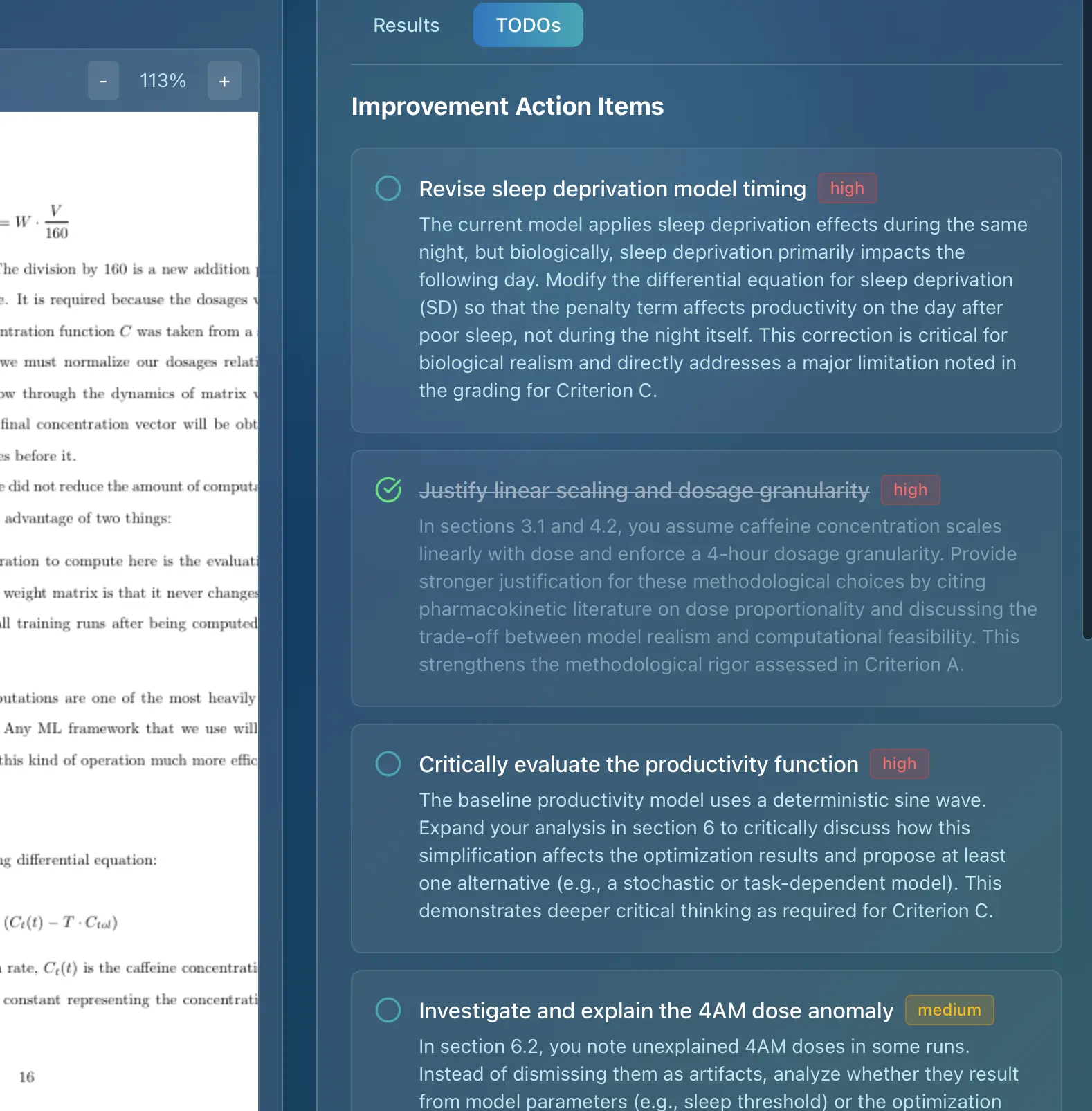
Get estimated marks by criterion, comments on your writing, and a clear list of what to fix first.
Common Mistakes to Avoid
- Plagiarism: Always cite your sources correctly.
- Ethical violations: Ensure your investigation is ethical and protects the rights of your participants.
- Poorly designed methodology: Plan your methodology carefully to ensure your data is valid and reliable.
- Inaccurate data analysis: Use appropriate statistical methods and interpret your results correctly.
- Superficial evaluation: Critically evaluate your investigation and suggest relevant modifications.
The Role of AI in Modern Assessment
Modern technology is changing how we approach academic assessment. AI grading assistants can now help teachers maintain consistency and rubric alignment in their evaluations while saving valuable time. These tools use the same official IB criteria to provide detailed feedback and scoring, ensuring that assessments meet the high standards expected in IB programs.
For educators looking to simplify their grading process while maintaining the quality and consistency that IB assessments demand, AI grading assistance offers a powerful solution that complements traditional teaching methods.
Conclusion
Mastering the IB Psychology Internal Assessment criteria is essential for achieving a high score. By understanding the requirements of each criterion, planning your investigation carefully, and seeking feedback from your teacher, you can maximize your chances of success. Remember to focus on clarity, accuracy, and critical thinking throughout the process.
Looking for more support with IB draft grading? Discover how AI grading assistants can help maintain consistency and rubric alignment in your evaluations while saving valuable time. Learn more about modern grading solutions designed specifically for IB educators.