IB Science IA Criteria Explained (Biology, Chemistry, Physics)
The Science Internal Assessment (IA) is a crucial component of your IB Biology, Chemistry, or Physics course, contributing significantly to your final grade. Understanding the science internal assessment criteria is paramount to achieving success. This practical guide will break down each criterion, providing clear explanations, practical tips, and useful advice to help you excel. We'll cover everything from research design to evaluation, ensuring you're well-prepared to tackle this challenging yet rewarding task.
What is the Science Internal Assessment?
The Science Internal Assessment is an individual investigation undertaken by IB students in Biology, Chemistry, or Physics. It allows you to explore a scientific question of your choice, applying the scientific method to design, conduct, analyze, and evaluate your own research. This hands-on experience not only reinforces your understanding of scientific concepts but also develops essential research and analytical skills.
Stuck on your IB draft?
Get instant, detailed feedback on structure, evidence, and reasoning, then compare it with your current school materials.
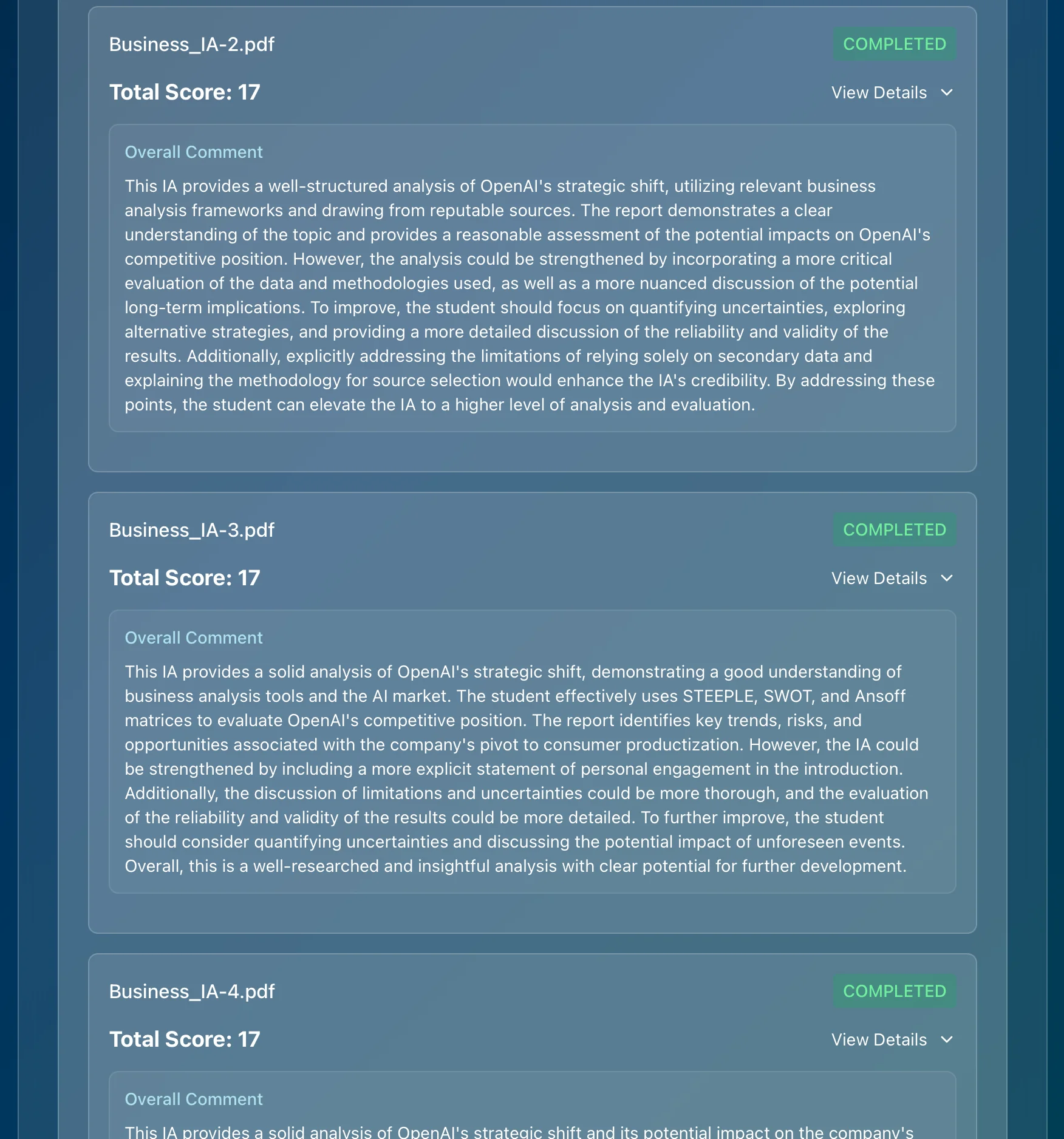
Understanding the Grading Criteria
The IB Science IA is assessed based on four key criteria: Research Design, Data Analysis, Conclusion, and Evaluation. Each criterion is worth 6 marks, totaling 24 marks for the entire assessment. Examiners use a detailed rubric to assess your work against specific performance standards within each criterion. Understanding these standards is crucial for planning your investigation and presenting your findings effectively.
Detailed Breakdown of Science Internal Assessment Criteria
Let's delve into each criterion in detail, exploring what examiners look for and how you can maximize your score.
Criterion names, marks, and mark bands below follow the IB subject guide. The band descriptions are our own plain-English summaries, so check your subject guide for the exact wording.
Criterion A: Research Design (6 marks)
What it assesses: How clearly the report sets out its research question in context and explains a method someone else could repeat.
Mark bands:
- 0 marks: Nothing in the work reaches the lowest band.
- 1-2 marks: The research question appears without context, method considerations are only mentioned, and the method is too thin for someone else to repeat.
- 3-4 marks: The question sits in a broad context, the main method considerations are described, and the method could be repeated apart from a few gaps or unclear steps.
- 5-6 marks: The question is set in a specific, well-chosen context, method considerations are explained, and the method is detailed enough for someone else to repeat.
Tips for success:
- Choose a focused research question: Avoid overly broad or vague questions. A well-defined question will guide your investigation and make it easier to collect and analyze data.
- Justify your methodology: Explain why you chose specific methods and materials. Consider alternative approaches and explain why they were not suitable.
- Address safety, ethical, and environmental considerations: Demonstrate awareness of potential risks and how you mitigated them. Consider the ethical implications of your research and its environmental impact.
- Example: Instead of asking "How does temperature affect reaction rate?", ask "How does increasing the temperature from 20°C to 40°C affect the initial rate of the iodine clock reaction, using starch as an indicator?"
Criterion B: Data Analysis (6 marks)
What it assesses: How clearly and precisely the report records and processes data, including uncertainties, in ways that answer the question.
Mark bands:
- 0 marks: Nothing in the work reaches the lowest band.
- 1-2 marks: Recording and processing are hard to follow and imprecise, uncertainties are barely considered, and processing has major gaps or errors.
- 3-4 marks: Recording and processing are either clear or precise but not both, uncertainties are considered with notable gaps, and processing has some significant errors or omissions.
- 5-6 marks: Recording and processing are clear and precise, uncertainties are handled appropriately, and the processing is correct and relevant to the question.
Tips for success:
- Collect sufficient data: Ensure you have enough data points to draw meaningful conclusions.
- Process data accurately: Use appropriate statistical techniques to analyze your data. Show your working clearly.
- Consider uncertainties: Calculate and propagate uncertainties throughout your analysis. Discuss the impact of uncertainties on your results.
- Present data effectively: Use clear and well-labeled graphs, tables, and figures to present your data. Ensure correct units, decimal places, and significant figures.
- Example: When calculating the rate of reaction, show the calculation, including units. Include error bars on graphs to represent uncertainties in measurements.
Criterion C: Conclusion (6 marks)
What it assesses: How well the conclusion answers the research question from the analysis and compares the result with accepted science.
Mark bands:
- 0 marks: Nothing in the work reaches the lowest band.
- 1-2 marks: A relevant conclusion is given, but the analysis does not support it and the comparison with accepted science is superficial.
- 3-4 marks: The conclusion is relevant but not fully consistent with the analysis, and it makes some relevant comparison with accepted science.
- 5-6 marks: The conclusion is justified, fully consistent with the analysis, and supported by a relevant comparison with accepted science.
Tips for success:
- State a clear conclusion: Directly answer your research question based on your data analysis.
- Support your conclusion with evidence: Refer to specific data points and trends to justify your conclusion.
- Compare to literature values: Research and compare your results to published data. Explain any discrepancies.
- Discuss uncertainties: Acknowledge the impact of uncertainties on your conclusion.
- Example: "The results support the hypothesis that increasing temperature increases the rate of reaction. The calculated activation energy of [value] kJ/mol is consistent with literature values for similar reactions (cite source)."
Criterion D: Evaluation (6 marks)
What it assesses: How well the report judges the weaknesses of its method and suggests realistic improvements.
Mark bands:
- 0 marks: Nothing in the work reaches the lowest band.
- 1-2 marks: Only generic weaknesses are named, and realistic improvements are simply listed.
- 3-4 marks: Specific weaknesses in the method are described, with realistic improvements that match them.
- 5-6 marks: The report explains how much each specific weakness affected the results and explains realistic improvements that target them.
Tips for success:
- Identify strengths and weaknesses: Discuss both the positive and negative aspects of your investigation.
- Explain the impact of weaknesses: Explain how limitations in your methodology might have affected your results.
- Suggest realistic improvements: Propose specific and feasible ways to improve your investigation.
- Be specific: Avoid vague statements. Provide concrete examples and explanations.
- Example: "A strength of the investigation was the use of a digital thermometer, which provided precise temperature measurements. A weakness was the lack of control over ambient light, which could have affected the rate of photosynthesis. To improve this, the experiment could be conducted in a dark room with a controlled light source."
How to Excel in Your Science Internal Assessment
- Start early: Don't leave the IA to the last minute. Plan your investigation carefully and allow ample time for data collection, analysis, and writing.
- Choose a topic you are interested in: This will make the process more enjoyable and engaging.
- Seek guidance from your teacher: Discuss your research question, methodology, and data analysis with your teacher to ensure you are on the right track.
- Keep a detailed lab notebook: Record all your observations, measurements, and calculations in a clear and organized manner.
- Proofread your work carefully: Check for errors in grammar, spelling, and scientific notation.
- Follow the IB guidelines: Ensure your IA meets all the requirements outlined in the IB subject guide.
Check your own draft
Get estimated marks by criterion, comments on your writing, and a clear list of what to fix first.
Common Mistakes to Avoid
- Choosing an overly ambitious research question: Keep your investigation manageable within the time and resources available.
- Failing to control variables: Ensure you are controlling all relevant variables to isolate the effect of the independent variable.
- Collecting insufficient data: Gather enough data points to draw meaningful conclusions.
- Making errors in data analysis: Double-check your calculations and ensure you are using appropriate statistical techniques.
- Failing to compare to literature values: Research and compare your results to published data.
- Providing a weak evaluation: Discuss the strengths and weaknesses of your investigation in detail and suggest realistic improvements.
The Role of AI in Modern Assessment
Modern technology is changing how we approach academic assessment. AI grading assistants can now help teachers maintain consistency and rubric alignment in their evaluations while saving valuable time. These tools use the same official IB criteria to provide detailed feedback and scoring, ensuring that assessments meet the high standards expected in IB programs.
For educators looking to simplify their grading process while maintaining the quality and consistency that IB assessments demand, AI grading assistance offers a powerful solution that complements traditional teaching methods.
Conclusion
Mastering the Science Internal Assessment requires a thorough understanding of the grading criteria and a commitment to rigorous scientific investigation. By following the tips and advice outlined in this guide, you can significantly improve your chances of success. Remember to plan carefully, collect and analyze data accurately, and evaluate your investigation critically. Good luck!
Looking for more support with IB draft grading? Discover how AI grading assistants can help maintain consistency and rubric alignment in your evaluations while saving valuable time. Learn more about modern grading solutions designed specifically for IB educators.