IB Social and Cultural Anthropology IA Criteria Explained
The Social and Cultural Anthropology Internal Assessment (IA) is a crucial component of your IB course, contributing 20% for SL students and 25% for HL students. Understanding the social and cultural anthropology internal assessment criteria is key to achieving a high score. This guide provides a detailed breakdown of the IB social and cultural anthropology grading rubric, offering practical tips and examples to help you excel. Whether you're a student, teacher, or parent, this resource will demystify the social and cultural anthropology assessment rubric and help you to succeed.
What is the Social and Cultural Anthropology Internal Assessment?
The Social and Cultural Anthropology Internal Assessment is a research-based project that allows students to apply anthropological concepts and methods to a topic of their choice. SL students complete a written observation and critique, while HL students undertake a limited fieldwork report. This assessment provides an opportunity to demonstrate your understanding of anthropological theory and your ability to conduct independent research.
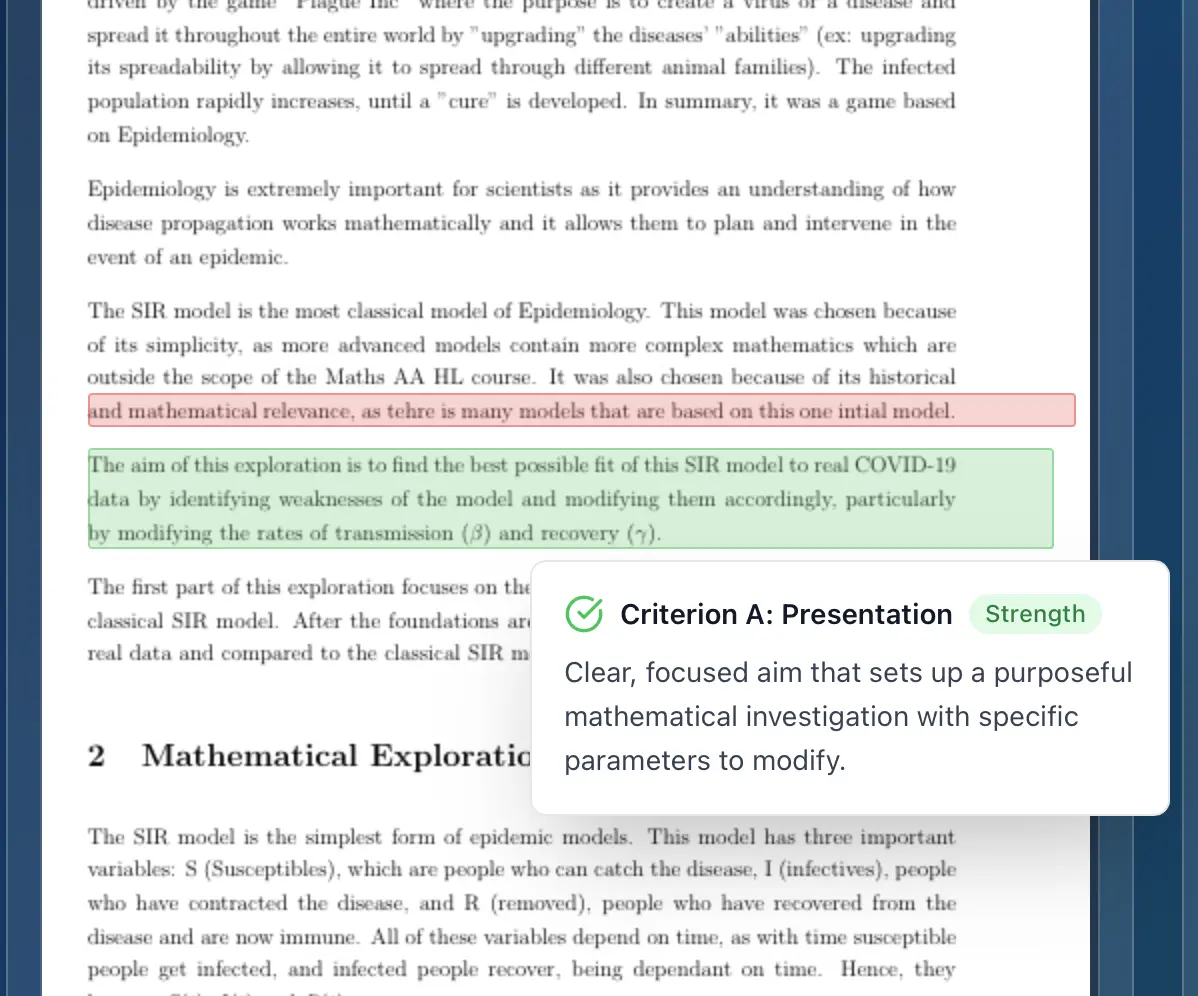
Stuck on your IB draft?
Get instant, detailed feedback on structure, evidence, and reasoning, then compare it with your current school materials.
Understanding the Grading Criteria
The IB grading criteria for the Social and Cultural Anthropology IA are designed to assess your understanding of key anthropological concepts, your ability to conduct research, and your critical thinking skills. The criteria are different for SL and HL students, reflecting the different requirements of each level. Each criterion is assessed on a scale, with specific mark bands outlining the expectations for each level of achievement. Understanding these mark bands is crucial for maximizing your score.
Detailed Breakdown of Social and Cultural Anthropology Internal Assessment Criteria
Here's a detailed breakdown of each criterion, including what it assesses, the mark bands, and tips for success:
Criterion names, marks, and mark bands below follow the IB subject guide. The band descriptions are our own plain-English summaries, so check your subject guide for the exact wording.
Criterion A (SL): Observation and report (4 marks)
What it assesses: How organized and detailed the observation report is, and how well it discusses the context of the observation.
Mark bands:
- 0 marks: Nothing in the work reaches the lowest band.
- 1-2 marks: The report has organization or detail, but lacks one of them, and says little about the setting of the observation.
- 3-4 marks: The report is organized and detailed, and the context of the observation is discussed at least partly.
What to check in your draft:
- The observation is specific and situated in context.
- Description is separated from interpretation.
- The report is both organized and detailed.
Criterion B (SL): Methodological and conceptual extension of initial fieldwork (6 marks)
What it assesses: How well you choose, describe, and justify a second research method linked to a key or inquiry-specific concept and to your first observation.
Mark bands:
- 0 marks: Nothing in the work reaches the lowest band.
- 1-2 marks: A second method is identified, its fit with a concept and the first observation is only partly shown, and its choice is barely justified.
- 3-4 marks: A second method is identified and described, its fit with a concept and the first observation is shown, and the choice is partly justified.
- 5-6 marks: A second method is described and explained, its fit with a concept and the first observation is clear, and that connection is justified and discussed.
What to check in your draft:
- The second method follows logically from the first observation.
- Its link to a key or inquiry-specific concept is explicit.
- The choice is justified, not just stated.
Criterion C (SL): Second fieldwork data collection and analysis (4 marks)
What it assesses: How soundly the data from the second method is analysed in relation to the concept and the method.
Mark bands:
- 0 marks: Nothing in the work reaches the lowest band.
- 1-2 marks: Data is analysed against the concept and method only superficially, and irrelevant or inconsistent data weakens it.
- 3-4 marks: Relevant data is analysed soundly against the concept and method; minor inconsistencies do not weaken it.
What to check in your draft:
- The data selected is relevant to the inquiry.
- Analysis uses the key or inquiry-specific concept.
- Irrelevant or inconsistent data does not weaken the analysis.
Criterion D (SL): Critical reflection of fieldwork research, methods and concepts/area of inquiry (12 marks)
What it assesses: How critically you compare the two methods, discuss your position as researcher, and reflect on what fieldwork taught you.
Mark bands:
- 0 marks: Nothing in the work reaches the lowest band.
- 1-3 marks: Reflection is superficial: the methods are barely compared, your position as researcher is only mentioned, and the fieldwork process is described rather than discussed.
- 4-6 marks: Reflection is present but not critical: limited comparison, an unclear focus, and limited discussion of your position and of what you learned.
- 7-9 marks: Some critical reflection: an established comparison of the methods, discussion of your position or its effect on results, and discussion of learning that lacks some clarity.
- 10-12 marks: Critical reflection: a balanced, detailed comparison, clear discussion of your position and its effects, and explicit discussion of what fieldwork taught you.
What to check in your draft:
- The first observation and second method are compared and evaluated.
- Your position as researcher and its effect on results are discussed.
- You explain what you learned about doing anthropology.
Criterion A (HL): Anthropological nature of the research (4 marks)
What it assesses: How clearly the area of inquiry, research question, and anthropological concepts fit together.
Mark bands:
- 0 marks: Nothing in the work reaches the lowest band.
- 1-2 marks: You name an area of inquiry and a research question, but do not clearly explain how they connect, and your concepts may not fit.
- 3-4 marks: The area of inquiry and research question are identified and linked in detail, using clearly relevant concepts.
What to check in your draft:
- The area of inquiry and research question are both identified.
- The link between them is explained in detail.
- Key or inquiry-specific concepts are relevant and used appropriately.
Criterion B (HL): Appropriateness and justification of methods (4 marks)
What it assesses: How well two research methods are chosen and justified, drawing on literature and panel feedback.
Mark bands:
- 0 marks: Nothing in the work reaches the lowest band.
- 1-2 marks: Two methods are identified with some explanation, but little link to literature or to panel feedback.
- 3-4 marks: Two methods are identified, explained, and partly justified against the question, with reference to literature and panel feedback.
What to check in your draft:
- Two methods fit the research question.
- Choices are justified with reference to relevant literature.
- Feedback from the panel discussion is taken into account.
Criterion C (HL): Awareness of ethical considerations (4 marks)
What it assesses: How well you identify and discuss ethical issues in the proposed research.
Mark bands:
- 0 marks: Nothing in the work reaches the lowest band.
- 1-2 marks: Possible ethical issues are identified, with little explanation of why they matter.
- 3-4 marks: Possible ethical issues are identified, explained, and discussed in relation to the proposed research.
What to check in your draft:
- Consent, privacy, risk, and representation are addressed where relevant.
- Each issue is tied to your actual fieldwork.
- You explain why each issue matters.
Criterion D (HL): Knowledge and understanding in context (6 marks)
What it assesses: How clearly the research connects to its area of inquiry and a conceptual or theoretical framework.
Mark bands:
- 0 marks: Nothing in the work reaches the lowest band.
- 1-2 marks: The area of inquiry and a conceptual or theoretical framework are identified, but the connection to the research is limited.
- 3-4 marks: The connection between the research, the area of inquiry, and the framework is established and explained, with some inconsistencies.
- 5-6 marks: The connection is established and explained in detail; any inconsistencies do not weaken it.
What to check in your draft:
- The area of inquiry and framework are identified.
- The research is explicitly connected to both.
- The relevance of those connections is explained.
Criterion E (HL): Critical thinking (9 marks)
What it assesses: How effectively you analyse your data, build an argument, and draw conclusions supported by evidence.
Mark bands:
- 0 marks: Nothing in the work reaches the lowest band.
- 1-3 marks: Limited data of unclear relevance, superficial analysis, an incomplete argument, and conclusions that do not fit the evidence.
- 4-6 marks: Generally appropriate data and some analysis, but less relevant material weakens it and the argument and conclusions have inconsistencies.
- 7-9 marks: Appropriate data analysed effectively, a coherent, well-structured argument, and conclusions well supported by evidence.
What to check in your draft:
- The data presented is relevant to the research question.
- The argument is coherent and well structured.
- Conclusions follow from the evidence.
Criterion F (HL): Evaluation of fieldwork process (doing anthropology) (9 marks)
What it assesses: How critically you evaluate your methods, your role as researcher, and the ethics of the fieldwork.
Mark bands:
- 0 marks: Nothing in the work reaches the lowest band.
- 1-3 marks: Evaluation is superficial: methods, your role as researcher, and ethical issues get little attention.
- 4-6 marks: Evaluation is present: methods are evaluated without full explanation, your role is examined with some irrelevant points, and the relevance of ethical issues is not fully shown.
- 7-9 marks: Critical evaluation that shows how research builds knowledge: methods, your role, and ethical issues are critically evaluated, though balance or specificity may slip.
What to check in your draft:
- Methodological strengths and weaknesses are evaluated.
- Your role as researcher (reflexivity) is examined.
- Ethical issues are evaluated for this specific research.
How to Excel in Your Social and Cultural Anthropology Internal Assessment
- Start early: Don't wait until the last minute to start working on your IA.
- Choose a topic that interests you: This will make the research process more enjoyable and engaging.
- Develop a clear research question: A well-defined research question will help you focus your research and analysis.
- Use appropriate research methods: Select methods that are suitable for your research question and topic.
- Collect and analyze data carefully: Ensure that your data is accurate and reliable.
- Write a clear and well-organized report: Your report should be easy to follow and understand.
- Seek feedback from your teacher: Ask your teacher for feedback on your work throughout the process.
- Proofread your work carefully: Check for errors in grammar, spelling, and punctuation.
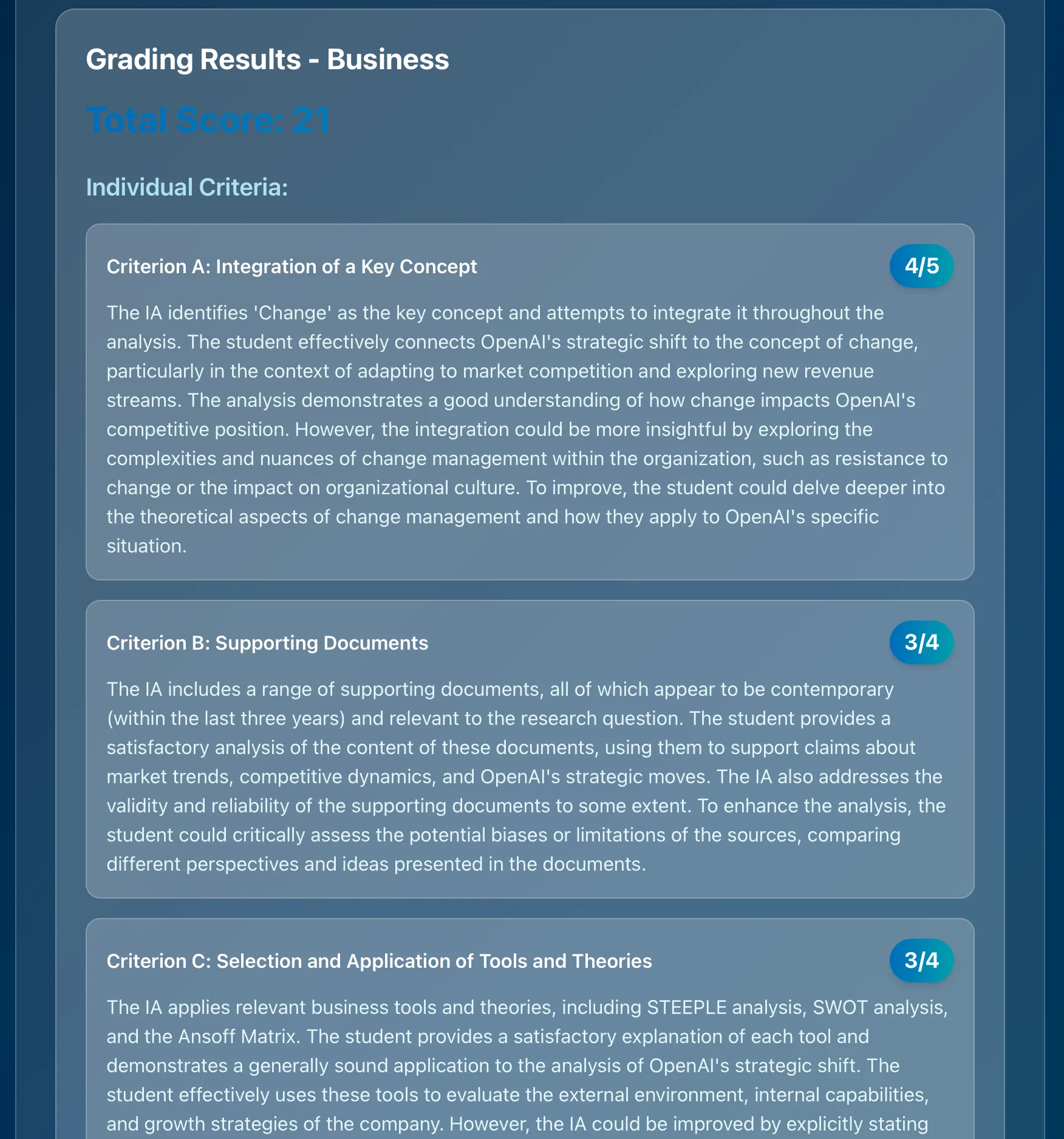
Check your own draft
Get estimated marks by criterion, comments on your writing, and a clear list of what to fix first.
Common Mistakes to Avoid
- Choosing a topic that is too broad: This can make it difficult to focus your research and analysis.
- Failing to develop a clear research question: This can lead to a lack of focus and direction.
- Using inappropriate research methods: This can result in unreliable data.
- Failing to analyze your data properly: This can lead to inaccurate conclusions.
- Writing a poorly organized report: This can make it difficult for the reader to understand your findings.
- Ignoring ethical considerations: This can damage your credibility and undermine your research.
The Role of AI in Modern Assessment
Modern technology is changing how we approach academic assessment. AI grading assistants can now help teachers maintain consistency and rubric alignment in their evaluations while saving valuable time. These tools use the same official IB criteria to provide detailed feedback and scoring, ensuring that assessments meet the high standards expected in IB programs.
For educators looking to simplify their internal assessment marking process while maintaining the quality and consistency that IB standards demand, AI grading assistance offers a powerful solution that complements traditional teaching methods. These tools can provide detailed feedback aligned with the assessment guidelines, helping students understand areas for improvement.
Conclusion
Mastering the Social and Cultural Anthropology Internal Assessment requires a thorough understanding of the social and cultural anthropology internal assessment criteria. By carefully reviewing the rubric, following the tips outlined in this guide, and avoiding common mistakes, you can significantly improve your chances of achieving a high score. Remember to start early, seek feedback, and present your work in a clear and well-organized manner. Good luck!
Looking for more support with IB draft grading? Discover how AI grading assistants can help maintain consistency and rubric alignment in your evaluations while saving valuable time. Learn more about modern grading solutions designed specifically for IB educators.