IB Sports Science IA Criteria Explained: What Examiners Look For
The Sports Science Internal Assessment (IA) is a crucial component of the IB Sports, Exercise and Health Science course, representing a significant portion of your final grade. Understanding the sports science internal assessment criteria is paramount to achieving a high score. This guide provides a detailed breakdown of each criterion, offering practical tips and examples to help you excel. We'll explore the IB sports science grading rubric, ensuring you understand exactly what examiners are looking for.
What is the Sports Science Internal Assessment?
The Sports Science Internal Assessment is an individual research project where students apply their knowledge and understanding of sports science principles to investigate a topic of their choice. It involves formulating a research question), designing a methodology, collecting and analyzing data, and evaluating the investigation. It's an opportunity to demonstrate your critical thinking, research skills, and scientific understanding.
Stuck on your IB draft?
Get instant, detailed feedback on structure, evidence, and reasoning, then compare it with your current school materials.
Understanding the Grading Criteria
The IB Sports Science IA is assessed against five criteria: Personal Engagement, Exploration, Analysis, Evaluation, and Communication. Each criterion is worth a specific number of marks, totaling 24 marks. Understanding the specific requirements of each criterion is essential for success. The assessment is criterion-referenced, meaning your work is judged against pre-defined standards, not against the performance of other students.
Detailed Breakdown of Sports Science Internal Assessment Criteria
Let's delve into each criterion, outlining what is assessed, the mark bands, and practical tips for success.
Criterion names, marks, and mark bands below follow the IB subject guide. The band descriptions are our own plain-English summaries, so check your subject guide for the exact wording.
Criterion A: Personal Engagement (2 marks)
What it assesses: How clearly the investigation shows your own thinking, initiative, and interest.
Mark bands:
- 0 marks: Nothing in the work reaches the lowest band.
- 1 mark: Limited personal engagement: little independent thinking, a rationale without personal significance, and little personal input.
- 2 marks: Clear personal engagement: significant independent thinking, a personally meaningful rationale, and evident personal input into design and presentation.
Tips for success:
- Choose a topic you're genuinely interested in. This will make the research process more enjoyable and allow your passion to shine through.
- Clearly explain your rationale for choosing the topic. Why is this research question important to you? How does it relate to your personal experiences or interests in sports science?
- Demonstrate initiative in the design or implementation of the investigation. This could involve adapting a standard methodology, developing a novel approach, or troubleshooting unexpected challenges.
Common mistakes to avoid:
- Selecting a generic topic that lacks personal relevance.
- Failing to explain your rationale for choosing the topic.
- Simply following a pre-existing protocol without demonstrating any independent thought or creativity.
Criterion B: Exploration (6 marks)
What it assesses: How focused the research question is, and how suitable the background, method, and safety, ethical, and environmental awareness are.
Mark bands:
- 0 marks: Nothing in the work reaches the lowest band.
- 1-2 marks: An unfocused question of some relevance, superficial background, a method of very limited suitability, and limited awareness of safety, ethics, or environment.
- 3-4 marks: A relevant but not fully focused question, mainly suitable background, a mainly suitable method with limitations, and some awareness of safety, ethics, or environment.
- 5-6 marks: A relevant, fully focused question, entirely suitable background, a highly suitable method, and full awareness of safety, ethics, and environment.
Tips for success:
- Develop a focused research question. Avoid broad or vague questions that are difficult to investigate.
- Provide sufficient background information. Explain the scientific concepts and theories relevant to your research question.
- Design a detailed and appropriate methodology. Clearly outline the procedures you will follow, the materials you will use, and the data you will collect.
- Address safety, ethical, and environmental considerations. Identify potential risks and explain how you will mitigate them.
Common mistakes to avoid:
- Formulating a research question that is too broad or too narrow.
- Failing to provide sufficient background information to support the investigation.
- Designing a methodology that is flawed or inappropriate for the research question.
- Neglecting to address safety, ethical, or environmental considerations.
Criterion C: Analysis (6 marks)
What it assesses: How well you record, process, and interpret enough relevant data, including uncertainty.
Mark bands:
- 0 marks: Nothing in the work reaches the lowest band.
- 1-2 marks: Too little relevant raw data, processing too inaccurate or insufficient, little attention to uncertainty, and incorrect or insufficient interpretation.
- 3-4 marks: Relevant but incomplete raw data, suitable but inconsistent processing, some attention to uncertainty, and broadly valid but incomplete interpretation.
- 5-6 marks: Enough relevant raw data, suitable and accurate processing, full attention to uncertainty, and correct, detailed interpretation.
Tips for success:
- Collect sufficient relevant data. Ensure you have enough data to draw meaningful conclusions.
- Process the data accurately and appropriately. Use appropriate statistical techniques to analyze your data.
- Acknowledge and address measurement uncertainty. Explain how measurement errors could affect your results.
- Interpret the data in relation to your research question. Explain what the data means and how it supports or refutes your hypothesis.
Common mistakes to avoid:
- Collecting insufficient or irrelevant data.
- Processing the data incorrectly or using inappropriate statistical techniques.
- Failing to acknowledge or address measurement uncertainty.
- Misinterpreting the data or drawing unsupported conclusions.
Criterion D: Evaluation (6 marks)
What it assesses: How well the conclusion is supported and compared with scientific context, and how well you discuss limitations and improvements.
Mark bands:
- 0 marks: Nothing in the work reaches the lowest band.
- 1-2 marks: The conclusion is irrelevant or unsupported, the comparison with scientific context is superficial, and limitations and improvements are only outlined.
- 3-4 marks: A relevant conclusion backed by the data, a partial comparison with the scientific context, described limitations, and some realistic improvements.
- 5-6 marks: A detailed, justified conclusion fully supported by data, a correct comparison with scientific context, and discussed limitations and realistic improvements.
Tips for success:
- Provide a clear and justified conclusion. State whether your data supports or refutes your hypothesis, and explain why.
- Compare your findings with existing scientific literature. How do your results compare to those of other researchers?
- Evaluate the strengths and weaknesses of your investigation. Identify potential sources of error and limitations of your methodology.
- Suggest realistic improvements for future investigations. How could the study be improved to address the limitations you identified?
Common mistakes to avoid:
- Drawing a conclusion that is not supported by the data.
- Failing to compare your findings with existing scientific literature.
- Ignoring the limitations of your investigation.
- Suggesting unrealistic or impractical improvements.
Criterion E: Communication (4 marks)
What it assesses: How clear, well structured, relevant, and concise the report is, with correct terminology and conventions.
Mark bands:
- 0 marks: Nothing in the work reaches the lowest band.
- 1-2 marks: Unclear presentation, poor structure with missing or confusing information, irrelevant material, and many terminology errors.
- 3-4 marks: Clear, well-structured, relevant, and concise presentation, with appropriate terminology and only minor errors.
Tips for success:
- Organize your report logically and clearly. Use headings, subheadings, and bullet points to structure your writing.
- Use appropriate terminology and conventions. Define any technical terms that may be unfamiliar to the reader.
- Write concisely and avoid jargon. Use clear and simple language to communicate your ideas.
- Proofread your report carefully for errors in grammar and spelling.
Common mistakes to avoid:
- Presenting the investigation in a disorganized or confusing manner.
- Using inappropriate terminology or conventions.
- Writing in a verbose or jargon-filled style.
- Failing to proofread the report for errors.
How to Excel in Your Sports Science Internal Assessment
- Start early: Don't leave the IA until the last minute. Give yourself plenty of time to plan, conduct, and write up your investigation.
- Seek feedback: Ask your teacher for feedback on your research question, methodology, and draft report.
- Follow the guidelines: Carefully read and follow the IB's guidelines for the Sports Science IA.
- Be organized: Keep track of your data, sources, and notes.
- Be critical: Evaluate your own work and identify areas for improvement.
- Manage your time effectively: Set realistic deadlines and stick to them.
- Review exemplar IAs: Analyze successful IAs to understand the expectations and standards.
Check your own draft
Get estimated marks by criterion, comments on your writing, and a clear list of what to fix first.
Common Mistakes to Avoid
- Poorly defined research question: A vague or overly broad research question will make it difficult to design and conduct a focused investigation.
- Inadequate background research: Failing to provide sufficient background information will weaken your understanding of the topic and your ability to interpret the results.
- Flawed methodology: A poorly designed methodology will lead to unreliable data and invalid conclusions.
- Insufficient data: Collecting too little data will make it difficult to draw meaningful conclusions.
- Inaccurate data processing: Errors in data processing will lead to incorrect results and flawed interpretations.
- Unjustified conclusions: Drawing conclusions that are not supported by the data will weaken your evaluation.
- Poor communication: Presenting the investigation in a disorganized or unclear manner will make it difficult for the examiner to understand your work.
The Role of AI in Modern Assessment
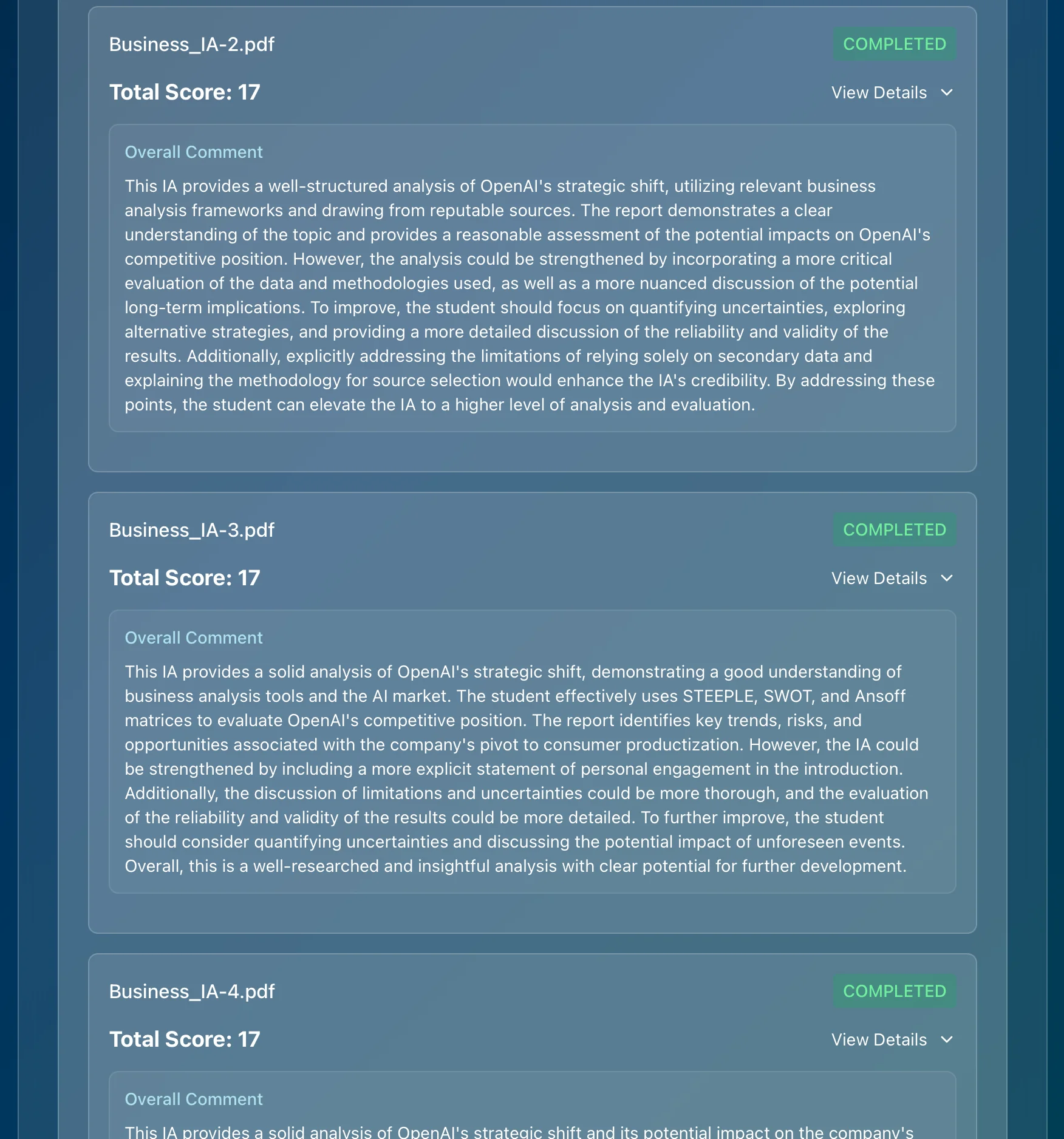
Modern technology is changing how we approach academic assessment. AI grading assistants can now help teachers maintain consistency and rubric alignment in their evaluations while saving valuable time. These tools use the same official IB criteria to provide detailed feedback and scoring, ensuring that assessments meet the high standards expected in IB programs.
For educators looking to simplify their grading process while maintaining the quality and consistency that IB assessments demand, AI grading assistance offers a powerful solution that complements traditional teaching methods.
Conclusion
Mastering the Sports Science Internal Assessment requires a thorough understanding of the grading criteria, careful planning, meticulous execution, and critical evaluation. By following the tips and advice outlined in this guide, you can increase your chances of achieving a high score and demonstrating your expertise in sports science. Remember to start early, seek feedback, and stay organized throughout the process. Good luck!
Looking for more support with IB draft grading? Discover how AI grading assistants can help maintain consistency and rubric alignment in your evaluations while saving valuable time. Learn more about modern grading solutions designed specifically for IB educators.