Using Your Extended Essay on University Applications
Your IB Extended Essay (EE) is more than just a graduation requirement; it's a powerful tool you can use to significantly strengthen your university applications. In this guide, we'll explore how to showcase the skills and knowledge gained through your EE to impress admissions committees and demonstrate your readiness for higher education. We'll cover everything from highlighting your research abilities to crafting compelling personal statements that incorporate your EE experience.
Introduction (Answer the Query Immediately)
The International Baccalaureate (IB) Extended Essay (EE) is a cornerstone of the IB Diploma Programme, demanding independent research and critical thinking. But did you know that this rigorous academic exercise can be a significant asset when applying to universities? Many students underestimate the power of the EE to showcase their intellectual curiosity, research skills, and dedication to a specific area of study. This guide will provide you with useful strategies on how to effectively use your EE experience to enhance your university applications, highlighting your strengths and setting you apart from other candidates. We'll explore how to articulate the skills you developed, the challenges you overcame, and the insights you gained throughout the EE process, changing it from a mere requirement into a compelling narrative that resonates with admissions officers.
Stuck on your IB draft?
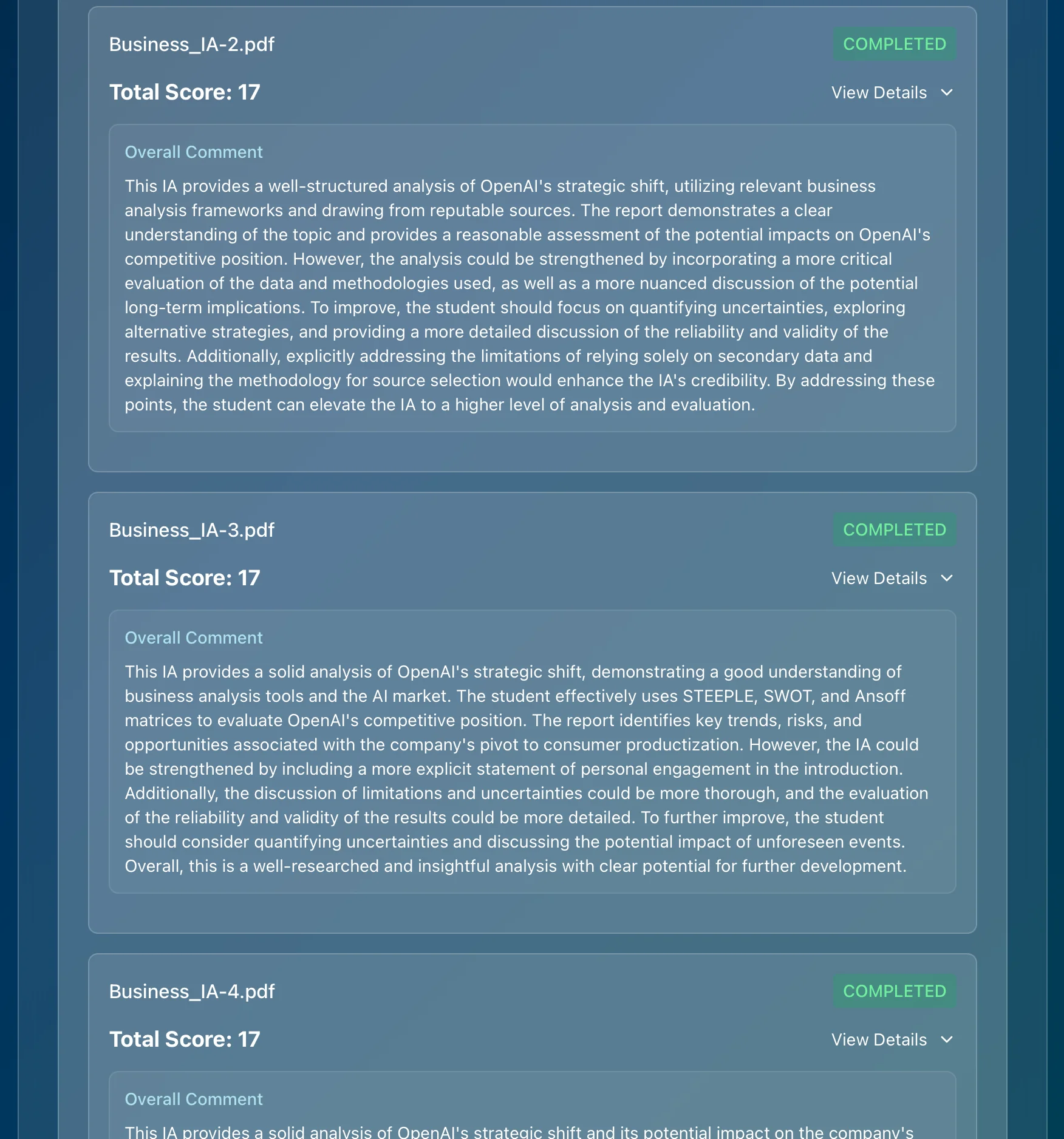
Get instant, detailed feedback on structure, evidence, and reasoning, then compare it with your current school materials.
Core Content Sections
Understanding the Value of Your Extended Essay
The EE is a substantial piece of independent research, typically around 4,000 words. It demonstrates several key qualities that universities value:
- Research Skills: The ability to formulate research questions, gather and analyze data, and draw informed conclusions.
- Critical Thinking: The capacity to evaluate information, identify biases, and construct logical arguments.
- Time Management: The discipline to plan, organize, and execute a complex project over an extended period.
- Subject-Specific Knowledge: A deep understanding of a particular area of study.
- Academic Integrity: Adherence to ethical research practices and proper citation methods.
Universities are looking for students who are not only academically strong but also possess the skills and mindset necessary to succeed in a demanding academic environment. Your EE provides concrete evidence that you possess these qualities.
Identifying Key Skills and Experiences from Your EE
Before you can effectively use your EE, you need to identify the specific skills and experiences you gained. Consider the following questions:
- What was your research question? How did you develop it, and why did you choose it?
- What research methods did you use? Did you conduct experiments, analyze data, or review existing literature?
- What challenges did you face, and how did you overcome them? This is a crucial area to highlight, as it demonstrates resilience and problem-solving skills.
- What were your key findings? What did you learn from your research, and how did it change your perspective?
- What are the limitations of your research? Acknowledging limitations demonstrates intellectual honesty and critical self-awareness.
- How did the EE process impact you personally and academically? Did it spark a new interest, solidify your career aspirations, or improve your writing skills?
Answering these questions will help you articulate the value of your EE in your university applications.
Showcasing Your EE in Your Personal Statement
Your personal statement is your opportunity to tell your story and demonstrate why you are a good fit for the university. Here's how to incorporate your EE experience:
- Connect your EE to your academic interests: Explain how your EE relates to the program you are applying for. For example, if you wrote an EE on the impact of climate change on coral reefs and are applying to a marine biology program, highlight the connection and explain how your research has fueled your passion for the field.
- Highlight the skills you developed: Use specific examples from your EE to illustrate your research, critical thinking, and problem-solving skills. Instead of simply stating that you are a good researcher, describe a specific challenge you faced during your research and how you overcame it.
- Discuss the impact of your EE on your personal growth: Explain how the EE process has shaped you as a student and as a person. Did it teach you the importance of perseverance, collaboration, or intellectual curiosity?
- Be specific and avoid generalizations: Use concrete examples and avoid vague statements. Instead of saying "I learned a lot from my EE," say "My EE taught me the importance of meticulous data analysis and the challenges of interpreting complex scientific findings."
- Tailor your statement to each university: Research the university's values and priorities and tailor your statement to demonstrate how your EE experience aligns with their mission.
Example:
"My Extended Essay, which explored the ethical implications of artificial intelligence in healthcare, ignited a passion for bioethics that I am eager to pursue at [University Name]. The rigorous research process, which involved analyzing complex philosophical arguments and conducting interviews with medical professionals, honed my critical thinking skills and taught me the importance of considering diverse perspectives. Overcoming the challenge of navigating conflicting ethical frameworks solidified my commitment to finding innovative solutions that prioritize patient well-being. I am confident that the research skills and ethical framework I developed through my EE will enable me to contribute meaningfully to the interdisciplinary field of bioethics at [University Name]."
Mentioning Your EE in Your Activities List
Your activities list provides a concise overview of your extracurricular activities and academic achievements. Include your EE and highlight its significance:
- Title: Extended Essay in [Subject]
- Description: Conducted independent research on [briefly state your research question]. Developed skills in [list key skills, such as research methodology, data analysis, critical thinking, and academic writing]. Achieved a grade of [state your grade].
- Quantify your achievements: If possible, quantify your achievements. For example, "Analyzed data from over 100 peer-reviewed articles" or "Presented research findings at a school-wide symposium."
Obtaining a Strong Recommendation Letter from Your EE Supervisor
Your EE supervisor can provide valuable insights into your research abilities, work ethic, and intellectual curiosity. Ask your supervisor to write a recommendation letter that highlights the following:
- Your research skills: How effectively did you formulate your research question, gather and analyze data, and draw conclusions?
- Your critical thinking abilities: How well did you evaluate information, identify biases, and construct logical arguments?
- Your work ethic and dedication: How committed were you to the EE process, and how did you handle challenges and setbacks?
- Your intellectual curiosity: How passionate were you about your research topic, and how did you demonstrate a genuine desire to learn?
- Your overall potential: How well do you think you will succeed in university, based on your performance on the EE?
Provide your supervisor with a copy of your EE, your research proposal, and a list of your accomplishments to help them write a strong and informative letter.
Common Challenges/Mistakes Section
Many students struggle to effectively use their EE in their university applications. Here are some common challenges and mistakes to avoid:
- Failing to connect the EE to your academic interests: If your EE seems unrelated to your chosen field of study, it may not be as impactful. Make a clear connection between your EE and your academic goals.
- Focusing too much on the topic and not enough on the skills: While the topic of your EE is important, universities are more interested in the skills you developed and the lessons you learned.
- Using vague or generic language: Avoid vague statements and use specific examples to illustrate your skills and experiences.
- Not proofreading your application materials carefully: Errors in grammar and spelling can undermine your credibility. Proofread your application materials carefully before submitting them.
- Underestimating the value of your EE: Don't be afraid to highlight your accomplishments and showcase the skills you developed through the EE process.
Advanced Tips/Strategies Section
- Consider publishing your EE: If your EE is of high quality, consider submitting it to a student research journal or presenting it at a conference. This can significantly enhance your application and demonstrate your commitment to research.
- Use your EE as a starting point for further research: If you are passionate about your EE topic, consider continuing your research in university. This can demonstrate your intellectual curiosity and commitment to your field of study.
- Network with professionals in your field: Reach out to professors or researchers who are working on similar topics and ask for their advice and guidance. This can help you expand your knowledge and make valuable connections.
- Reflect on your EE experience: Take time to reflect on what you learned from the EE process and how it has shaped you as a student and as a person. This will help you articulate the value of your EE in your university applications.
Check your own draft
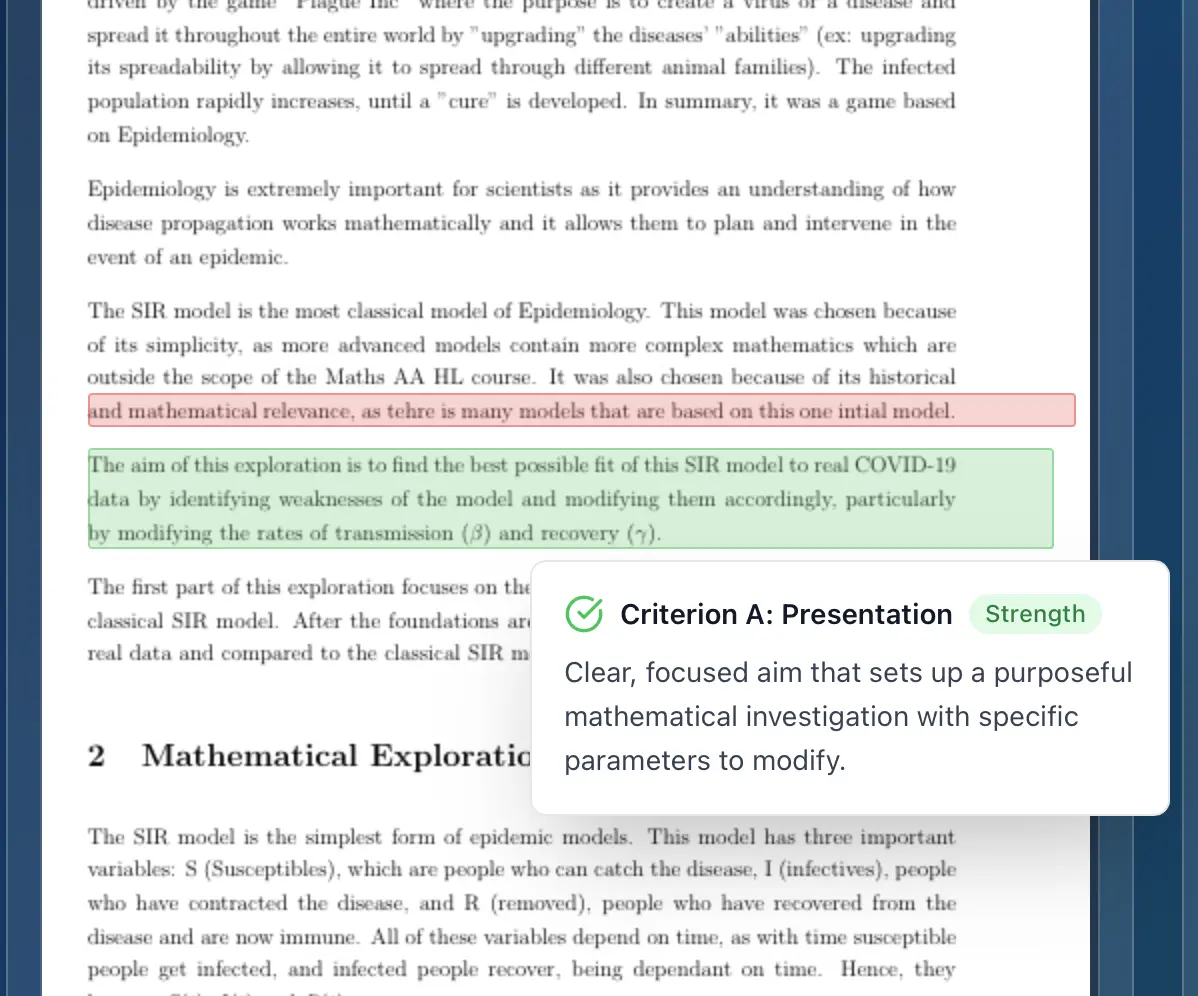
Get estimated marks by criterion, comments on your writing, and a clear list of what to fix first.
Technology and Modern Assessment Section
Technology is rapidly changing the landscape of education, and the IB is no exception. AI tools are becoming increasingly valuable for both students and teachers, particularly in the context of complex assessments like the Extended Essay. One of the biggest challenges for teachers is providing consistent, detailed, and rubric-aligned feedback on student work. This is where AI grading assistants like Marksy can make a significant difference.
Marksy uses advanced algorithms to analyze student essays based on official IB rubrics, providing instant, rubric-aligned feedback on each criterion. This not only saves teachers valuable time but also ensures that students receive clear and useful guidance on how to improve their work. The AI identifies areas of strength and weakness, suggests specific improvements, and helps students understand exactly what they need to do to achieve a higher grade.
Furthermore, AI tools like Marksy promote fairness and objectivity in assessment. By applying the IB rubrics consistently across all student submissions, these tools minimize the potential for bias and ensure that every student is evaluated according to the same standards. This is particularly important for the Extended Essay, which is a significant component of the IB Diploma Programme.
For students, understanding the nuances of the IB rubrics can be challenging. Marksy provides a detailed breakdown of each criterion, making it easier for students to understand what is expected of them and how their work will be assessed. This can help students to take ownership of their learning and make targeted improvements to their essays.
Conclusion with Clear Next Steps
Your IB Extended Essay is a valuable asset that can significantly enhance your university applications. By understanding the skills and experiences you gained through the EE process and effectively showcasing them in your personal statement, activities list, and recommendation letters, you can demonstrate your readiness for higher education and set yourself apart from other candidates.
Next Steps:
- Reflect on your EE experience: Identify the key skills and experiences you gained.
- Craft a compelling narrative: Develop a personal statement that highlights your EE and its impact on your academic interests and personal growth.
- Obtain a strong recommendation letter: Ask your EE supervisor to write a letter that showcases your research abilities and potential.
- Explore AI grading assistance: Consider using tools like Marksy to gain a deeper understanding of the IB rubrics and improve your essay writing skills.
Want to improve your IB Extended Essay? Try Marksy for free today and see what the feedback points out to improve your IB scores and simplify your grading process. Visit our website to sign up for a free trial and discover how Marksy can help you succeed in the IB Diploma Programme.