Question 2

Biology HL Paper 1B (May 2025, TZ2)

  1. The diagram shows levels of DDT, a pesticide, in an aquatic food web in Lake Kariba, Africa. Numbers represent ppm (parts per million) of DDT in fat tissue.
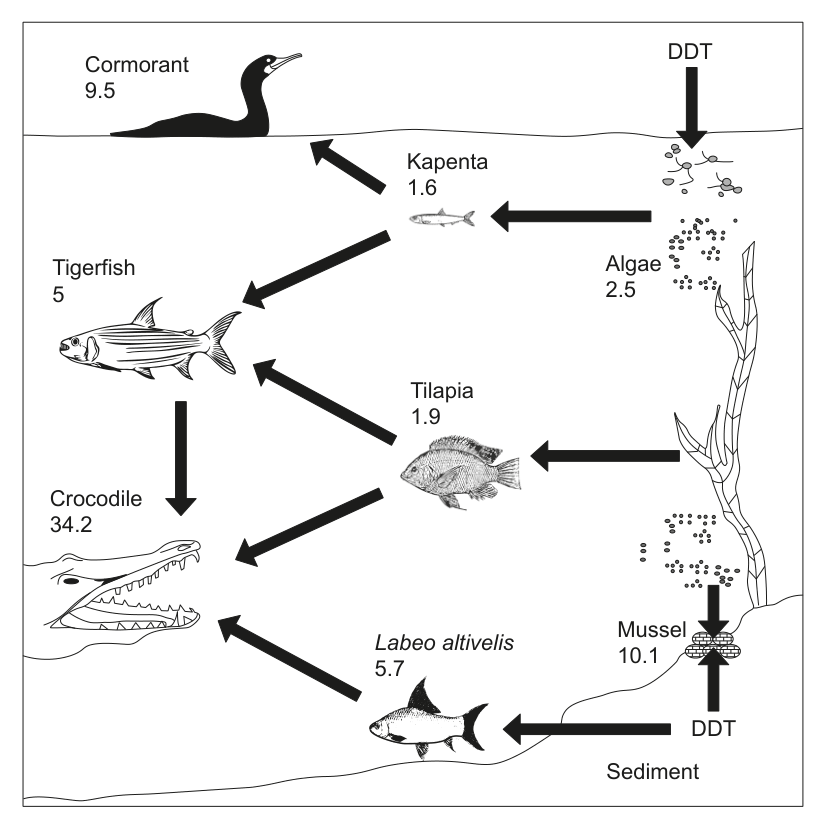
Diagram illustrating an aquatic food web in Lake Kariba, Africa, with various organisms (Cormorant, Kapenta, Algae, Tigerfish, Tilapia, Labeo altivelis, Mussel, Crocodile) and their respective DDT levels in ppm, along with arrows indicating energy flow and DDT input from sediment.

(a) Justify the observation that the crocodile has a higher mean DDT level than the cormorant or tigerfish. [2]

(b) Identify, with a reason, which fish would be the safest to consume. [2]

(c) Outline how the population size of tilapia could be estimated. [3]

(d) Discuss the impact of overfishing in Lake Kariba and how sustainable harvesting of resources can be assessed. [4]