Question 9

From Physics HL Paper 2 (May 2024, TZ2)

  1. (a) A conducting rod of length L is moved with speed v at right angles to a uniform magnetic field of flux density B. The field is directed into the plane of the page.
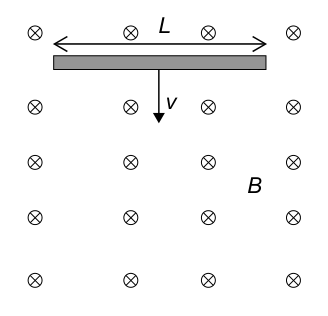
A diagram illustrating a conducting rod of length L moving with speed v at right angles to a uniform magnetic field B, which is directed into the plane of the page. The magnetic field is represented by 'X' symbols.

(i) Show, using Faraday’s law or otherwise, that the potential difference, V, established between the ends of the rod is V = vBL. [3]

(ii) Identify the end of the rod that becomes negatively charged. [1]

(b) A coil is rotating in a region of magnetic field with angular speed 12.56 rad s⁻¹. At t = 0, the field is parallel to the surface of the coil.
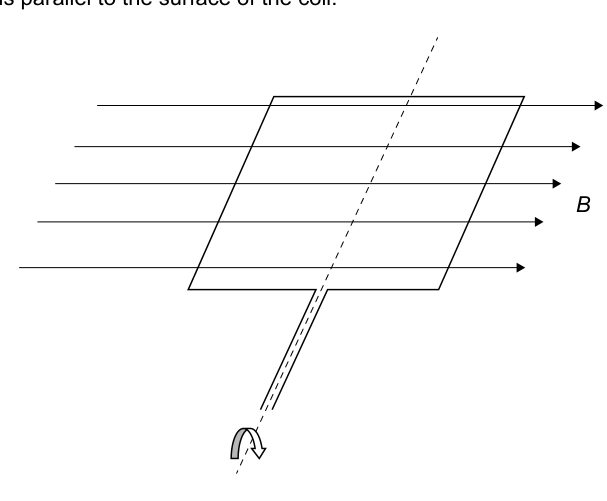
A diagram illustrating a coil rotating in a magnetic field, with magnetic field lines (B) shown parallel to the coil's surface. An arrow indicates the rotation of the coil.

(i) State the magnetic flux linkage through the coil at t = 0. [1]

(ii) Draw, on the axes, a graph to show the variation with time of the induced emf in the loop. (No numbers are required on the vertical axis.) [2]
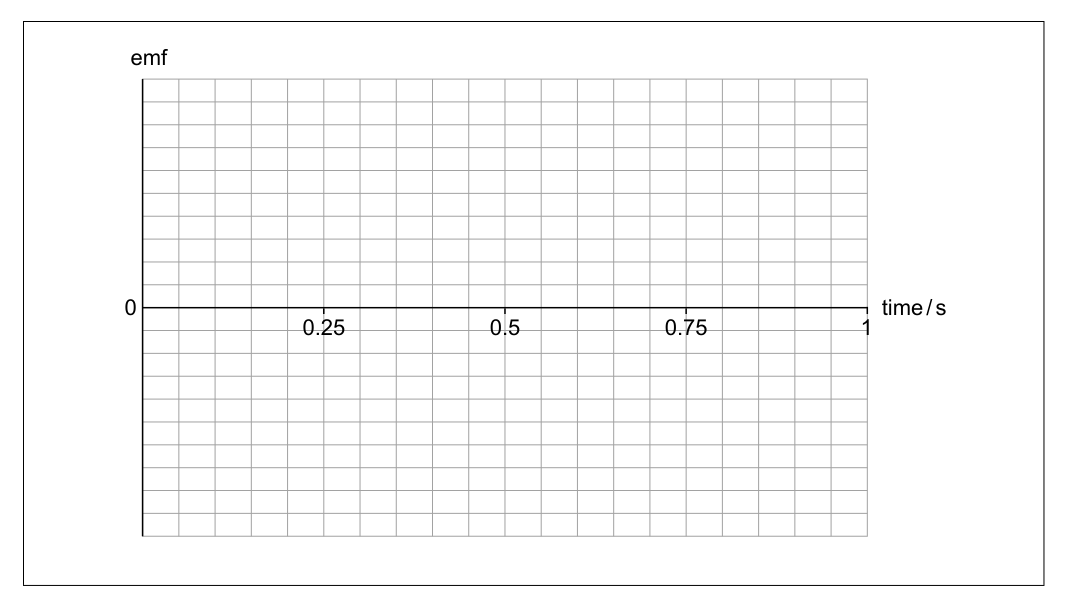
Graph with time on the x-axis and emf on the y-axis, with labels 0, 0.25, 0.5, 0.75, 1 on the x-axis.

(c) A capacitor is connected to a cell. The switch S is closed and the capacitor becomes fully charged.
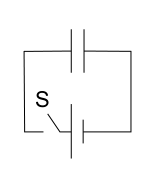
A circuit diagram showing a capacitor connected to a switch S.

A dielectric is then inserted in between the plates of the capacitor. Suggest what, if anything, will happen to the charge on one plate of the capacitor. [2]

Textbook topics in this question

Review the exact course sections assessed by each question part.

Mixed-topic question