Question 1

From Physics HL Paper 1B (May 2025, TZ1)

  1. A student is analysing a sample of water. To determine its density, the student measures the volume with a measuring cylinder and the mass with an electronic balance.

(a) Identify one way to ensure that the volume is read accurately. [1]

The following data are collected:
Volume = (10.6 ± 0.2) cm³
Mass = (10.82 ± 0.01) g

(b) (i) Calculate the density of the sample and its absolute uncertainty. [2]

(ii) State your answers in kg m⁻³ and with correct precision. [1]

(Question 1 continued)
When the density was measured, the sample was at 35°C. The student has a graph that shows the variation with temperature of the density of pure water.
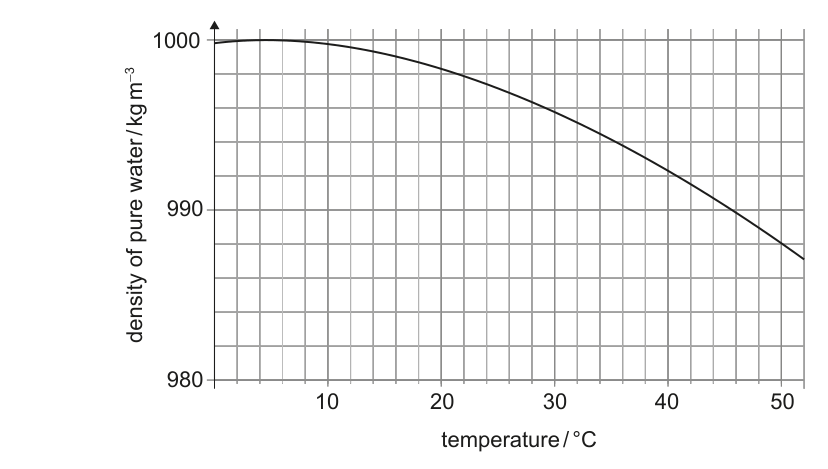
A line graph showing the density of pure water in kgm^-3 on the y-axis against temperature in °C on the x-axis. The density decreases as temperature increases.

(c) Suggest whether the water sample can be considered pure. [2]

Textbook topics in this question

Review the exact course sections assessed by each question part.

Mixed-topic question
1(a)Experimental measurement technique · legacy topic
1(b)(i)7.1 Particles, Temperature, and Internal EnergyMeasurement uncertainty propagation · legacy topic
1(b)(ii)SI unit conversion and significant figures · legacy topic
1(c)7.1 Particles, Temperature, and Internal EnergyExperimental conclusion from uncertainty · legacy topic