IB Business IA Criteria Explained: What Examiners Look For
Understanding the business internal assessment criteria is crucial for success in your IB Business Management course. This guide provides a detailed breakdown of the IB business grading rubric, offering practical insights and useful advice to help students, teachers, and parents navigate the business assessment rubric effectively. We'll explore each criterion, offering tips and examples to maximize your score and understand the IB grading criteria.
What is the Business Internal Assessment?
The Business Internal Assessment (IA) is a significant component of the IB Business Management course, accounting for 25% of the final grade at SL and 20% at HL. It's an individual research project where students investigate a real-world business issue or opportunity. The IA requires students to apply business management tools, theories, and concepts to analyze the chosen topic and draw well-supported conclusions. It’s a chance to demonstrate your understanding of business principles in a practical context.
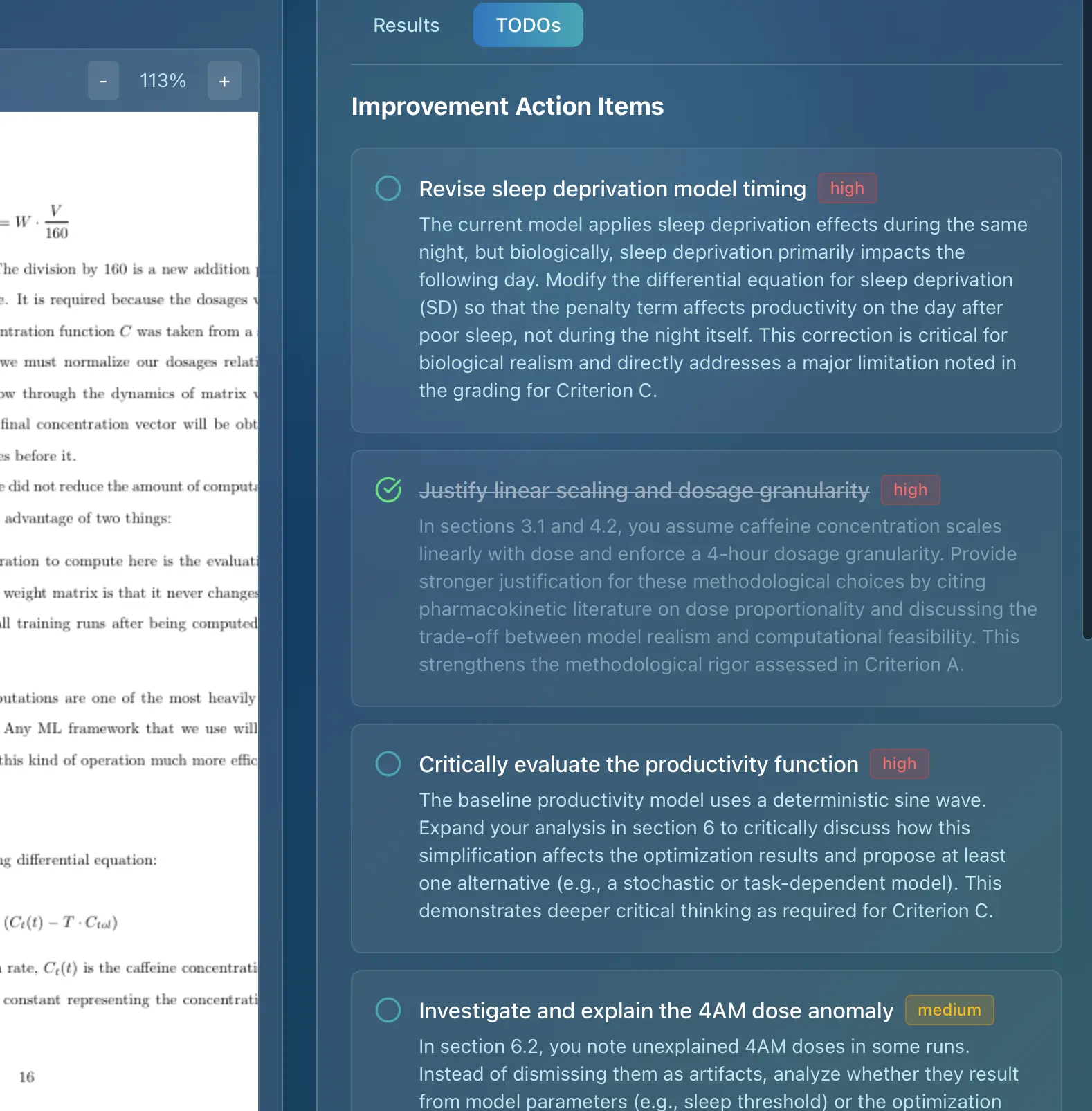
Stuck on your IB draft?
Get instant, detailed feedback on structure, evidence, and reasoning, then compare it with your current school materials.
Understanding the Grading Criteria
The IB Business IA is assessed against seven criteria, each focusing on different aspects of the research process and presentation. These criteria ensure a holistic evaluation of the student's understanding and application of business management principles. Each criterion carries a specific weight, contributing to the overall IA score. Understanding these criteria is the first step to achieving a high grade.
Detailed Breakdown of Business Internal Assessment Criteria
Criterion names, marks, and mark bands below follow the IB subject guide. The band descriptions are our own plain-English summaries, so check your subject guide for the exact wording.
Criterion A: Integration of a key concept (5 marks)
What it assesses: How well one key concept (change, creativity, ethics, or sustainability) is analysed and woven through the project.
Mark bands:
- 0 marks: Nothing in the work reaches the lowest band.
- 1 mark: Shows knowledge of the key concept.
- 2 marks: Describes how the key concept connects to the organization.
- 3 marks: Analyses how the key concept applies to the organization.
- 4 marks: Partly integrates that analysis into the project.
- 5 marks: Integrates that analysis effectively throughout the project.
Tips for success:
- Choose a key concept that is genuinely relevant to your research question) and the organization.
- Explicitly state how the key concept influences the business decisions and outcomes.
- Provide specific examples and evidence to support your analysis.
- Common mistakes to avoid: Selecting a key concept that is only tangentially related to the topic or failing to consistently integrate the concept throughout the IA.
Criterion B: Supporting documents (4 marks)
What it assesses: Whether you use three to five relevant supporting documents with enough depth and a range of views.
Mark bands:
- 0 marks: Nothing in the work reaches the lowest band.
- 1 mark: Fewer than three or more than five documents, or they are barely relevant.
- 2 marks: Three to five generally relevant documents, some lacking depth.
- 3 marks: Three to five relevant documents with enough depth.
- 4 marks: Three to five relevant, in-depth documents that offer a range of ideas and views.
Tips for success:
- Select supporting documents that are recent (within the last three years) and directly relevant to your research question.
- Critically evaluate the validity and reliability of each document. Consider the source, author, and potential biases.
- Analyze the documents in detail, highlighting different perspectives and ideas.
- Common mistakes to avoid: Using outdated or irrelevant documents, failing to assess the validity and reliability of the documents, or simply summarizing the documents without providing analysis.
Criterion C: Selection and application of tools and theories (4 marks)
What it assesses: How well business management tools and theories are chosen and applied to the research question.
Mark bands:
- 0 marks: Nothing in the work reaches the lowest band.
- 1 mark: Few tools or theories are used, or they don't fit the question.
- 2 marks: Some tools and theories are applied, but their relevance is superficial.
- 3 marks: Tools and theories are adequately chosen and applied, though their relevance is not always clear.
- 4 marks: Tools and theories are well chosen and applied with clear relevance to the question.
Tips for success:
- Choose business tools and theories that are appropriate for your research question and the data you have collected.
- Clearly explain the chosen tools and theories, demonstrating your understanding of their principles.
- Apply the tools and theories in a comprehensive and insightful manner, drawing meaningful conclusions from your analysis.
- Discuss the strengths and weaknesses of your findings based on the tools and theories used.
- Common mistakes to avoid: Selecting inappropriate tools or theories, failing to explain the tools and theories clearly, or applying the tools and theories superficially.
Criterion D: Analysis and evaluation (5 marks)
What it assesses: How effectively data from the supporting documents is used to analyse and evaluate the research question.
Mark bands:
- 0 marks: Nothing in the work reaches the lowest band.
- 1 mark: Little data from the documents and no analysis or evaluation.
- 2 marks: Superficial use of document data, leading to limited analysis and evaluation.
- 3 marks: Adequate use of document data with some analysis and evaluation.
- 4 marks: Enough document data and mostly effective analysis and evaluation, with some integration of ideas.
- 5 marks: Effective use of document data, thorough analysis and evaluation, and sustained integration of ideas that weighs assumptions and implications.
Tips for success:
- Go beyond simply describing the data and findings. Analyze their implications and significance.
- Evaluate the strengths and weaknesses of the data and findings. Consider potential biases and limitations.
- Integrate ideas from different sources to create a coherent and insightful analysis.
- Ensure your analysis is logical and well-supported by evidence.
- Common mistakes to avoid: Providing superficial analysis, failing to evaluate the data critically, or presenting a disjointed analysis.
Criterion E: Conclusions (3 marks)
What it assesses: Whether the conclusions follow from the evidence and explicitly answer the research question.
Mark bands:
- 0 marks: Nothing in the work reaches the lowest band.
- 1 mark: Conclusions are superficial or do not match the evidence.
- 2 marks: Some conclusions match the evidence.
- 3 marks: Conclusions match the evidence and clearly answer the research question.
Tips for success:
- Ensure your conclusions directly answer your research question.
- Justify your conclusions with evidence from your analysis.
- Avoid introducing new information in the conclusion.
- Offer realistic and appropriate ideas for extending the study.
- Common mistakes to avoid: Drawing conclusions that are not supported by the evidence, introducing new information in the conclusion, or failing to address the research question directly.
Criterion F: Structure (2 marks)
What it assesses: Whether the project is organized with an appropriate structure.
Mark bands:
- 0 marks: Nothing in the work reaches the lowest band.
- 1 mark: The structure is limited.
- 2 marks: The structure is appropriate.
Tips for success:
- Use a clear and logical structure, with a well-defined introduction, main body, and conclusion.
- Ensure your argument is consistent and easy to follow.
- Provide context and background information in the introduction.
- Present and analyze your findings in the main body.
- Answer your research question in the conclusion.
- Common mistakes to avoid: Presenting a disorganized IA, failing to provide context, or presenting a confusing argument.
Criterion G: Presentation (2 marks)
What it assesses: Whether the project includes the required presentation elements: title page, accurate table of contents, headings and subheadings, and numbered pages.
Mark bands:
- 0 marks: Nothing in the work reaches the lowest band.
- 1 mark: At least one required element is missing (title page, accurate contents, headings, page numbers).
- 2 marks: All required presentation elements are present.
Tips for success:
- Adhere to the word limit.
- Include all essential elements, such as a title page, table of contents, page numbers, and bibliography.
- Use appropriate formatting, including headings and sub-headings.
- Cite your sources correctly and consistently.
- Common mistakes to avoid: Exceeding the word limit, omitting essential elements, using poor formatting, or failing to cite sources correctly.
Good to know:
- The business research project has a limit of 1,800 words; work beyond it is not read.
- A key concept other than change, creativity, ethics, or sustainability scores 0 for criterion A.
How to Excel in Your Business Internal Assessment
- Start Early: Don't wait until the last minute. Begin your research and writing process well in advance to allow ample time for analysis and revision.
- Choose a Relevant Topic: Select a topic that genuinely interests you and aligns with your strengths. This will make the research process more engaging and improve the quality of your work.
- Develop a Clear Research Question: A well-defined research question is crucial for focusing your investigation and guiding your analysis.
- Seek Feedback: Regularly seek feedback from your teacher or peers throughout the IA process. This will help you identify areas for improvement and refine your work.
- Proofread Carefully: Before submitting your IA, proofread it carefully for any errors in grammar, spelling, or formatting.
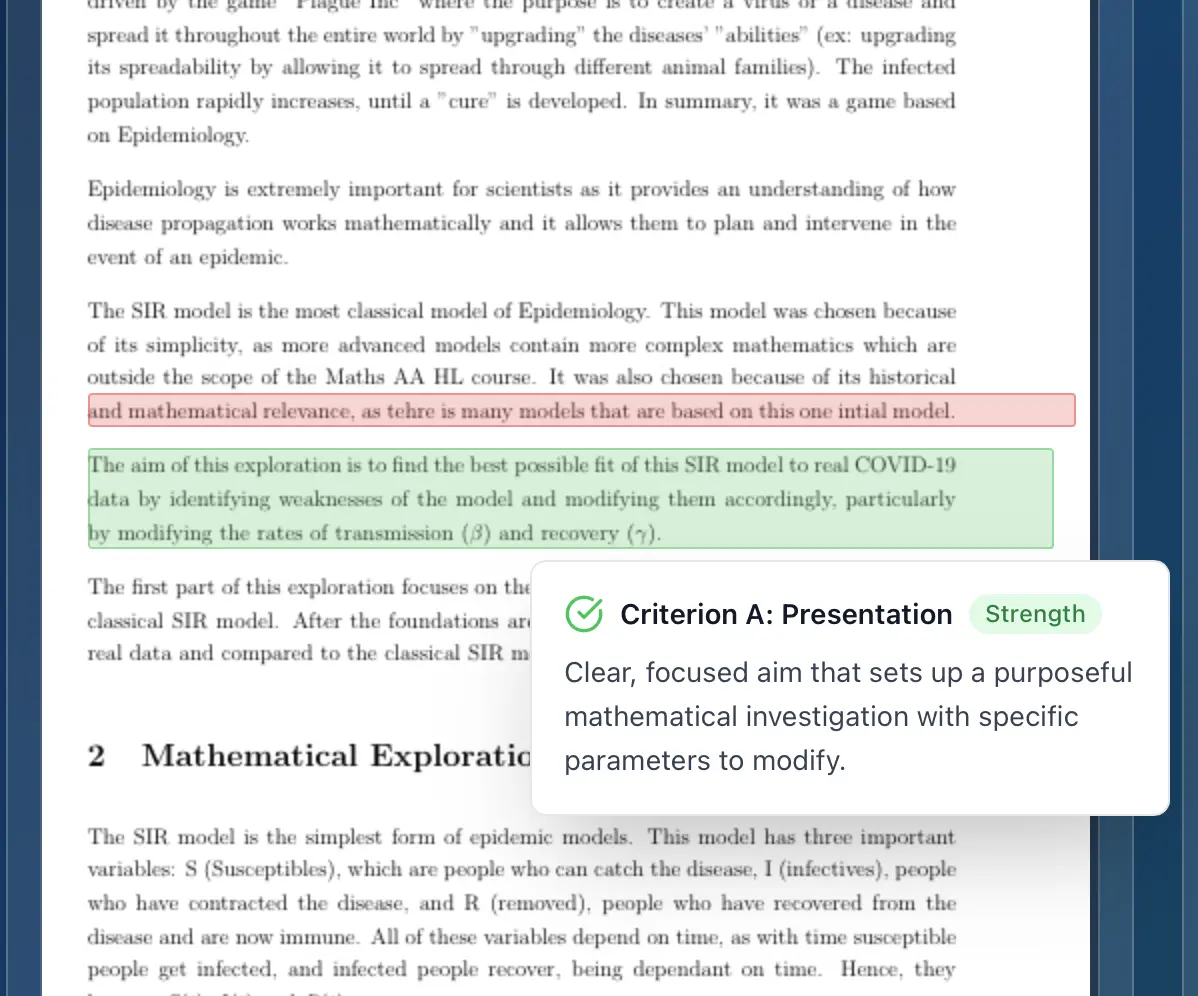
Check your own draft
Get estimated marks by criterion, comments on your writing, and a clear list of what to fix first.
Common Mistakes to Avoid
- Superficial Analysis: Avoid providing a shallow analysis of the data and findings. Strive for depth and critical thinking.
- Lack of Justification: Ensure that all your claims and conclusions are well-supported by evidence from your research.
- Inappropriate Tools and Theories: Select business tools and theories that are relevant to your research question and the data you have collected.
- Poor Structure and Presentation: Pay attention to the structure and presentation of your IA to ensure it is well-organized and easy to follow.
- Plagiarism: Always cite your sources correctly and avoid plagiarism.
The Role of AI in Modern Assessment
Modern technology is changing how we approach academic assessment. AI grading assistants can now help teachers maintain consistency and rubric alignment in their evaluations while saving valuable time. These tools use the same official IB criteria to provide detailed feedback and scoring, ensuring that assessments meet the high standards expected in IB programs.
For educators looking to simplify their internal assessment marking process while maintaining the quality and consistency that IB standards demand, AI grading assistance offers a process that complements traditional teaching methods and keeps feedback connected to the assessment criteria.
Conclusion
Mastering the business internal assessment criteria is essential for achieving success in your IB Business Management course. By understanding the IB business grading rubric, applying the tips and advice provided in this guide, and avoiding common mistakes, you can significantly improve your IA score. Remember to start early, seek feedback, and present your work in a clear and organized manner.
Looking for more support with IB draft grading? Discover how AI grading assistants can help maintain consistency and rubric alignment in your evaluations while saving valuable time. Learn more about modern grading solutions designed specifically for IB educators.