IB Computer Science IA: Choosing the Right Solution for Criterion C
Struggling with your IB Computer Science Internal Assessment (IA)? You're not alone! The IA is a significant component of your final IB Computer Science grade, and mastering it can feel daunting. This ultimate guide provides a clear breakdown of the IA requirements, offering expert tips, strategies, and examples to help you plan, develop, and evaluate your project effectively. Whether you're just starting or looking to refine your work, this guide will equip you with the knowledge and tools you need to succeed and achieve a top score in your IB Computer Science IA. We'll cover everything from choosing the right project to understanding the grading criteria, ensuring you're well-prepared for this crucial assessment.
Understanding the IB CS Internal Assessment
The Internal Assessment in IB Computer Science is a project-based assessment where you, as a student, independently design, develop, and evaluate a computational solution to a problem. This project allows you to demonstrate your understanding of computer science concepts and your ability to apply them in a practical context. It's a significant part of your overall grade, so understanding the requirements and excelling in this assessment is crucial.
Why is the IA Important?
The IA is worth 20% of your final IB Computer Science grade at HL (Higher Level) and 30% at SL (Standard Level). Beyond the grade, the IA provides a valuable opportunity to develop essential skills such as problem-solving, critical thinking, and project management – skills that are highly valued in higher education and the professional world.
The IA Structure: A Criterion-Based Approach
The IA is assessed based on five criteria, each focusing on a different aspect of the project:
- Criterion A: Planning (6 marks): This assesses your ability to define a clear scenario, justify your proposed solution, and establish measurable success criteria.
- Criterion B: Solution Overview (6 marks): This assesses your ability to document the development process and provide a detailed design overview.
- Criterion C: Development (12 marks): This assesses your ability to implement the proposed solution, demonstrating appropriate techniques and justifying your choices.
- Criterion D: Functionality and Extensibility of Product (4 marks): This assesses the functionality of the product and its potential for future development and maintenance.
- Criterion E: Evaluation (6 marks): This assesses your ability to evaluate the product against the success criteria and provide recommendations for future development.
Understanding these criteria is the first step towards achieving a high score. Let's dive into each criterion in detail.
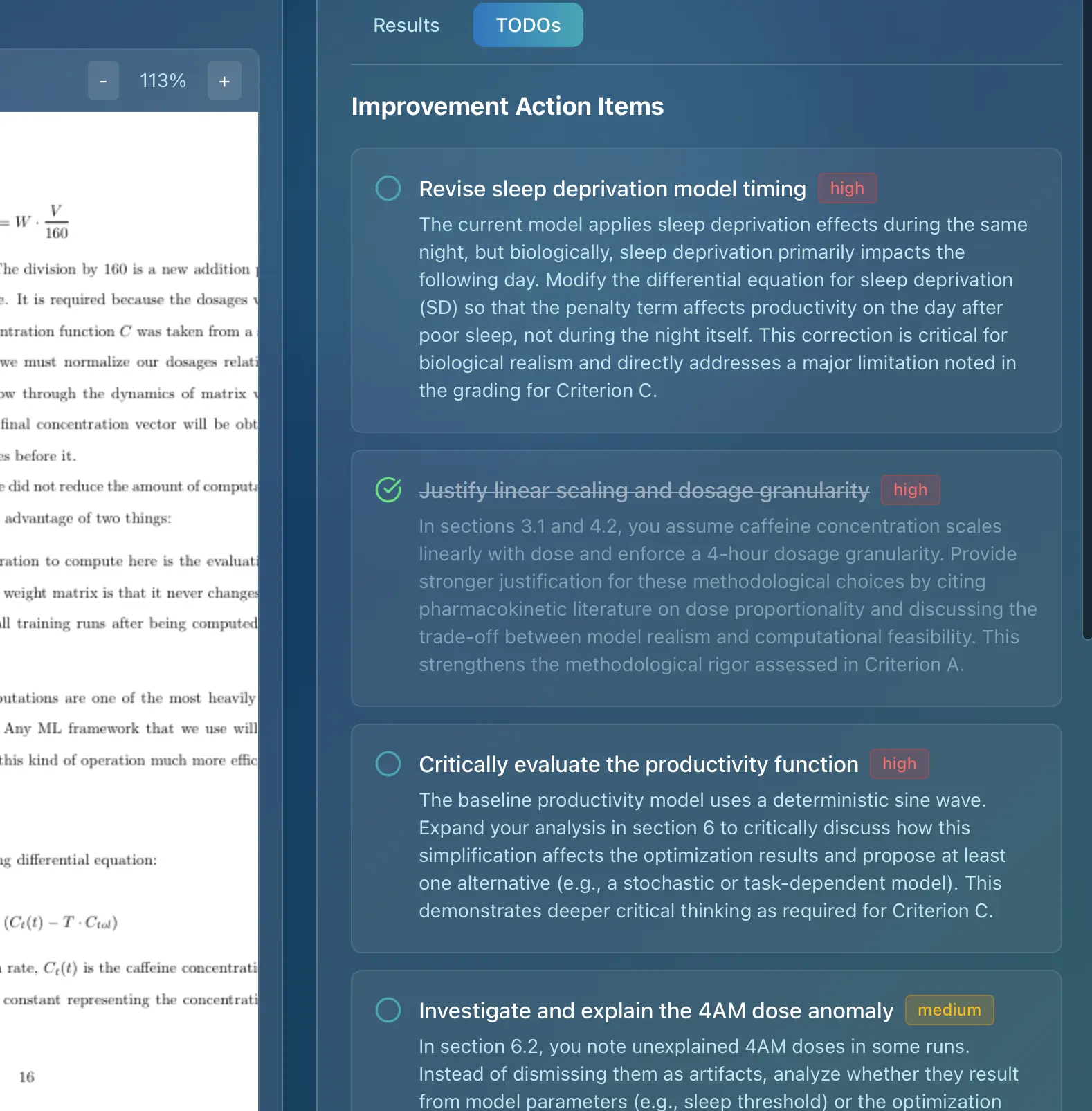
Stuck on your IB draft?
Get instant, detailed feedback on structure, evidence, and reasoning, then compare it with your current school materials.
Criterion A: Planning - Laying the Foundation for Success
Criterion A is all about setting the stage for your project. It focuses on the initial planning stages and ensures that your project is well-defined and justified.
Defining a Clear Scenario
The first step is to identify a real-world problem or need that your project will address. This scenario should be specific and relevant.
- Example (Good): A local library needs a system to manage its book inventory, track loans, and generate reports on popular titles.
- Example (Weak): A game. (Too broad and lacks a clear client or purpose)
Key Tip: Choose a scenario that genuinely interests you and aligns with your skills. This will make the project more engaging and easier to manage.
Justifying the Proposed Solution
Once you have a scenario, you need to explain why your proposed solution is the best approach. Consider alternative solutions and explain why your chosen approach is more effective or efficient.
- Example: "A database-driven system is the most suitable solution for the library because it allows for efficient storage and retrieval of information, supports complex queries, and can be easily scaled to accommodate future growth."
Key Tip: Research existing solutions and identify their limitations. This will strengthen your justification for your proposed solution.
Establishing Measurable Success Criteria
Success criteria are the benchmarks you will use to evaluate the success of your project. These criteria should be specific, measurable, achievable, relevant, and time-bound (SMART).
- Example:
- The system should allow librarians to add, edit, and delete book records within 5 seconds.
- The system should generate a report of overdue books within 10 seconds.
- The system should accurately track book loans with 99% accuracy.
Key Tip: Consult with your client (e.g., the librarian) to identify their specific needs and expectations. This will ensure that your success criteria are relevant and meaningful.
Demonstrating Client Consultation
Document your communication with your client or advisor. This could include meeting notes, emails, or interviews. This demonstrates that your project is driven by real-world needs and that you have considered the client's perspective.
Mark Allocation Breakdown for Criterion A:
- 0 Marks: Nothing in the work reaches the lowest band.
- 1-2 Marks: A suitable scenario and client are stated and the product choice is identified, but the success criteria are mostly unsuitable.
- 3-4 Marks: The scenario is stated with evidence of client consultation, the product choice is partly explained, and some suitable success criteria are given.
- 5-6 Marks: The scenario is described with evidence of consultation, the product choice is justified, and a range of suitable success criteria is given.
Criterion B: Solution Overview - Mapping Out Your Project
Criterion B focuses on documenting your development process and providing a detailed design overview.
Record of Tasks
Maintain a detailed record of the tasks you undertake throughout the project. This could be a Gantt chart, a Kanban board, or a simple task list.
- Example:
- Week 1: Requirements gathering and analysis.
- Week 2: Database design.
- Week 3: User interface design.
- Week 4-6: Coding and testing.
Key Tip: Break down your project into smaller, manageable tasks. This will make the project less overwhelming and easier to track.
Design Overview
Provide a detailed description of your project's design, including:
- System Architecture: Describe the overall structure of your system, including the different components and how they interact.
- Data Structures: Explain the data structures you will use to store and manage data.
- Algorithms: Describe the algorithms you will use to perform specific tasks.
- User Interface (UI) Design: Provide mockups or wireframes of your user interface.
Key Tip: Use diagrams and visual aids to illustrate your design. This will make it easier for the examiner to understand your project.
Outline Test Plan
Create a test plan that outlines how you will test your project to ensure that it meets the success criteria.
- Example:
- Test Case: Add a new book to the database.
- Input: Book title, author, ISBN, etc.
- Expected Output: The book is successfully added to the database.
- Actual Output: (Record the actual output and whether the test passed or failed)
Key Tip: Test your project thoroughly and document your testing process. This will demonstrate that you have taken steps to ensure the quality of your work.
Mark Allocation Breakdown for Criterion B:
- 0 Marks: Nothing in the work reaches the lowest band.
- 1-2 Marks: The record of tasks, design overview, and outline test plan are thin, so a reader struggles to follow how you built the product.
- 3-4 Marks: They are partly complete and give a basic picture of how the product was developed.
- 5-6 Marks: They are detailed and complete, so a reader can follow exactly how you built the product.
Criterion C: Development - Bringing Your Solution to Life
Criterion C is where you demonstrate your coding skills and your ability to implement your proposed solution.
Use of Appropriate Techniques
Choose programming languages, libraries, and frameworks that are appropriate for your project. Justify your choices and explain why they are well-suited for the task.
- Example: "I chose Python for this project because it is a versatile language with a wide range of libraries for data analysis and web development. The Flask framework simplifies the process of creating web applications, and the Pandas library provides powerful tools for data manipulation."
Key Tip: Focus on using techniques that you understand well and that are relevant to your project. Don't try to use overly complex techniques just for the sake of it.
Algorithmic Thinking
Demonstrate your ability to design and implement efficient algorithms. Explain the logic behind your algorithms and justify your design choices.
- Example: "The search algorithm uses a binary search to efficiently locate books in the database. This algorithm has a time complexity of O(log n), which is significantly faster than a linear search for large datasets."
Key Tip: Use comments in your code to explain the purpose of each section and the logic behind your algorithms.
Effective Use of Existing Tools
Leverage existing tools and libraries to simplify your development process. Explain how you are using these tools and why they are beneficial.
- Example: "I used the Bootstrap framework to create a responsive and visually appealing user interface. Bootstrap provides a set of pre-built CSS components and JavaScript plugins that simplify the process of creating web applications."
Key Tip: Properly cite any external libraries or resources that you use in your project.
Screenshots and Explanations
Include screenshots of your code and your application in action. Provide clear explanations of what the screenshots are showing and how they relate to your project.
Mark Allocation Breakdown for Criterion C:
- 0 Marks: Nothing in the work reaches the lowest band.
- 1-4 Marks: Techniques show low complexity and ingenuity or don't address the scenario; little use of existing tools; no explanation of the techniques; sources not identified.
- 5-8 Marks: Techniques show moderate complexity and ingenuity; some appropriate use of tools; some explanation of why the techniques suit the task; all sources identified.
- 9-12 Marks: Techniques show high complexity and ingenuity for the scenario; tools used appropriately; techniques explained and suited to the task; all sources identified.
Criterion D: Functionality and Extensibility of Product - Showcasing Your Solution
Criterion D assesses the functionality of your product and its potential for future development and maintenance.
Functionality
Create a video demonstrating the functionality of your product. The video should clearly show how the product works and how it meets the requirements of the scenario.
Key Tip: Keep the video concise and focused. Highlight the key features of your product and explain how they address the needs of the client.
Extensibility
Discuss the potential for future development and maintenance of your product. Consider how the product could be expanded to include new features or adapted to meet changing needs.
- Example: "The system could be extended to include a recommendation engine that suggests books to users based on their reading history. It could also be integrated with a mobile app to allow users to access the library catalog from their smartphones."
Key Tip: Design your product with extensibility in mind. Use modular design principles and follow coding best practices to make it easier to maintain and modify in the future.
Mark Allocation Breakdown for Criterion D:
- 0 Marks: Nothing in the work reaches the lowest band.
- 1-2 Marks: The video shows the product only partly working, and extending it would be difficult.
- 3-4 Marks: The video shows the product working well, and some extensions would be straightforward.
Criterion E: Evaluation - Reflecting on Your Project
Criterion E focuses on evaluating your product against the success criteria and providing recommendations for future development.
Evaluating Against Success Criteria
Assess the extent to which your product meets the success criteria that you defined in Criterion A. Provide evidence to support your evaluation, such as test results, user feedback, and performance metrics.
- Example: "The system successfully allows librarians to add, edit, and delete book records within 5 seconds, meeting the first success criterion. However, the system generates the overdue books report in 12 seconds, slightly exceeding the target of 10 seconds."
Key Tip: Be honest and objective in your evaluation. Acknowledge any limitations or shortcomings of your product and explain why they occurred.
Client/Advisor Feedback
Include feedback from your client or advisor in your evaluation. This could be in the form of a written statement, an interview transcript, or a summary of their comments.
Key Tip: Ask your client or advisor specific questions about their experience using your product. This will help you gather valuable feedback and identify areas for improvement.
Recommendations for Future Improvement
Provide realistic and detailed recommendations for future improvement of your product. Consider how the product could be enhanced to address its limitations or to meet new needs.
- Example: "To improve the performance of the overdue books report, I recommend optimizing the database queries and implementing caching mechanisms. I also recommend conducting further user testing to identify any usability issues and to gather feedback on potential new features."
Mark Allocation Breakdown for Criterion E:
- 0 Marks: Nothing in the work reaches the lowest band.
- 1-2 Marks: Limited evaluation against the success criteria, little client feedback, and trivial or unrealistic recommendations.
- 3-4 Marks: Partial evaluation against the success criteria including client feedback, and mostly realistic recommendations.
- 5-6 Marks: Full evaluation against the success criteria including client feedback, and realistic recommendations.
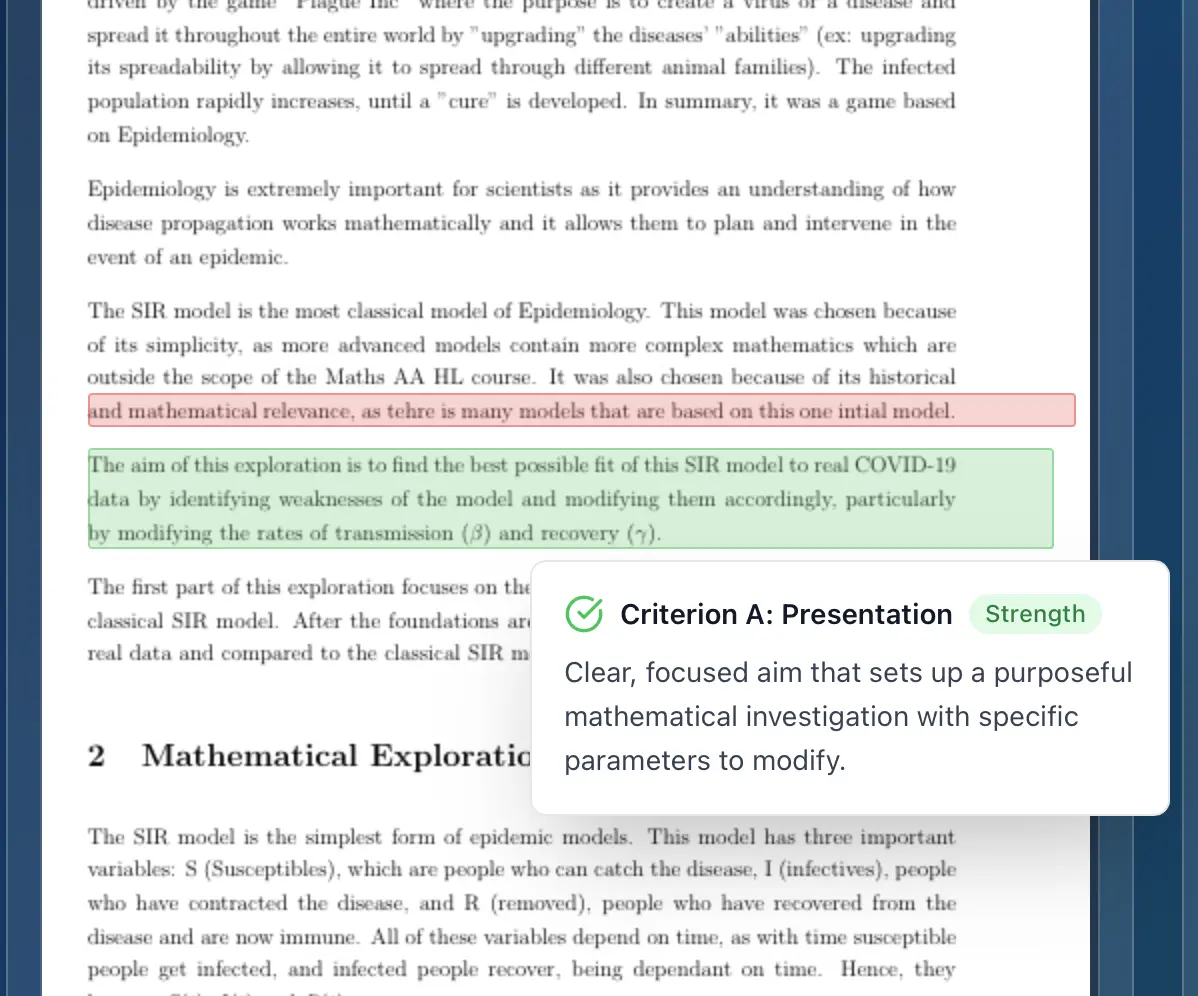
Check your own draft
Get estimated marks by criterion, comments on your writing, and a clear list of what to fix first.
Common Challenges and Mistakes in the IB CS IA
- Choosing an Overly Ambitious Project: Select a project that is manageable within the given timeframe and your skill level.
- Poor Planning: Failing to plan adequately can lead to scope creep, missed deadlines, and a poorly executed project.
- Inadequate Testing: Thoroughly test your product to identify and fix bugs.
- Lack of Documentation: Document your development process, design decisions, and testing results.
- Ignoring the Rubric: Carefully review the assessment criteria and ensure that your project addresses all requirements.
Advanced Tips and Strategies for a Top Score
- Start Early: Begin working on your IA as soon as possible to avoid last-minute stress.
- Seek Feedback: Regularly seek feedback from your teacher, peers, and client.
- Iterate and Refine: Use feedback to improve your project and address any weaknesses.
- Focus on Quality: Prioritize quality over quantity. A well-executed, focused project is better than an ambitious but poorly implemented one.
- Showcase Your Skills: Use the IA as an opportunity to demonstrate your understanding of computer science concepts and your ability to apply them in a practical context.
Technology and Modern Assessment: The Role of AI
The landscape of education is constantly evolving, and technology, particularly AI, is playing an increasingly significant role in assessment. AI tools can provide valuable support to both students and teachers in the IB program.
For students, AI can offer personalized learning experiences, identify areas for improvement, and provide instant feedback on their work. For teachers, AI can automate grading, provide detailed analytics on student performance, and free up time for more personalized instruction.
Marksy: Your AI Grading Assistant for IB
Marksy is a leading AI grading assistant specifically designed for the International Baccalaureate (IB). It helps teachers provide consistent, detailed feedback on IB assessments, including the Computer Science IA. Marksy uses official IB rubrics to support rubric alignment and consistency, providing rubric-aligned scoring, detailed criterion-by-criterion feedback, and suggestions for improvement. This not only saves teachers valuable time but also helps students understand exactly how to improve their work and achieve higher scores. By using AI, Marksy helps maintain assessment quality while streamlining the grading process.
Conclusion and Next Steps
The IB Computer Science Internal Assessment is a challenging but rewarding experience. By understanding the assessment criteria, planning carefully, and developing your project effectively, you can achieve a high score and demonstrate your skills as a computer scientist. Remember to seek feedback, iterate on your work, and use available resources to maximize your success.
Want to improve your IB CS IA?
Try Marksy for free today and see what the feedback points out. Marksy will help you understand the IB rubrics, identify areas for improvement, and ultimately achieve your best possible score. Sign up for a free trial now and see how Marksy can transform your IB journey!