IB Computer Science IA Criteria Explained: What Examiners Look For
The IB Computer Science Internal Assessment (IA) is a significant component of your final grade. Understanding the computer science internal assessment criteria is crucial for success. This guide provides a clear breakdown of the IB computer science grading rubric, offering practical tips and useful advice to help you achieve the highest possible marks. We'll explore each criterion in detail, explaining what examiners are looking for and how you can effectively demonstrate your skills and knowledge.
What is the Computer Science Internal Assessment?
The Computer Science Internal Assessment is an individual project where you apply your programming skills and knowledge to solve a real-world problem. It's an opportunity to showcase your understanding of computer science concepts, your ability to design and implement a solution, and your critical thinking skills. The IA allows you to explore an area of computer science that interests you, providing a more in-depth learning experience than traditional coursework.
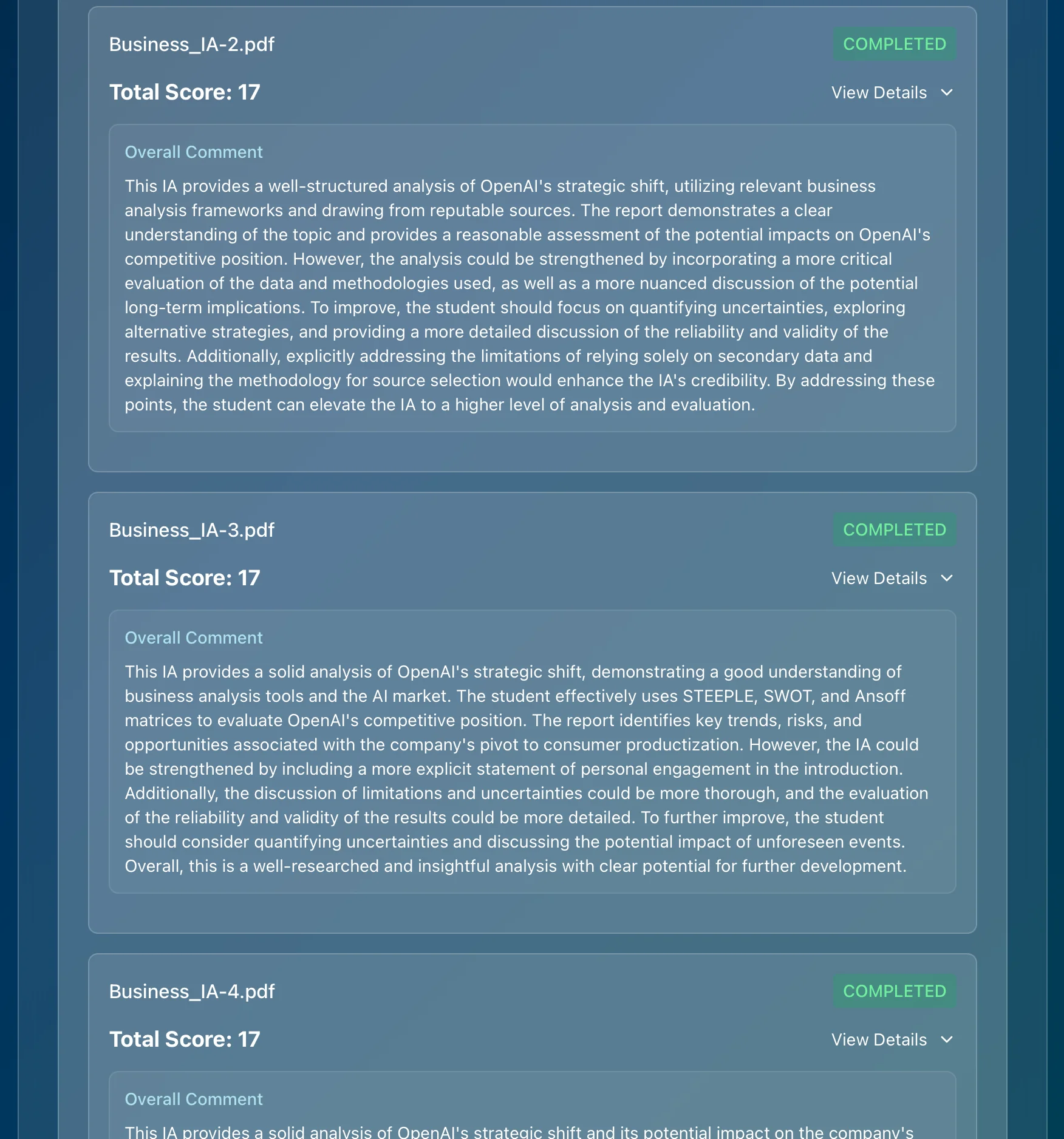
Stuck on your IB draft?
Get instant, detailed feedback on structure, evidence, and reasoning, then compare it with your current school materials.
Understanding the Grading Criteria
The IB Computer Science IA is assessed against five criteria: Planning, Solution Overview, Development, Functionality and Extensibility of Product, and Evaluation. Each criterion focuses on a different aspect of the project, from the initial planning stages to the final evaluation. Understanding the specific requirements of each criterion is essential for structuring your project and maximizing your score. The IB grading criteria are designed to assess not only your technical skills but also your ability to think critically, solve problems, and communicate effectively.
Detailed Breakdown of Computer Science Internal Assessment Criteria
Let's delve into each criterion, providing a detailed explanation of what is expected and how to achieve top marks.
Criterion names, marks, and mark bands below follow the IB subject guide. The band descriptions are our own plain-English summaries, so check your subject guide for the exact wording.
Criterion A: Planning (6 marks)
What it assesses: How clearly you set out the scenario, your client, the reason for the product, and its success criteria.
Mark bands:
- 0 marks: Nothing in the work reaches the lowest band.
- 1-2 marks: A suitable scenario and client are stated and the product choice is identified, but the success criteria are mostly unsuitable.
- 3-4 marks: The scenario is stated with evidence of client consultation, the product choice is partly explained, and some suitable success criteria are given.
- 5-6 marks: The scenario is described with evidence of consultation, the product choice is justified, and a range of suitable success criteria is given.
Tips for success:
- Clearly define your scenario: Provide a detailed description of the problem you're addressing and the context in which it exists.
- Identify your client: Clearly state who will benefit from your solution. This could be a specific individual, a group, or an organization.
- Justify your solution: Explain why you chose your particular approach. Consider alternative solutions and explain why your chosen solution is the most appropriate.
- Establish measurable success criteria: Define specific, measurable, achievable, relevant, and time-bound (SMART) criteria for evaluating the success of your project. For example, "The program should process 1000 data entries in under 5 seconds."
- Document client consultation: Keep a record of your meetings and discussions with your client or advisor. This demonstrates that you've considered their needs and feedback.
- Example: Instead of saying "The program should be fast," say "The program should complete the calculation within 2 seconds for a dataset of 1000 entries."
Common mistakes to avoid:
- Failing to clearly identify the client.
- Not providing a strong rationale for the chosen solution.
- Creating success criteria that are vague and not measurable.
- Neglecting to document consultations with the client or advisor.
Criterion B: Solution Overview (6 marks)
What it assesses: How complete and clear the record of tasks, design overview, and outline test plan are.
Mark bands:
- 0 marks: Nothing in the work reaches the lowest band.
- 1-2 marks: The record of tasks, design overview, and outline test plan are thin, so a reader struggles to follow how you built the product.
- 3-4 marks: They are partly complete and give a basic picture of how the product was developed.
- 5-6 marks: They are detailed and complete, so a reader can follow exactly how you built the product.
Tips for success:
- Maintain a detailed record of tasks: Document each step of the development process, including the date, task description, and estimated time.
- Provide a comprehensive design overview: Include diagrams, flowcharts, and pseudocode to illustrate the structure and functionality of your solution.
- Clearly link to Criterion A: Ensure that your design overview directly addresses the scenario and client needs identified in Criterion A.
- Develop a comprehensive test plan: Outline how you will test each functionality of your solution to ensure it meets the success criteria. Include test cases, expected results, and actual results.
- Thoroughly consider main functionalities: Describe each function in detail, explaining its purpose, inputs, and outputs.
- Example: Include a UML diagram to visualize the classes and relationships in your program.
Common mistakes to avoid:
- Failing to maintain a detailed record of tasks.
- Providing a superficial design overview that lacks detail.
- Not linking the design overview to the scenario and client needs.
- Creating an inadequate test plan.
- Not thoroughly considering the main functionalities of the product.
Criterion C: Development (12 marks)
What it assesses: How complex and ingenious your techniques are, how well you use existing tools, and how clearly you explain them.
Mark bands:
- 0 marks: Nothing in the work reaches the lowest band.
- 1-4 marks: Techniques show low complexity and ingenuity or don't address the scenario; little use of existing tools; no explanation of the techniques; sources not identified.
- 5-8 marks: Techniques show moderate complexity and ingenuity; some appropriate use of tools; some explanation of why the techniques suit the task; all sources identified.
- 9-12 marks: Techniques show high complexity and ingenuity for the scenario; tools used appropriately; techniques explained and suited to the task; all sources identified.
Tips for success:
- Demonstrate complexity and ingenuity: Use advanced programming techniques and algorithms to solve the problem.
- Show evidence of algorithmic thinking: Explain the logic behind your code and how it solves the problem efficiently.
- Use existing tools effectively: Choose appropriate libraries and frameworks to enhance your solution.
- Justify your choices: Explain why you chose specific techniques and tools.
- Provide clear and relevant screenshots: Include screenshots of your code and the running application to illustrate your development process.
- Identify all sources: Properly cite any code, libraries, or resources you used.
- Ensure compatibility: Make sure your product is fully compatible with the scenario and client needs identified in Criterion A and the design overview in Criterion B.
- Example: Use advanced data structures like trees or graphs if appropriate for your problem. Implement efficient search algorithms like binary search.
Common mistakes to avoid:
- Using simple or inappropriate techniques.
- Not demonstrating algorithmic thinking.
- Using existing tools inadequately or inappropriately.
- Failing to justify choices of techniques and tools.
- Providing irrelevant or missing screenshots.
- Not identifying all sources.
- Creating a product that is incompatible with the scenario and design overview.
Criterion D: Functionality and Extensibility of Product (4 marks)
What it assesses: How well the video shows the product working, and how easily it could be extended or modified.
Mark bands:
- 0 marks: Nothing in the work reaches the lowest band.
- 1-2 marks: The video shows the product only partly working, and extending it would be difficult.
- 3-4 marks: The video shows the product working well, and some extensions would be straightforward.
Tips for success:
- Create a clear and concise video: Demonstrate all the key functionalities of your product in a video.
- Ensure the product functions well: Thoroughly test your solution to ensure it works as intended.
- Design for extensibility: Use modular design principles to make it easy to add new features or modify existing ones.
- Enable maintainability: Write clean, well-documented code that is easy for others to understand and maintain.
- Example: Use object-oriented programming principles to create reusable and modular components.
Common mistakes to avoid:
- Providing a missing or inadequate video.
- Creating a product that functions poorly or not at all.
- Designing a product that is difficult to expand or modify.
- Writing code that is difficult to understand and maintain.
Criterion E: Evaluation (6 marks)
What it assesses: How fully the product is evaluated against the success criteria with client feedback, and how realistic your recommendations are.
Mark bands:
- 0 marks: Nothing in the work reaches the lowest band.
- 1-2 marks: Limited evaluation against the success criteria, little client feedback, and trivial or unrealistic recommendations.
- 3-4 marks: Partial evaluation against the success criteria including client feedback, and mostly realistic recommendations.
- 5-6 marks: Full evaluation against the success criteria including client feedback, and realistic recommendations.
Tips for success:
- Evaluate against success criteria: Systematically evaluate your product against each of the success criteria you defined in Criterion A.
- Include client/advisor feedback: Gather feedback from your client or advisor and incorporate it into your evaluation.
- Provide realistic recommendations: Suggest specific and achievable improvements for future development.
- Explain your recommendations in detail: Justify your recommendations and explain how they would improve the product.
- Example: "Based on feedback from the client, the user interface could be improved by adding a more intuitive navigation system. This would make it easier for users to find the information they need."
Common mistakes to avoid:
- Failing to evaluate the product against the success criteria.
- Not including feedback from the client or advisor.
- Providing unrealistic or poorly explained recommendations.
How to Excel in Your Computer Science Internal Assessment
Here are some general tips to help you excel in your Computer Science Internal Assessment:
- Start early: Don't wait until the last minute to start your project. Give yourself plenty of time to plan, develop, and evaluate your solution.
- Choose a project that interests you: You'll be more motivated to work on a project that you find engaging.
- Keep it manageable: Don't try to tackle a project that is too complex or ambitious. Focus on delivering a well-designed and functional solution.
- Document everything: Keep a detailed record of your progress, including your planning, design, development, and testing.
- Seek feedback: Ask your teacher, advisor, or peers for feedback on your project throughout the development process.
- Follow the IB guidelines: Make sure you understand and follow all the requirements and guidelines for the Internal Assessment.
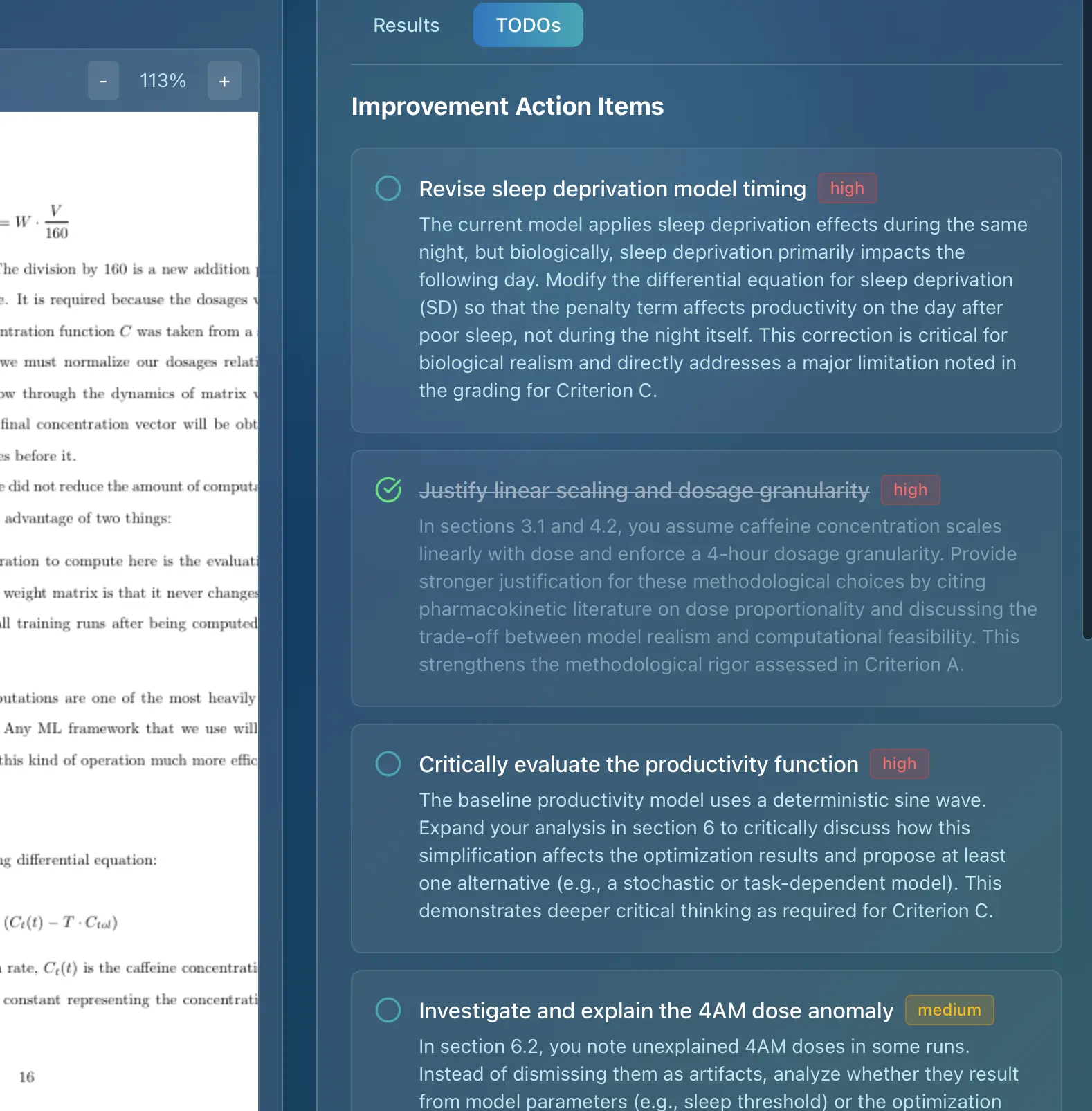
Check your own draft
Get estimated marks by criterion, comments on your writing, and a clear list of what to fix first.
Common Mistakes to Avoid
Here's a list of frequent errors students make on their IB Computer Science IA:
- Poor planning: Failing to adequately plan the project, leading to scope creep and missed deadlines.
- Inadequate documentation: Not documenting the development process sufficiently, making it difficult to understand the project and justify design choices.
- Lack of complexity: Choosing a project that is too simple and doesn't demonstrate sufficient programming skills.
- Poor coding practices: Writing messy, undocumented code that is difficult to understand and maintain.
- Insufficient testing: Not thoroughly testing the product, leading to bugs and functionality issues.
- Superficial evaluation: Providing a superficial evaluation that doesn't critically analyze the strengths and weaknesses of the product.
- Plagiarism: Copying code or ideas from other sources without proper attribution.
The Role of AI in Modern Assessment
Modern technology is changing how we approach academic assessment. AI grading assistants can now help teachers maintain consistency and rubric alignment in their evaluations while saving valuable time. These tools use the same official IB criteria to provide detailed feedback and scoring, ensuring that assessments meet the high standards expected in IB programs.
For educators looking to simplify their grading process while maintaining the quality and consistency that IB assessments demand, AI grading assistance offers a powerful solution that complements traditional teaching methods.
Conclusion
Mastering the IB Computer Science Internal Assessment requires a thorough understanding of the grading criteria and a commitment to planning, developing, and evaluating your solution effectively. By following the tips and advice in this guide, you can increase your chances of achieving top marks and demonstrating your skills and knowledge in computer science. Remember to start early, choose a project that interests you, document everything, and seek feedback throughout the process. Understanding the IB computer science marking scheme is half the battle!
Looking for more support with IB draft grading? Discover how AI grading assistants can help maintain consistency and rubric alignment in your evaluations while saving valuable time. Learn more about modern grading solutions designed specifically for IB educators.