- (a) Rutherford modelled the scattering of alpha particles by a nucleus of gold. However, when the initial alpha particle energy is greater than a certain value E₀, the fraction of alpha particles scattered at angles close to 180° does not follow Rutherford's model.
Outline
(i) why this deviation from the model occurs, and [1]
(ii) how E₀ can be used to estimate the nuclear radius of gold. [2]
Gold-198 (Au-198) is a radioactive nuclide of gold. Au-198 decays into stable mercury-198 (Hg-198) with an emission of a beta particle followed by one or two gamma photons.
The half-life of Au-198 is 2.69 days.
(b) (i) Calculate, in s⁻¹, the decay constant of Au-198. [1]
(ii) A sample contains 5.0 mg of pure Au-198. Determine the mass of Hg-198 present in the sample after one week. [2]
(Question 3 continued)
Gamma photons of the following frequencies are emitted in the decay of Au-198:
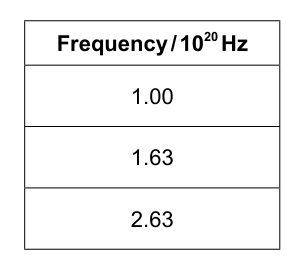
(c) Explain how this observation provides evidence that nuclear energy levels are discrete. [2]