- A sound detector moves along a line connecting it to a stationary loudspeaker. The loudspeaker emits a sound of frequency 1700 Hz. The speed of sound in air is 340 ms⁻¹. The detected frequency of the sound is 1600 Hz.
(a) (i) State the direction of motion of the detector. [1]
(ii) Calculate the speed of the detector. [2]
The loudspeaker and the detector are now stationary and above a surface of water. The loudspeaker is at point L and the detector is at point D. L and D are at the same height above the surface of the water. The sound reaches D by two routes: along the direct path LD and the reflection-path LPD.
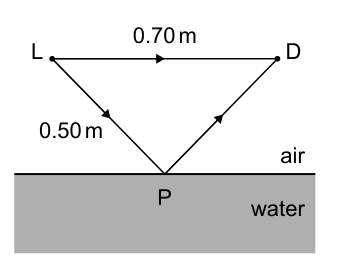
The following data are given:
Frequency of the sound wave = 1700 Hz
Speed of sound in air = 340 ms⁻¹
Speed of sound in water = 1500 ms⁻¹
Distance LD = 0.70 m
Distance LP = 0.50 m
(b) (i) Calculate the wavelength of the sound wave in air. [1]
(ii) Outline why sound from L undergoes destructive interference at D. [2]
(c) Predict whether the sound wave can enter the water at P. [3]