IB Geography IA Criteria Explained: What Examiners Look For
The IB Geography Internal Assessment (IA) is a crucial component of your final grade. Understanding the geography internal assessment criteria is key to achieving a high score. This guide provides a detailed breakdown of each criterion, offering practical tips and examples to help you excel. We'll explore the IB geography grading rubric, ensuring you know exactly what examiners are looking for.
What is the Geography Internal Assessment?
The Geography Internal Assessment is a piece of independent fieldwork and analysis conducted by IB Geography students. It's an opportunity to apply geographical concepts and skills to a real-world issue, allowing you to demonstrate your understanding of the subject matter and your ability to conduct research. The IA is marked internally by your teacher and then externally moderated by the IB.
Stuck on your IB draft?
Get instant, detailed feedback on structure, evidence, and reasoning, then compare it with your current school materials.
Understanding the Grading Criteria
The IB Geography IA is assessed against six criteria, each focusing on different aspects of the investigation. Each criterion is marked out of a specific number of points, and the total score contributes to your overall IB grade. Familiarizing yourself with these criteria is the first step towards a successful IA. Let's delve into each criterion in detail.
Detailed Breakdown of Geography Internal Assessment Criteria
Criterion names, marks, and mark bands below follow the IB subject guide. The band descriptions are our own plain-English summaries, so check your subject guide for the exact wording.
Criterion A: Fieldwork question and geographic context (3 marks)
What it assesses: How focused and geographical your fieldwork question is, how it links to theory, and how well your maps show the location.
Mark bands:
- 0 marks: Nothing in the work reaches the lowest band.
- 1 mark: The question is not a proper geographical question, is too broad, lacks a location, or cannot use primary data; the map is missing or unsuitable.
- 2 marks: A geographical question linked to the syllabus or theory, with a specific location suitable for primary data; the map is copied or lacks conventions.
- 3 marks: A focused geographical question with a precise location, a described link to theory that allows hypotheses, and maps that follow conventions.
Tips for success:
- Choose a focused question: Avoid overly broad questions. Instead, narrow your focus to a specific issue in a particular location. For example, instead of "How does tourism affect the environment?", consider "How does cruise ship tourism impact water quality in the bay of X?".
- Link to the syllabus: Explicitly state which syllabus topic your question relates to. This demonstrates your understanding of the curriculum.
- Provide detailed geographic context: Include relevant background information about the location, such as its physical geography, population, economy, and environmental issues.
- Use maps effectively: Include clear and accurate maps showing the location of your fieldwork site, its surrounding area, and any relevant geographical features. Ensure mapping conventions are followed (north arrow, scale, key, title).
Criterion B: Method(s) of investigation (3 marks)
What it assesses: How well you describe your methods and explain why the data they collect is relevant, and whether you use them correctly.
Mark bands:
- 0 marks: Nothing in the work reaches the lowest band.
- 1 mark: Methods are listed or vague, may not collect enough relevant data, and instruments or sampling are not used correctly.
- 2 marks: Methods are described with how the data relates to the question; instruments and sampling are used correctly, but the data may be minimal.
- 3 marks: Methods are described with a clear explanation of how the data fits the theory, question, or hypotheses; correct use of instruments and sampling gives reliable primary data.
Tips for success:
- Describe your methods in detail: Explain exactly how you collected your data, including the equipment used, the sampling techniques employed (e.g., random, stratified, systematic), and the number of data points collected.
- Justify your choices: Explain why you chose those particular methods. How are they appropriate for answering your research question)? What are their strengths and limitations?
- Link to the fieldwork question: Clearly explain how your methods will help you answer your research question.
- Consider both quantitative and qualitative data: A mix of both often provides a more clear understanding.
Criterion C: Quality and treatment of information collected (6 marks)
What it assesses: How relevant and sufficient your data is, and how well you present it.
Mark bands:
- 0 marks: Nothing in the work reaches the lowest band.
- 1-2 marks: Much of the data is irrelevant or insufficient, presentation techniques do not suit it, and graphs or tables often break conventions.
- 3-4 marks: Most data is relevant and supports partial analysis, presentation suits the data type, and conventions are followed with occasional errors.
- 5-6 marks: All data is relevant and sufficient for full analysis, the best presentation techniques are used, and conventions are followed.
Tips for success:
- Collect relevant data: Ensure that all the data you collect directly relates to your research question.
- Collect sufficient data: Gather enough data to allow for meaningful analysis. The amount of data needed will depend on your research question and methods.
- Ensure data quality: Take steps to ensure the accuracy and reliability of your data. This might involve using calibrated equipment, following standardized procedures, and taking multiple measurements.
- Present data effectively: Choose appropriate data presentation techniques, such as graphs, tables, maps, and diagrams. Ensure that all presentations are clear, accurate, and follow conventions (e.g., labeled axes, titles, keys).
Criterion D: Written analysis (8 marks)
What it assesses: How well your analysis explains the data and links it to the question, hypotheses, theory, location, and methods.
Mark bands:
- 0 marks: Nothing in the work reaches the lowest band.
- 1-2 marks: Some descriptive techniques are unsuitable, data is outlined without linking it to the question, and only obvious trends are listed.
- 3-4 marks: Suitable descriptive techniques; any statistics are irrelevant or contain errors; trends are described and linked to the question, allowing a descriptive answer.
- 5-6 marks: Suitable descriptive and statistical techniques; trends and statistics are linked to the question; anomalies are listed; the question can be answered despite gaps in evidence.
- 7-8 marks: Suitable descriptive and statistical techniques (with confidence levels where relevant); trends, statistics, and anomalies are explained and linked to the question, theory, location, and methods; the question can be answered with at most minor gaps.
Tips for success:
- Go beyond description: Don't just describe your data; analyze it. Look for trends, patterns, and anomalies.
- Use statistical techniques: Employ appropriate statistical techniques to analyze your data, such as measures of central tendency (mean, median, mode), measures of dispersion (range, standard deviation), and correlation analysis.
- Interpret your results: Explain what your results mean in relation to your research question, hypotheses, and geographic context.
- Link to geographical theory: Connect your findings to relevant geographical theories and concepts.
- Address anomalies: Explain any unexpected or unusual results.
- Use supporting evidence: Back up your analysis with evidence from your data.
Criterion E: Conclusion (2 marks)
What it assesses: Whether you reach a clear conclusion to the fieldwork question that the analysis supports.
Mark bands:
- 0 marks: Nothing in the work reaches the lowest band.
- 1 mark: A conclusion is given, partly supported by the analysis.
- 2 marks: A clear conclusion is given, supported by the analysis.
Tips for success:
- Clearly answer your research question: State your conclusion in a clear and concise manner.
- Support your conclusion with evidence: Summarize the key findings from your analysis that support your conclusion.
- Avoid introducing new information: The conclusion should be based on the analysis presented in the previous section.
Criterion F: Evaluation (3 marks)
What it assesses: How well you explain the strengths and weaknesses of your investigation and the likely impact of improvements.
Mark bands:
- 0 marks: Nothing in the work reaches the lowest band.
- 1 mark: Strengths, weaknesses, and improvements are listed but are mostly superficial or irrelevant.
- 2 marks: Strengths, weaknesses, and improvements are outlined and mostly relevant.
- 3 marks: The most relevant strengths and weaknesses of methods, question, data presentation, and location are explained, with improvements and their likely impact.
Tips for success:
- Identify strengths and weaknesses: Discuss the strengths and weaknesses of your fieldwork methods, data collection techniques, and analysis.
- Be specific: Provide concrete examples to support your evaluation.
- Suggest realistic improvements: Propose specific and realistic ways to improve your fieldwork in the future.
- Explain the impact of improvements: Explain how these improvements would address the weaknesses you identified and potentially lead to more accurate or reliable results.
Good to know:
- The written report has a limit of 2,500 words.
How to Excel in Your Geography Internal Assessment
- Start early: Don't leave the IA until the last minute. Give yourself plenty of time to plan, conduct fieldwork, analyze data, and write your report.
- Choose a topic you are interested in: This will make the process more enjoyable and engaging.
- Seek guidance from your teacher: Your teacher is your best resource for advice and support.
- Plan your fieldwork carefully: Develop a detailed fieldwork plan before you start collecting data.
- Keep accurate records: Maintain detailed records of your fieldwork methods, data collection, and analysis.
- Proofread your work carefully: Check for errors in grammar, spelling, and punctuation.
Check your own draft
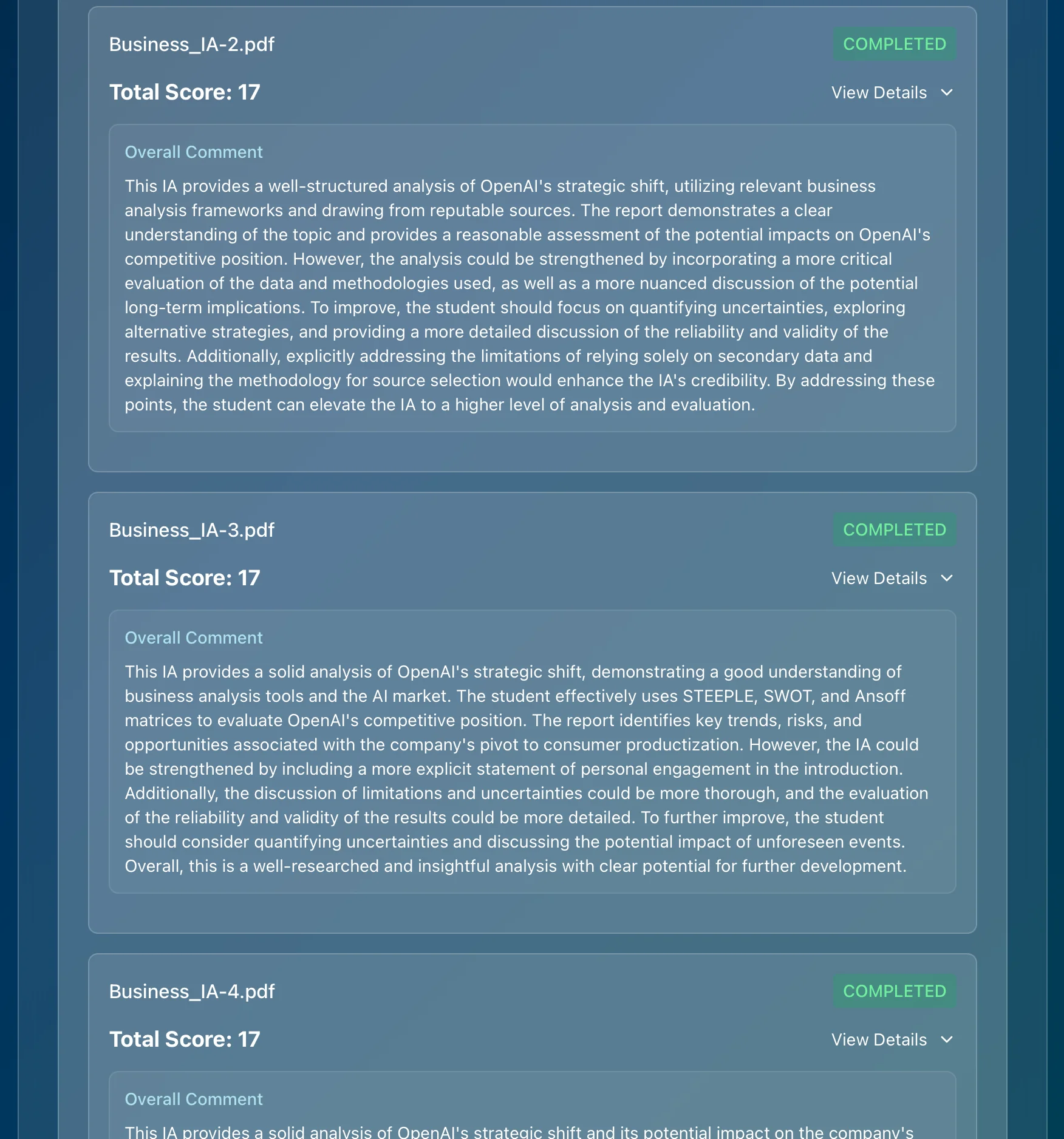
Get estimated marks by criterion, comments on your writing, and a clear list of what to fix first.
Common Mistakes to Avoid
- Choosing a question that is too broad or too narrow.
- Failing to link the fieldwork question to the syllabus.
- Using inappropriate or poorly justified methods.
- Collecting insufficient or irrelevant data.
- Failing to analyze the data effectively.
- Drawing conclusions that are not supported by the data.
- Failing to evaluate the methodology.
- Plagiarism.
The Role of AI in Modern Assessment
Modern technology is changing how we approach academic assessment. AI grading assistants can now help teachers maintain consistency and rubric alignment in their evaluations while saving valuable time. These tools use the same official IB criteria to provide detailed feedback and scoring, ensuring that assessments meet the high standards expected in IB programs.
For educators looking to simplify their grading process while maintaining the quality and consistency that IB assessments demand, AI grading assistance offers a powerful solution that complements traditional teaching methods.
Conclusion
Understanding the IB Geography Internal Assessment criteria is essential for success. By following the tips and advice in this guide, you can increase your chances of achieving a high score. Remember to plan carefully, conduct thorough fieldwork, analyze your data effectively, and write a clear and concise report. Good luck!
Looking for more support with IB draft grading? Discover how AI grading assistants can help maintain consistency and rubric alignment in your evaluations while saving valuable time. Learn more about modern grading solutions designed specifically for IB educators.