Question 4

From Physics HL Paper 2 (May 2024, TZ2)

  1. (a) The diagram shows a junction in a circuit.
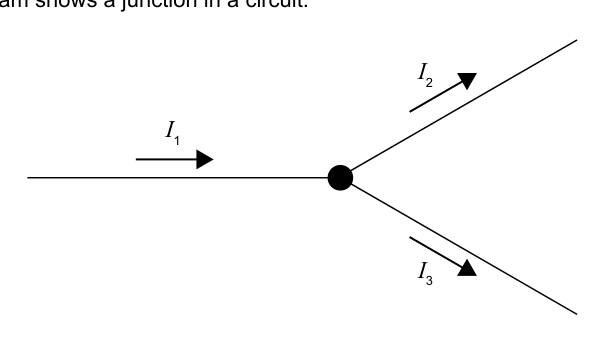
Diagram showing a junction in a circuit with currents I1, I2, and I3 indicated by arrows.

The currents in the three wires are related by I₁ = I₂ + I₃.
State the fundamental law of Physics from which this relation is derived. [1]

(b) A cell of emf 1.50 V and internal resistance r is connected to a resistor of resistance 5.00 Ω and an ideal voltmeter V.
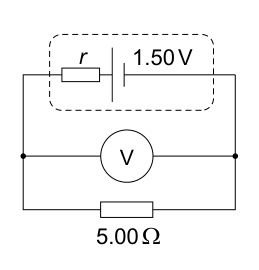
Circuit diagram showing a cell with internal resistance 'r' and EMF 1.50 V, connected to a 5.00 Ω resistor and an ideal voltmeter V.

The reading of the voltmeter is 1.20 V.

(i) Determine the internal resistance r of the cell. [2]

(ii) A second 5.00 Ω resistor is connected in parallel to the first resistor.
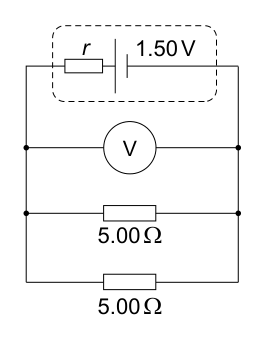
A circuit diagram showing a voltage source of 1.50 V with internal resistance r, connected to a parallel combination of two 5.00 Ohm resistors. A voltmeter V is connected across the parallel combination.

State and explain the change, if any, in the voltmeter reading without further calculation. [2]

(c) A proton moves on a circular path in a region of uniform magnetic field of magnetic flux density B that is directed into the plane of the page.
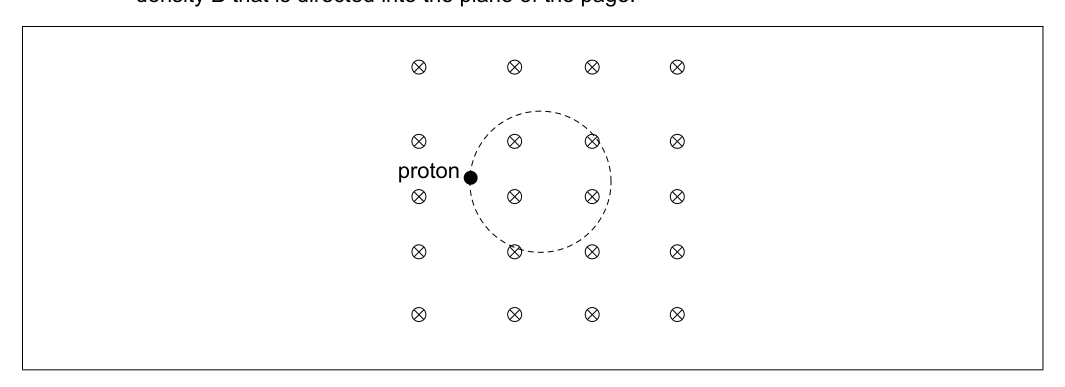
A diagram showing a proton moving in a circular path within a uniform magnetic field, with the field lines directed into the page.

(i) On the diagram, draw an arrow to indicate the velocity of the proton at the position shown. [1]

(ii) Show that the frequency of revolution of the proton is given by f = eB / 2πmₚ. [3]

(iii) The magnitude of B is 2.5 T. Calculate the frequency of revolution of the proton. [1]

Textbook topics in this question

Review the exact course sections assessed by each question part.

Mixed-topic question